

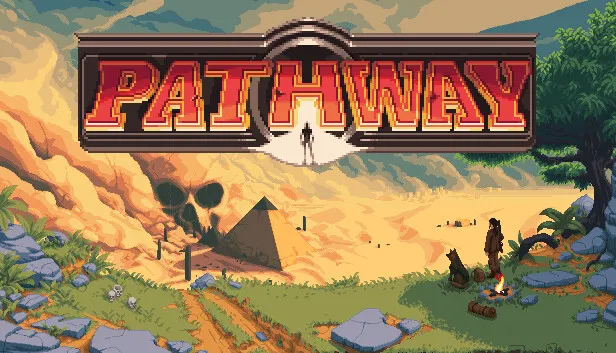
Stephan Naujoks about writing Pulp for Pathway.
Pathway is an “FTL-but” game: like FTL, but with accessible, turn-based team tactics instead of real-time battles on a starship. Oh yeah, and with Nazis, pyramids and shotguns too. Much like the roguelite FTL, the player travels from node to node, takes decisions in simple text events, attempts to survive battles as unscathed as possible, and successfully manages resources to arrive at their destination.
Pathway was mainly self-financed and developed with a four-person core team over four years. Our publisher joined us relatively late; Chucklefish gave us complete creative freedom and also went above and beyond in their support for us – the collaboration could not have gone better.
Unfortunately, the same cannot be said for the development process.
Our original vision of team-based tactics with no random hit element looked great on paper. But after two years of development, it became clear that this concept simply did not work in practice. With a heavy heart, we decided to start over: Pathway would now be based more on traditional XCOM turn-based tactics – but with more compact battles.
It was this new beginning that created the conditions for us to complete Pathway successfully. Team roles were also reassigned so that each of us could now bring our individual strengths to bear. This was also when we first decided to take our meta-game in the direction of FTL. This reorganization of our team resulted in considerable streamlining in terms of decision-making processes and implementation. However, it also sowed the seed for the ongoing conflict between the old and new creative director, which would shape the rest of the development process.
After three release delays, we were financially and mentally exhausted. Pathway was released on Steam, GoG and Humble Store on April 11, 2019. For a day or two, we topped the global sales charts, before a wave of lukewarm reviews and mixed player feedback on Steam brought that initial success to an end.
With a heavy heart, we decided to reinvest 60% of our initial income in a six-month post-release patch. On October 9 2019, our Adventurers Wanted update finally went online and was well received by our players. Since then, the average player feedback on Steam has risen from 60% to 73%. Pathway has not yet been financially profitable for us. But hope remains that this could change one day.
Local flavor events are crucial for Pathway’s atmosphere.
Creative influences
The year is 1936 – the Nazis are sending expeditions deep into the endless deserts of the Middle East!
The world is on the brink of disaster, as a war for the mysterious element Valkyrium rages in the shadows!
Victory or defeat – the outcome rests on the shoulders of a small group of adventurers!
Pathway’s worldbuilding was inspired by the lurid “pulp” adventure magazines of the 1920s and 1930s. Named for the cheap wood pulp paper on which they were printed, these penny novels satisfied the longings of a readership whose real lives were shaped by increasing urbanization, boring office jobs and an emerging global economic crisis: pulp magazines provided pure escapism.
Decades later, the Indiana Jones franchise distilled the essence of this genre brilliantly, revitalizing the tradition of exotic adventure films. Films such as Raiders of the Lost Ark (1981) or The Mummy (1999), but also historical classics such as Lawrence of Arabia (1962) had an important influence on Pathway. Together with comic book series such as Tintin (1929 – 1976) or Corto Maltese (1967 – 1989), these were the pop culture sources that we drew on.
Various historical memoirs and monographs from the early decades of the last century from 1900 up to the Second World War were another important source. Western discourse on the Orient was in full swing, colonialism was in its final bloom – and this is reflected in the memoirs of the adventurers, explorers and military writers of the era.
Our differing lighting settings were an important tool in creating diverse moods.
‘What’s happening?’ – ‘Damn, it was the Nazis all along!’
Firstly, it has to be said: on a creative level, writing for Pathway was a great experience. Pulp is a wonderful genre when it comes to creative freedom: diabolical Nazis, ancient evils, hair-raising perils, fearless heroes, last-minute rescues – the occasional inconsistency or improbability can be forgiven as long as the action and adventure elements work. Pulp author Raymond Chandler once summed up this philosophy very nicely: “When in doubt have a man come through a door with a gun in his hand.”
When it comes down to it, pulp is an optimistic genre: no matter how imminent the end of the world, there’s always a solution – even if it is just brute force. Of course, this can-do approach very much suits the way we play computer games today.
But pulp does not act in a vacuum, as it is a “historical” genre. However fantastic the events, they still take place in our world. After all, countries like Egypt or Morocco are not fictitious, and it is well known that 1936 also happened in the real world.
So it takes a certain amount of historical and regional research to create a coherent sense of time and place. Personally, I found this aspect of my work very appealing because it was, in a way, a counterpoint to my otherwise free-ranging imagination.
For example, designing the plot devices (e.g. the mythical artifacts hunted for by the player and the antagonists), required both imagination and research.
To script the event logic, we developed a flowchart tool that allows us to use multiple branches and perform simple in-editor testing. The whole thing is directly connected to the loca.
Of course, we could have taken an easier approach: a quick brainstorming session about the appearance of the artifact, slap on a fantasy name and you’re done! But in my opinion, a film like Indiana Jones and the Raiders of the Lost Ark works so brilliantly precisely because Nazis actually did exist. Secondly, they were a real global threat. And thirdly, the Ark of the Covenant (much like the Holy Grail) plays a central role in the Judeo-Christian tradition.
As a result, within minutes, the film effortlessly creates a backdrop of menace that is second to none.
Just for fun, let’s compare that to Indiana Jones and the Temple of Doom (1984). The baddies are an evil cult in India (sure, the Thuggees existed, but how many people have actually heard of them?). They are a regional threat, at best. The plot device – the
“Sankara stones” – are generic fiction.
Of course, these things are always a matter of taste, but I have no problem telling you which of these examples is my favourite.
Therefore, creating a specific mood for the mythological background of the game was an important goal for me as an author. A lot of time and creative effort went into anchoring our plot devices, such as the Wrath of God in a (fictitious) Old Testament tale, or in creating an apocryphal Ethiopian back story for the Merkabah Divine Chariot.
I think this effort is justified because it makes the difference between good and bad worldbuilding. Of course, it is impossible to quantify this kind of added value, and every player will judge it differently. I definitely enjoyed it!
The metadata editor: All objects and characters have various metadata that we can edit and place precisely in this tool (e.g. the ejection location of the cartridge case).
Pulp and its pitfalls
As entertained as we all are by these tales of real men with an unwavering sense of justice and a gift for settling things with their fists, pulp as a genre is, of course, essentially reactionary. Examples abound of chauvinistic, narrow-minded attitudes, racist prejudice and other exaggerated stereotypes – as famously evident in the bloodthirsty tales of Conan the Barbarian or the cosmic horror of the Cthulhu mythos, both of which are classics from the world of pulp.
I do not think we simply reproduced those genre conventions uncritically. On the other hand, we did not subject them to a post-modern deconstruction or explicitly subvert them in the style of Inkle’s 80 Days (2014) – a fantastic game that made highly imaginative use of its Jules Verne source material.
Instead, we opted to make Pathway an affectionate, tongue-in-cheek genre hommage, a cheerful collection of references that doesn’t take itself too seriously and seeks mainly to entertain.
This approach was not well received by everybody. This has to do with the fact that our adventures take place in the real world – or at least in a distorted version of it. Common fantasy tropes that would be waved through without comment in any other RPG setting sometimes provoked anger.
For example, Gamespot criticized the way we represented the local population in Pathway with the following observation: “The locals you meet are helpless simpletons, peaceful goat herders at best and, at worst, cowards hiding in ruined villages and collapsed caves until you wander by to hopefully rescue them.”
This is a completely legitimate criticism, even if it actually describes a trope as old as role-playing games themselves. Nevertheless, we gratefully accepted this criticism and included in our Adventurers Wanted patch, among other things, a storyline about Arab freedom fighters who had united to fight the Nazis.
Individual character perks may unlock additional event options.
Other criticisms focused on a lack of historical accuracy or the fact that we merely used our exotic locations as a backdrop. Once again, this was a deliberate creative decision. If we had wanted to include contemporary history and politics in our adventures, there was plenty of material for this in the region: 1936 was the year of the Arab uprising against the British mandate administration in Palestine, and the Second Italo-Abyssinian War – in which Mussolini approved the widespread use of mustard gas – was raging in Abyssinia. Less than twenty years ago, Turkey and the Syrian Desert had been the main backdrops for the atrocities of the Armenian Genocide.
All this would have been ideal for a dark political thriller or a bloody war drama, but that had never been our goal. Above all, we wanted Pathway to entertain with exciting, and ultimately optimistic stories, rather than making a political-historical statement. As far as possible, we wanted to avoid real-world, local political conflicts.
But of course, everything in the Middle East is political, and just because we wanted to avoid politics does not mean we always succeeded – two examples from our forums illustrate this:
Firstly, an Israeli player politely inquired why there were no Jews in our Palestine. (I had naively hoped to avoid a controversial situation by not addressing the subject of Jews and Palestinians, focusing instead on more neutral geographical reference points such as the Dead Sea – but we agreed that I would fix this shortcoming in a future content patch.)
Secondly, an angry Turkish player was annoyed that we referred to Eastern Anatolia as the Armenian Highlands in our game. (This is an internationally recognized designation that is no longer used in Turkey for obvious reasons – we did not pursue that discussion.)
We did manage to avoid any major controversies, but all things considered, I would say: If you want to avoid controversy, don’t set your game in the Middle East.
The main level editor for the modules from which we then generate the levels using a random generator. The whole editor is WYSIWYG.
Creation of an episode
Pathway’s events are text-based – however, we always depict the described events in parallel graphically. Simple events come with a single, static in-game scene. More complex events, however, need several scenes with scripts that add a certain dynamic to the action: grenade blasts, exploding ammo dumps, etc.
Our workflow for the production of an event typically went as follows: Once an idea for an event had formed in my mind, I checked with our graphic designer Simon to clarify possible problems with the visual implementation and the smartest way to avoid them.
The specifics of our graphics engine, its isometric perspective, our visual style and a limited pool of animations often meant that we would be agonizing about the technical and visual practicalities of implementing very cinematic ideas.
In many cases, it made sense to rewrite an insignificant detail in order to avoid conflicts; in other cases, we came up with more creative solutions that RockPaperShotgun affectionately described as follows: “Pathway’s knowing pastiche and limited animation means it’s like watching the Matrix with puppets, or a stop motion Die Hard.”
Pathway consists of over 6,000 hand-made modules. These modules are then randomly assembled into levels in the level generator.
Once the underpinnings for an event had been clarified, I entered its steps into our custom event editor. In the editor, I had various puzzle pieces that I could use to define the details of the flow logic: defining acting characters, setting probabilities for event outcomes, assigning loot blocks or granting experience – our event editor was a huge toolbox that I could use to arrange events however I wanted.
The editor was also great because it enabled me to approach technical event design on a purely visual level. Over time, the editor was given numerous tweaks and new features as our tools programmer was able to react very flexibly to our needs.
Once the process logic was in place, Simon added event scenes with dynamic camera movements and action scripts. These scenes included randomized level elements, ensuring visual variation even when they were repeated. In parallel, I wrote the event texts, which could then be exported from the loca IDs of our event loca to the text blocks of the editor.
The stencil editor is the tool used to construct the templates for the random generators. The colored sectors will later be populated in the game with the modules shown above.
Because our events had to work for both male and female characters, we assigned a placeholder when passages mentioned a character, and always created them in two variants: one male and one female. Depending on which character appeared in a given situation, the name was then inserted automatically into the relevant text and, depending on their gender, the correct text variant was selected.
An important focus of our event design was replayability – more complex events, therefore, consisted of several parallel branching storylines, enabling the course of the event to vary depending on player decisions, special character perks and random probabilities.
These design decisions were also reflected in our word count. The entire loca for Pathway comprised nearly 100,000 words – 75,000 of which belonged to the events.
Overall, our event design was a highly iterative process that went through several internal rounds and responded to player feedback as part of our post-release patch.
The stencil editor is the tool used to construct the templates for the random generators. The colored sectors will later be populated in the game with the modules shown above.
Final thoughts
The lot of a computer game author is a tragic one to some extent, as text and gameplay compete for a player’s attention.
This is an inherently structural contradiction – like the fact that gameplay will always take priority as the more fundamental game element. Everyone knows what it’s like to click away a game text after the first line because you are totally gripped by the gameplay – as an author you have to accept this fact with a certain sense of humour.
On the other hand, text-heavy games like Pathway can only develop their charm if players actually read the text.
For example, our “nothing happens” events are core stylistic devices that we intended to reflect the lonely and desolate atmosphere of a long journey through the desert.
My vanitas vignettes also belong in this category: short flavour texts describing the fate of lost empires, forgotten deities and ill-fated conquerors – meditations on arrogance and impermanence in 80 words or less.
Personally, these were little highlights for me, but this approach was not appreciated by every type of player – quite a few found these non-gameplay events rather frustrating.
Sometimes you just have to accept that you can’t please everybody. On the other hand, many of our players gave us very positive, even ecstatic feedback.
What remains is a vague, bitter-sweet feeling, since we now know that we might have achieved this level of player satisfaction and an even better general response to Pathway if only the quality of our post-release patch could have been delivered at the initial release. Next time, fail better!
Stephan Naujoks – Author and Game Designer
Stephan studied history and went on to use his private passion in his profession. He has been working in the games industry for over ten years. He will be happy to answer further questions at naujoks@robotality.com.