

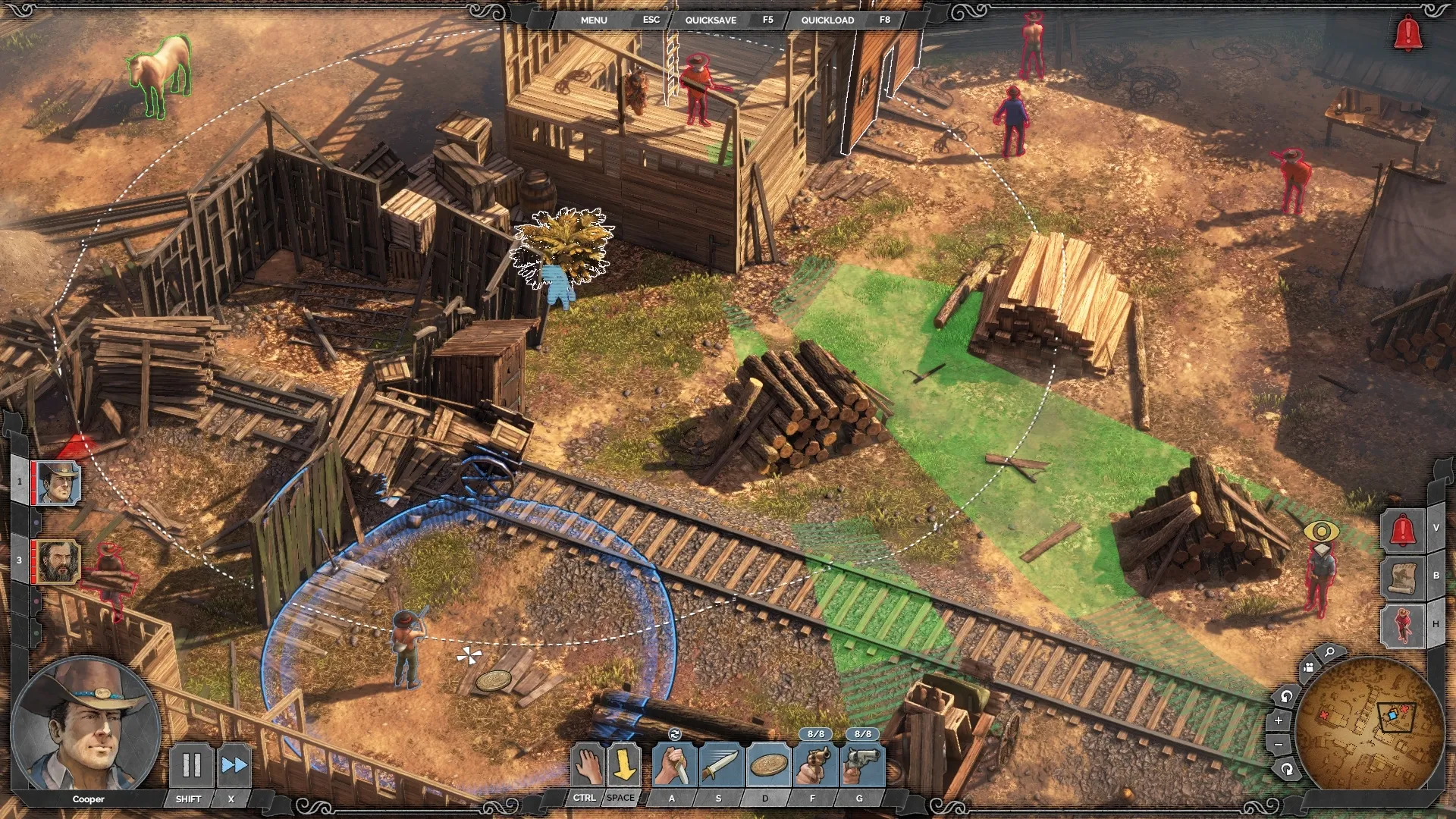
UnityContainer sheds light on the development of the real-time tactics game Desperados III in an XXL interview with Mimimi Games.
Mimimi Games was founded in 2008. In its early years, the Munich based developer had to do regular commission work with titles such as Whoowasit (2012) in order to keep the company running.
That changed with the release of the real-time tactics game Shadow Tactics: Blades of the Shogun (2016). The Studio won four awards at the German Developer Award 2016: Best Game Design, Best PC/Console Game, Best German Game and Best Studio. Mimimi Games suddenly became one of the hottest German game developers, so THQ Nordic took notice of Mimimi Games and gave them the development contract for Desperados III. A wise decision because series like Commandos and Desperados were a great source of inspiration for Shadow Tactics.
Mimimi Games wins the award for Best German Studio at the German Developer Award 2016.
Desperados III was released on June 16, 2020, and achieved top ratings. Our Computec colleagues from PC Games gave it 9/10, on Steam the average is 10/10, and the Metacritic
average of 86% is also impressive.
At the end of 2020, Mimimi Games took the next step as a company and is now going to self-publish their next game codenamed “Süßkartoffel” (Sweet Potato). It will also be a real-time tactics game, will be released not before 2023 and is already something special in Germany. Codename Süßkartoffel is the first game to be funded by the stately game’s promotion with an amount of 2 million euros. Mimimi moved to a new office building in Munich and plans to expand its staff from 30 to 40 people in 2021. The studio is currently looking for additional employees in many areas.
UnityContainer had the opportunity to interview Mimimi Games. We talked about the sometimes stoney past, the surely exciting future of the studio and, of course, the development of Desperados III. This is part 1/3 – don’t miss the other parts coming in the next days.
UnityContainer: Let us look back: How and where did you celebrate the success of Shadow Tactics: Blades of the Shogun? Would you have expected such a success?
Dominik Abé: Crying alone at home. Since our studios was close to bankruptcy at release we had very mixed feelings. But we celebrated a bit at the German Developer Awards. The real success of Shadow Tactics was a slow and steady one. I think, now after four years and the release of Desperados III we slowly understand and see the real meaning and success of it.
How did you get the contract for Desperados III? Was there a pitch or did THQ Nordic come directly to you?
Dominik Abé: During the final phase of Shadow Tactics, we pitched a new Desperados to THQ Nordic which they signed shortly after the release of Shadow Tactics. We have always been big fans of Desperados and Commandos and had a look out for those IPs.
Despite your success with Shadow Tactics, how much respect did you have for the task?
Dominik Abé: A lot. The pressure was quite high to make two successful games in a row. And to be frank: Desperados III had to be even a bigger one because the production was more expensive. At least we were confident as we understand the genre at its heart. But to do right by an existing IP and its fan base is not easy. Working on one of my favorite IPs was also a lot of fun. It was a great honor to shape the franchise in a modern direction.
How did the collaboration with THQ Nordic go? How concrete and strict were their demands on you?
Dominik Abé: THQ Nordic trusted us a lot and gave us nearly complete freedom. Only some topics that might change the future usage of the IP needed to be discussed in detail. There was only one case I remember where they put in a veto and even there we fully understood their decision.
Westerns are not exactly a hip genre these days. How much do you think Red Dead Redemption 2 has helped you in this case?
Dominik Abé: This is hard to say for us. Perhaps it hyped and made the western genre more visible for the mainstream audience in general but this has also been happening through other media, such as Hollywood movies, as well. On the other hand, it might have taken away some of the uniqueness because there now was another and way bigger title for western fans available.
The line between challenge and frustration is thin. How did you manage to balance it so well in the end?
Dominik Abé: This is true, particularly if the last stage of development seems to take forever. But on the other hand, you have a clear challenge that implicates very explicit tasks that you can work on. The frustration comes if you run out of ideas what you can work on to improve something. That was especially true when we were optimizing the game for consoles. It was okay to make baby steps but it felt quite desperate when we ran out of ideas. The thing that keeps you going is the confidence that the game you are going to release will be good and hopefully even awesome. The excitement to know that your game will soon be played by others is very high and gives you some adrenaline. This time was quite emotional because you know the end is just around the corner – but the last small step seems to be impossible to make at times. During these times you experience rapidly changes between ups and downs. You need a lot of trust in yourself and the people you work with to stay confident and focused.
Overall: What were the biggest challenges and how did you master them?
Bianca Dörr: We had multiple challenges during production regarding different areas in the art team. Here are some examples:
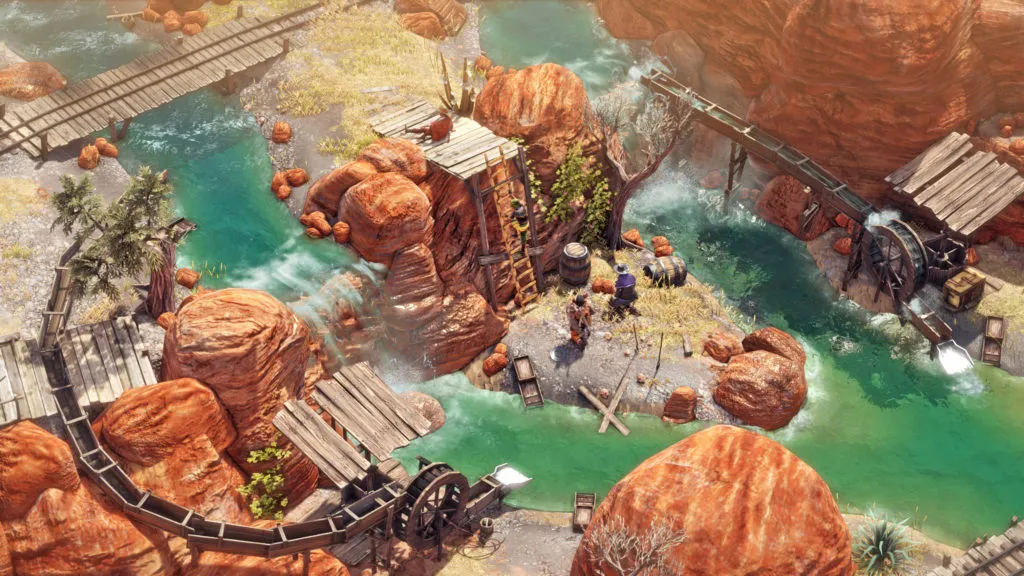
First of all, the graphic style of Desperados III was a big challenge for us. After Shadow Tactics, we were very ambitious. We wanted to make everything look better by adding more details, create unique settings and ramp up the overall quality of the graphics. We realized that we didn’t have the required capacity to finish all the assets and levels in time. In addition, we underestimated the amount of overhead and planning time the project needed, which resulted in lack of time for team members regarding their creative work, such as making textures. We solved this problem by getting external art support.
Early on in the development process, we decided to move toward a more minimalist overall aesthetic for Desperados III’s UI, as we wanted to move away from the old-school, cluttered HUDs real-time tactics games are usually associated with. We wanted to create a fresh and modern interface. Of course, moving in this direction took lots and lots of iterations until we arrived at a satisfying end result. Curating thousands of images for the UI can quickly get very overwhelming. Hence, writing custom scripts and tools to automatically export assets with corresponding image size and name was critical in the asset creation process.
Having more and bigger levels with high amount of details resulted in the need for more VFX and environment art. To make a level look lively, you need ambient VFX, such as falling leaves, dust, moving flags, etc. Also, the player should be able to explore the maps and discover lots of little environment stories. In both fields, we discovered that we needed more support. So we hired an additional VFX and an environment artist, who helped us achieve the quality that we wanted to deliver.
For the animations of Desperados III, we used motion-capturing for the first time. All animations for our other projects were hand keyed by our only animation artist Cem, who got some support from another colleague from time to time. We underestimated how much overhead this would imply and also planned too many animations and cutscenes overall. In comparison to Shadow Tactics, in which the cutscenes used mainly existing animations and were in general very simple, we wanted to tell the story of Desperados III in a more vivid way with higher quality. That’s why we decided to use motion-capturing. In the end, this was a fantastic experience for us – despite the fact that it was only manageable with careful planning and more time in general.
Frieder Mielke: Certainly, the biggest challenge was to bring the game to PlayStation 4 and Xbox One in a technical state that we would be satisfied with. We defined pretty early on that this meant a stable 30 fps frame-rate at FullHD (1080p) resolution. Getting there was far from easy though. After porting Shadow Tactics to PlayStation 4 and Xbox One in 2017, we transferred a lot of our learnings from that to the pre-production of Desperados III. This meant that we had to change and add several core systems to better fit into how Unity handles systems internally. This ranged from improving transform data caching (position, rotation and scale of objects) to implementing a robust editor “pre-warm” phase (pre-calculating and instantiating objects before the game runs on target). With these changes and our experiences with console porting of Shadow Tactics, we were rather confident to meet our performance goals with Desperados III without too much trouble. Among other factors, this lead to us checking way too late if we are actually on track to hit our framerate and resolution targets on consoles.
Long story short: When we had finally realized that we were in trouble, we had to shift most of our programming resources into figuring out if we could get Desperados III running on consoles at all – even if it meant downgrading frame-rate, resolution or other parts of the game. At the same time, this meant that we could not take care of finalizing features, fixing gameplay bugs and the like, so all other departments were left to their own devices for quite a while. After about six months of purely focusing on optimization, we saw a light at the end of the tunnel. That’s when we said that we would be able to ship Desperados III on consoles with our original goals regarding the technical setting. It still took quite a while to finalize all the little (or not so little) details we left open, such as smoothing out frame stutter during loading screens, handling memory fragmentation, making sure replay data wasn’t lost in weird cases, fixing crashes caused by Unity’s cloth system, and much much more.
Moritz Wagner: While there is always a huge number of challenges during production and I have probably already forgotten half of them, the following three spring to mind: In the beginning, a big challenge that we faced was making the game feel like its a clear advancement over Shadow Tactics from a design perspective. There wasn’t too much criticism to go off, since Shadow Tactics was received so incredibly well.
Then many of the initial ideas for new features, which we had in the beginning, didn’t work out, so we scrapped them. At some point we had to make sure that we still implemented things that would make Desperados III stand out more, which leads to the next topic. Designing Isabelle (the voodoo character) was a huge challenge. We wanted her skill set to feel powerful and be true to the vision players would have, but also her skills shouldn’t be overpowered. We went through countless iterations of her skills – until we finally arrived at something that worked for us. Combine this with the fact that her being so different from a gameplay perspective was also very important for the issue, that we didn’t just deliver a reskin of Shadow Tactics, we really had to get her right.
The third one is just the overall level of quality of Desperados III. It made huge advancements in every aspect, be it technical, visual etc. Hence, this created many, many small challenges all over the place and I think we underestimated this a little.
What would you have done differently in retrospect and why?
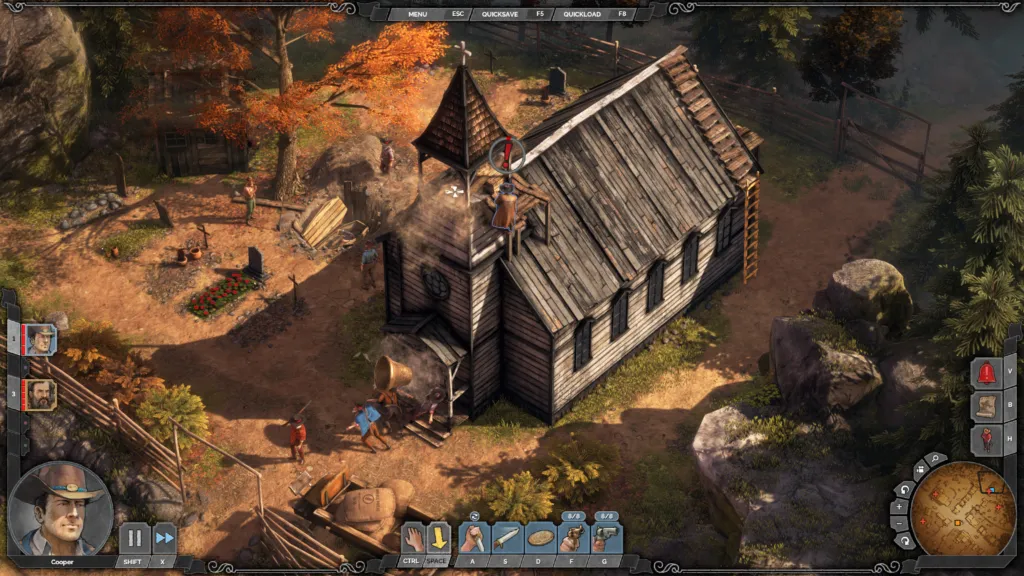
Bianca Dörr: The amount of detail was something that gave us a bit of a headache and is something that we should have done differently. While the graphics of Desperados III look great and were well received, we shouldn’t have added so much tiny detail in textures and the overall environment art. Once everything was integrated in the levels, we noticed that the readability really suffered from all the micro details we had added. It made it much harder to detect enemies and sometimes you wouldn’t really know where to go – since everything kind of looked too similar. The level of detail was nice to look at but interfered with anything gameplay related. So we had to find ways to highlight important assets and lead the eye of the player. After many iterations, we finally managed to find a balance between detail and gameplay.
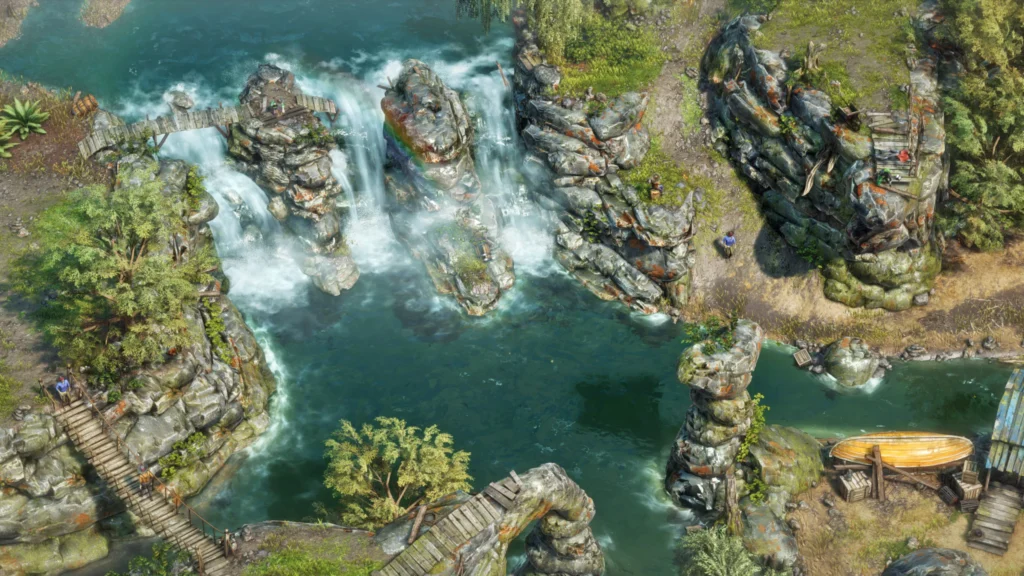
For example, we established the color yellow as a gameplay color. According to that logic, everything that the player must see or can use is yellow or has some yellow touches in the game. Color in general was our tool to lead the player’s eye. In Mission 11 of Desperados III called “Queen’s Nest”, green and brown color tones are dominating the map, so by adding white paint coats on the houses and giving them some colored assets helped to separate them from the environment.
Frieder Mielke: We definitely should not have relied so heavily on our improvements to core system optimizations. Only through early and repeated testing you can make sure that all the things in game development work as intended. Therefore, it should be the same for target platform optimization. From early on, we didn’t prioritize the tasks to look into console performance high enough, and as such they were often moved back due to expanding development time of other features. In addition to that, we had the notion that we could only really evaluate the performance of the game when the levels were at a reasonably high content level (i.e. feature complete and no dummy assets in place anymore). Both of these factors contributed to us neglecting console performance in the early stages and then running into a wall when actually trying to look into it. Curiously on PC, Desperados III usually ran better or at least similar to Shadow Tactics on our development machines, so this never threw up any red flags. The big takeaway here is to always test on your actual target hardware, even if your estimations tell you everything should be fine.
Moritz Wagner: From a pure design-perspective, honestly not too much. There are certain things we, as designers, would liked to have done differently in hindsight. Like trying to make a story that interacts better with gameplay and doesn’t rely on cutscenes so heavily. But what we shouldn’t forget is that this still is a Desperados game. And this is part of the Desperados-style of telling stories. So I don’t think this would have been the game to actually do this while delivering what fans want from a Desperados game.
The other big thing is making the game easier for newcomers to the genre. We did a lot for that, but I believe we can do a lot better. It’s not so simple to make a game – that is actually fun because it’s hard – easier for newcomers without losing the fun part.
Why did you make the look more realistic than Shadow Tactics, what was the concept behind it?
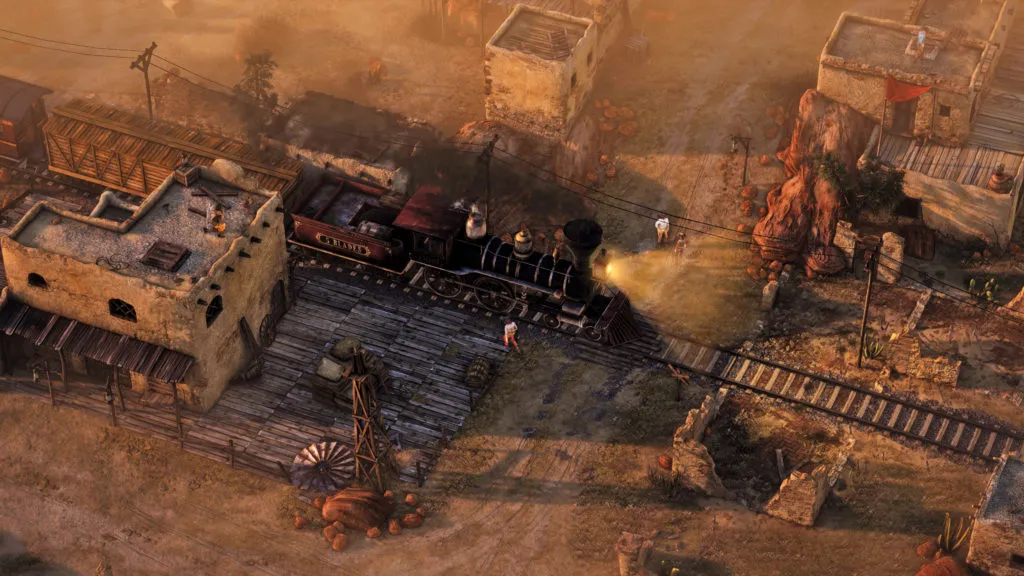
Bianca Dörr: For Shadow Tactics, we had more freedom regarding the art style since there was no predecessor. Also, we were only four artists at that time so we had to limit ourselves in what was manageable. Desperados is an established franchise, which is why we wanted to capture the look and feel of the original. We wanted Desperados III to look like a modern version of the original Desperados game. Like Commandos, which we examined closely for Shadow Tactics, Desperados has much detail, crisp textures and a overall realistic style approach. Our art team always wants to create a style that looks handcrafted and has some level of stylization in it. That’s why we added hand-painted touches to the textures. With this mixture, we didn’t only copy the style but created something to call our own. As we developed the style during pre-production, we tried to get as close as possible to the original style but also made sure to add our own touches. We were very content with the result. During production, the style developed further and we added more and more detail which made the style look a bit more realistic than originally planned.
Of course, there were voices at the announcement that said “This will be no more than Shadow Tactics in the Wild West”. I could imagine that it’s a hard situation: On the one hand you want to refute the critics and do justice to the franchise and the Desperados fans, on the other hand Shadow Tactics is a great game and it would be foolish to do everything differently now. How did you master this balancing act?
Moritz Wagner: Yes, this definitely isn’t easy. And it’s also a little unfair in my opinion. Shadow Tactics is a game that took the ideas and concepts of Desperados as well as Commandos and turned them into – what we think – a modern version should look like. Therefore, it just made sense that our next game was going to build on those things, especially if its a Desperados game. Because we believe this is what a modern game in this genre and those franchises should play like. I don’t fully understand people who are saying, Desperados III is too similar to Shadow Tactics. This was sort of the whole purpose of Shadow Tactics to begin with. But overall, I think, we struck a good balance here. The game feels like a Desperados game and this is the most important thing. Are there similarities to Shadow Tactics? Sure. Could there have been less? Probably. But when I look at how the game is received, we did a good job in the end. The occasional “this is just a reskin” comments are a little irritating of course since it’s very far from the truth. But what are you going to do? You have pain-points like that in any game you ship. In the end, it’s still a little weird to me, though. Some people claim that they want to see innovation, but in reality they don’t. They usually wish for something they already know and can rely on. They want an over-paint that looks different enough for them to excite them and then a soft pillow filled with enough familiarity to fall into when they start playing. An example: Criticizing us for having some of the same skills as in Shadow Tactics is like criticizing a shooter for having a Shotgun. There are staples for certain genres and I think that is fine.
How did you manage to make the gamepad control work so well?
Moritz Wagner: I think that we already laid out the groundwork here during Shadow Tactics. Since we knew we were going to bring Shadow Tactics to consoles, we focused on it right from the beginning. Everything we created was designed with the gamepad in mind. And this carried through to Desperados III, of course. For Shadow Tactics we played the very, very clunky PlayStation 2 version of Commandos 2. But we saw potential there and knew that with what we know about design today, we can make it work. Then, when Diablo 3 was released on consoles it showed even better how to do it and what works. So in the end its just this: Being aware of gamepad controls from the start and then making sure it works perfectly along the way. It even helped us staying more elegant and on track in our design, I think. It’s a good restriction to have sometimes, to avoid complexity creeping in.
One of the things that makes Desperados III stand out is that there are many possible solutions. How important is it to you to give the player a lot of freedom of choice and how did you try to ensure this?
Moritz Wagner: It is very important to us and one of the core pillars of the game. It was a process for us to learn how to do this, especially coming from the game we made before Shadow Tactics, which is the 3rd person action-adventure The Last Tinker: City of Colors. It was a very linear experience and whenever we found players were doing something, which we didn’t want them to do, we “fixed” it. For Shadow Tactics we started thinking differently about it and started to support such things and maybe even make it a viable, designed path. But the core of all of this is how we designed the player characters and their skills. The way they interact with each other and the AI makes it so that any situation is basically solvable with any or even no skills at all. We create this space in the game where we deliberately give up control as designers and hand it over to the players and our systems’ synergy. Our job now becomes maintaining the boundaries of that space, so it is just right, but without interfering too much with what is actually possible inside of them. Something else we do, especially in level-design, is to make sure that there always are multiple ways. This starts from the large overall mission structures and goes down to every individual enemy-setup.
How did you get the idea for Isabelle’s voodoo magic? Weren’t you afraid that it might be inappropriate or too powerful?
Moritz Wagner: During prototyping for Desperados III one of the first things we prototyped was an ability that let players control guards. It instantly felt fun and fresh and we wanted to do it. From then on we kept working and iterating on this idea for almost a year. At some point, we realized that the mind control in itself would be too powerful as a skill that Isabelle could use all the times. Everything we tried either made it feel wrong or too strong. That’s when we decided to make it an “ammunition-based” skill that can intentionally be overpowered when used. Following this, we had to find something new that would be part of her normal skillset. We are all big fans of the Arkane Studios games here, so its no surprise that we settled on something from Dishonored 2. A lot of iteration time went into making the connect skill work the way it should work in our game. It had a lot of implications and other things needed to be considered, so its very complex.
Regarding magic or voodoo being appropriate in this game: This was something that some people have voiced concerns about before it was released and even after the game’s launch. There are three points that speak for the use of magic/voodoo in Desperados: 1) It makes total sense in the setting. We have a chapter in Louisiana and New Orleans where voodoo was a thing at that time. 2) As previously discussed, we wanted to innovate at some stages. Fans wanted innovation. And if you stay completely realistic, there is only so much you can do with skills. So we wanted and needed to push it in that regard. 3) The Desperados franchise itself had a lot of occult stuff going on within its setting, so in my opinion magic isn’t something that is as far off as some make it out to be inside that world of Desperados. When we looked at old design documents, we even saw that they planned on adding zombies to the game at some stage. The final boss fight of the first game takes place in a cave full of devil worshipping cowboys and “El Diablo” the final boss is literally inhumanely strong. You only manage to take him down by dealing “666” damage in the end.
A game like Desperados III stands or falls with the heroic troops. What were your goals when you designed the game and how did you try to achieve them?
Moritz Wagner: The characters are another big pillar. We wanted all of them to feel unique with their skill sets and personalities. At the same time, they should be well-rounded. They need to be fun to play with and listen to during dialogue and cutscene. Their personality should develop during the game. This becomes very hard if you have five main characters, not one. Another important thing is not to make them TOO specialized. This is a trap that the old Desperados and Commandos games, in particular, fell into. There were certain characters that are mostly useless and only work great in specific situations when their hyper-specialized skillset makes sense. We didn’t want that. This is why each of our characters has the “basic” skills – such as killing or moving bodies. They are just not as efficient at it as someone else might be.
In Shadow Tactics you were able to concentrate on the PC version first, in Desperados III you developed several versions in parallel. How did you adapt your production processes to make this possible? What were the biggest difficulties?
Tom Kersten: We were trying to build on the experience and knowledge we gathered from the Shadow Tactics console port delivery. All the console-specific features we would need, like gamepad UI & controls, already had a pretty good basis for building and improving upon. Right from the start, for these features we moved them along side-by-side the PC version development. This wasn’t too difficult for us because actually, that was the way we had already worked on Shadow Tactics, as well – all the “console” features were pretty much already part of the PC release version of Shadow Tactics back then. What came after the PC release was “just” the part where we would make sure we fulfil all the console manufacturer technical requirements and the game would run properly. We had already made a lot of performance optimization for Shadow Tactics and we were to deliver Desperados III for the same console generation (Xbox One, PS4). Naturally, we thought we had a pretty good baseline for where we would kick off things from in order to build the new game for consoles. With that in mind, we decided to really get into the process of console test builds and optimization tasks late in the production, after our Beta milestone. This way, we’d have almost all the final content in the game so we knew how far we would need to go from there towards hitting our performance goal. There would be little surprises in terms of bigger changes in the content of the overall game that may require us to start all over on something that we thought we had already fixed.
However, what sounded like a proper plan on paper turned out to give us a lot of headaches. The bugs and performance issues specific to console versions turned out to be far bigger than expected. Some of it just needed a lot of time to be fixed and optimized but there were some issues that were rooted deeper down in the Unity engine. Therefore, we needed to talk to the Unity guys to have them investigate it and try to help us. These are just those unforeseeable things in game development that always happen. Fortunately, by working all together to find a solution, we eventually managed to pull through. But I remember it wasn’t particularly fun for some of our coding staff as they had to investigate memory leaks for weeks and weeks. And of course, it was not a laughing matter for our production schedule – as we basically had to delay final game delivery for a while without even being able to say for certain when we can be finished. That’s how tough these engine bugs were to track down. We are really thankful for THQ Nordic to stay calm during this difficult production period.
We were all really relieved when we were finally able to say “okay we think we’ve got it, now we can estimate all the remaining things we need to do before we can send the game out for certification and be done with it”.
Audio-visually Desperados III stands out from Shadow Tactics. Motion capturing, 75 music tracks, a really good voice output in German AND English – how did you manage that as a comparatively small team?
Tom Kersten: The short answer is: With the help of some really good external partners, who are masters of their craft 🙂 … But okay, I’m going to give you a bit more insights here, as well. 😉
Music and voice-overs are something we already had experience in handling with the help of our excellent partners Filippo Beck Peccoz, our freelance Audio Lead and composer, and OMUK, a London- and L.A.-based recording studio, respectively. But motion-capturing was something completely new for us, and it’s also an aspect that has an impact on the other two, as well. Mo-capped cut scenes need to be properly voiced and scored, and this process has a lot of parallels to actually shooting a movie. It was difficult for us to handle simply because we were missing the experience (we do have that now!). Moreover, there were many assets to take care of, a lot of work that had to be done with too little time, as well as a lot of tasks to coordinate between Mimimi Games’ own design, code, art and animation departments, TakeOne (our motion capture recording studio service provider) and OMUK. Plus, there were also the other recording studios that would dub the game in other languages like German.
When we started production on Desperados III we were set on using motion-capturing for the cut scenes because this is a Western-themed game and it felt like the right move for us to orchestrate the game’s story in that way (it still does!). We then eventually decided to use motion-capturing for many of the in-game animations because the first results we saw there in terms of quality versus having everything hand-crafted by our animator Cem were staggering. Don’t get me wrong, Cem is a fantastic animator. But there were just so many things to do and with him being the only animator in our team we were sure we can get more things done with a higher level of quality if we went this way.
However, once we moved fully into production, it turns out – as it always is the case – there are more obstacles. The amount of mo-capped in-game animations was huge, not just to work through but also to stay on top of everything. Furthermore, we still had the cut scenes to take care of which, as I mentioned earlier, had a very complex workflow attached to them, and one that was completely new to us.
But over the course of the production, we were able to make more and more improvements in our workflows and increase our efficiency. We finished all our animation tasks pretty late in the production but we managed to complete everything.
Now, we want to put all that knowledge, which we gained through a tough production process, to good use for the future. We are willing and eager to prove that we can manage it better for Codename Süßkartoffel, which means less pain for the team so they can truly focus on their creativity and how to put all those cool things in the game. We believe we are ready for it.
In our research, we are always amazed at the comparatively small European game developers, all of whom are listed on the stock exchange. Team 17 in London, 11 bit studios in Warsaw, Dontnod in Paris, to name just a few. In Germany, this does not seem to be an option. Not even Crytek went public. Sooner or later, the studios will be taken over by other companies – by companies that have raised their capital on the stock exchange. Keyword THQ Nordic. How do you see that? Are the hurdles so much higher in Germany? Or is the stock exchange a medium-term issue for you to remain independent? Or will you at some point become part of the Embracer Group? 😉
Johannes Roth: Becoming part of a larger group opens up many new doors, and it provides new ways of becoming stable and growing. But right now, we are in a very good position, thanks to our previous two real-time tactics titles being published by external partners. I’d argue that the traditional model worked well for us and our partners. Now, self-publishing was one of the opportunities that we surprisingly had the luxury of choosing from. We felt like that if we don’t do this right now we might never do it. We grow older, more risk-averse and might simply not have the guts to pull through with it anymore. I’d like Mimimi Games to be in the strongest position possible before talking about selling the company or shares.
So, with the next project, we want to increase Mimimi Games’s value and go our own path. We think that going through self-publishing at least once will achieve that. Even if it’s only for the experience as well as the “lessons learned” – and not necessarily monetary reasons. Still, releasing a successful Codename Süßkartoffel will go a long way getting there.
You mentioned your new project Codename: Süßkartoffel. It’s one of the first projects to benefit from the Games funding from the German government, specifically with 2 million euros. How difficult was the way there? Many readers naturally ask themselves: What do you have to do to get so much money from the federal government?
Johannes Roth: The way to even getting the chance to apply for a grant by the German government was long and rocky. It included many years of improving regional funding like the FFF-Bayern in Bavaria, merging two opposing associations into one, developing a whole new grant concept as a single group and then receiving the blessing from the EU. Anyway, we did it! Now, from applying to getting greenlit by the BMVI takes around three months. I’d say the application and process is fair. There are things that could be easier or improved upon, but it’s really not the moment to complain about things: We are simply happy. To get the funding, you have to prove that the full project is funded (the grant supplies developers with 25-50%, depending on the total budget sum) and your team has the skills to realize the project. You also have to pass a culture test from the EU. I believe that for smaller studios, in particular, having the remaining 50-75% of the budget is the hardest part. But as long as you are applying with a project that’s plausibly and checks out, publishing deals are allowed.
What can you tell us about Codename: Süßkartoffel? What kind of game is it?
Matthias Kraut: We can’t share much more than what we announced in our statement: Our next project Codename Süßkartoffel is going to be our first self-published and our third real-time tactics game! However, I can tell you a bit more about why we call the project “Süßkartoffel”. Of course, the game will not actually be titled Codename Süßkartoffel once it is released. It is the internal codename for the project. As such, it is an evolution of the previous codename Kartoffel, which we used for Desperados III. Before we made the Kartoffel project public we fittingly called publisher THQ Nordic “farmer” in our internal communication. Although we have no idea when we will start working on it, the game after Codename Süßkartoffel already has a vegetable codename, too: Mangold.
With Codename: Süßkartoffel you become a publisher yourself for the first time, after having worked with Daedalic (Shadow Tactics) and THQ Nordic (Desperados III) before. How did this step come about? Why do you take it and how important are the 2 million for it?
Johannes Roth: We want to make our own decisions – and mistakes. No matter what the result is going to be: We will become a better developer from this experience. This is also true if we were to work with a traditional publisher again in the future. Self-publishing is very motivating and we are going to learn a lot in a very short time. On the other hand, of course, there have always been frustrations about processes or things that we had no influence over in a publisher partnership. We’re complaining at a high level here because the collaborations have always been very good overall. But our thesis is that self-publishing is going to be more stressful, but with less frustration and heteronomy attached. At the end of the day, a much larger share of the revenue will remain with us. We will also retain all brand rights and are completely free in this respect. In addition, the value of our company will increase significantly. These are all important factors why we decided to go the self-publishing route.
What are your values as a company? What makes you attractive to potential applicants?
Johannes Roth: We invested quite a few months in 2020 to build a proper mission statement for our company. Although it’s currently only used internally, it’s the backbone of what we use for making tough decisions, for what we write on our website or how we communicate. Maybe one day we will release a public version of our mission statement, but the core of it is: A happy Mimimi Games needs both – outstanding games as well as a satisfied, happy team. That includes not only a definition of what makes a great game for us, but also family-friendly salaries as well as how we deal with crunch. How do you balance it all, where are the boundaries? The new mission statement already helped our five newcomers a lot. Moreover, we have professionalized ourselves from a structural perspective and appointed clear contact persons in management roles. Tasks, competencies and responsibilities are discussed and recorded. In my opinion, we are very well positioned for further growth – also with the new and spacious office that we moved into this year. Furthermore, we are now talking more with international applicants. We have built good financial reserves for the studio – and we communicate this in a very transparent way to the team – which provide the necessary stability. Even in a worst-case scenario, no one needs to have existential fears at Mimimi Games.
You have advertised many vacancies. Do you necessarily have to live in Munich (or the surrounding area) or are remote full-time jobs an issue for you?
Johannes Roth: Yes, being able to work at our office is a requirement, we don’t do remote-only jobs so far. We understand that some might see this as a backwards-thinking attitude, but we strongly believe in the value of working face-to-face and on-site, especially for creative processes during game development. This is also why we require applicants to speak German fluently – we want people to socialize and keep misunderstandings to a minimum. Currently, home-office is obviously possible due to the pandemic, but we can’t wait for the team to be fully back together. We know that we reduce the pool of possible candidates, but for now this is what feels right to us.
Will there be a Desperados 4 from Mimimi Games?
Johannes Roth: The Desperados IP is owned by THQ Nordic, so at least Codename Süßkartoffel won’t make use of it.