

The creation of a mobile game about Swiss politics.
Swiss politics as a mobile game: A combination that does not fit together at first glance. Never could something so serious and complicated as politics work as a fun video game, right? Why, yes, it can work! The think tank Avenir Suisse and we at Blindflug Studios have combined exactly these two things together in a cheeky and yet educational way. With a wink of irony, we turned the political system of Switzerland into a virtual board game called Democratia – The Isle of Five.
In two articles, we show you how it was done. You get a look behind the scenes of a Swiss developer studio and learn how an idea evolves into a finished game. Discover how we turned Avenir Suisse’s work and research into an entertaining, interactive experience.
In part 1, we tell you how we came up with the concept idea for the game, and how Blindflug Studios and Avenir Suisse combined their talents for this project.
In part 2, we take a closer look at the technical and artistic world of game development. There you will also learn how we dealt with the Covid-19 lockdown and how we were able to make the best out of this challenging situation.
Part 1: Avenir Suisse needs a game!
For 20 years, Avenir Suisse has been coming up with ideas for Swiss politics and economics. To celebrate the 20th anniversary of the think tank, they wanted to create something special that would pay tribute to their work in a new way. A travelling exhibition would have been a classic choice, but a project that functions digitally as well as interactively would appeal to a broader audience. After a lengthy process, they knew what their anniversary gift should be: a mobile game. To be more precise: A game that would not only entertain but also inspire reflection and discussion about Switzerland’s political future, with questions like “How will Switzerland develop over the next 20 years?” and “What could happen to our country in the future?”.
For this, Avenir Suisse needed a game development team that could turn this core idea into a real game. With a tender, they called on game developers to apply for a pitch. For us at Blindflug Studios, this was the perfect opportunity to prove ourselves with our expertise and creative skills. Especially because Avenir’s project proposal also matches our company philosophy. We want to make precisely the kind of games that revolve around real-world topics but are also fun to play. We are convinced that computer games are the ideal medium to experience complex real-world problems interactively.
The Brainstorming – What do you need for a good game about politics?
A mobile game about Swiss politics – that is the assignment. Now what kind of game can you make that meets this requirement? Which genre of games would fit? Should it be a single-player or multiplayer game? To find out, the core team of Blindflug sat down for a big brainstorming session.
First of all, it was essential to find a game concept that matches up well with the customer. We knew that our proposal for a think tank like Avenir Suisse must offer a lot of complexity and political depth. Politics means discussing and finding compromises, so the game should motivate the players to debate and cooperate. What kind of game makes it possible to experience these activities together through play? Parlor games, of course, such as board and card games that you play with friends and family! Thus, it soon became apparent that it should be a multiplayer game that you play with several people in the same room. A brave choice, since this concept hasn’t been tried out very often in mobile games so far.
Our game should also be funny and simplify political topics in a clever way to appeal to a wider audience. For inspiration, we looked to the world of comics. The French comic series Asterix has been combining politics and humour for decades to talk about modern issues with simple analogies. Current topics are dealt with in an archaic setting, which is exactly an approach that appealed to the Blindflug team for this project.
The Asterix book Asterix and the Missing Scroll from 2015 deals with current issues such as whistleblowers and modern communications media. Asterix in Switzerland from 1970 lovingly parodies typical clichés about Switzerland. Therefore, we decided to use a medieval “Helvetia” style but with the possibility to still represent modern technology and sciences with this aesthetic. The video game Bad North also helped as a visual inspiration with its simple, modern pastel-coloured look. Avenir Suisse conveys a smart, modern aesthetic; hence, the game should have a suitable style.
In summary, we set the following cornerstones for our game idea:
- The game uses politics and visions of the future as its core themes in the gameplay.
- It represents a simulation of political discourse.
- It encourages discussion and reflection on political developments in Switzerland.
- You can play it with several people. The computer AI replaces missing players.
- It appeals to a wide range of people, to gamers and non-gamers alike.
- Especially Swiss families should find it appealing. Ideally, the parents and kids play it together at their kitchen table.
- It offers a lot of humour, clever analogies, and surprises.
- The game is charming and exciting to watch, and it has a modern and stylish presentation.
The idea – Switzerland as an island with five tribes
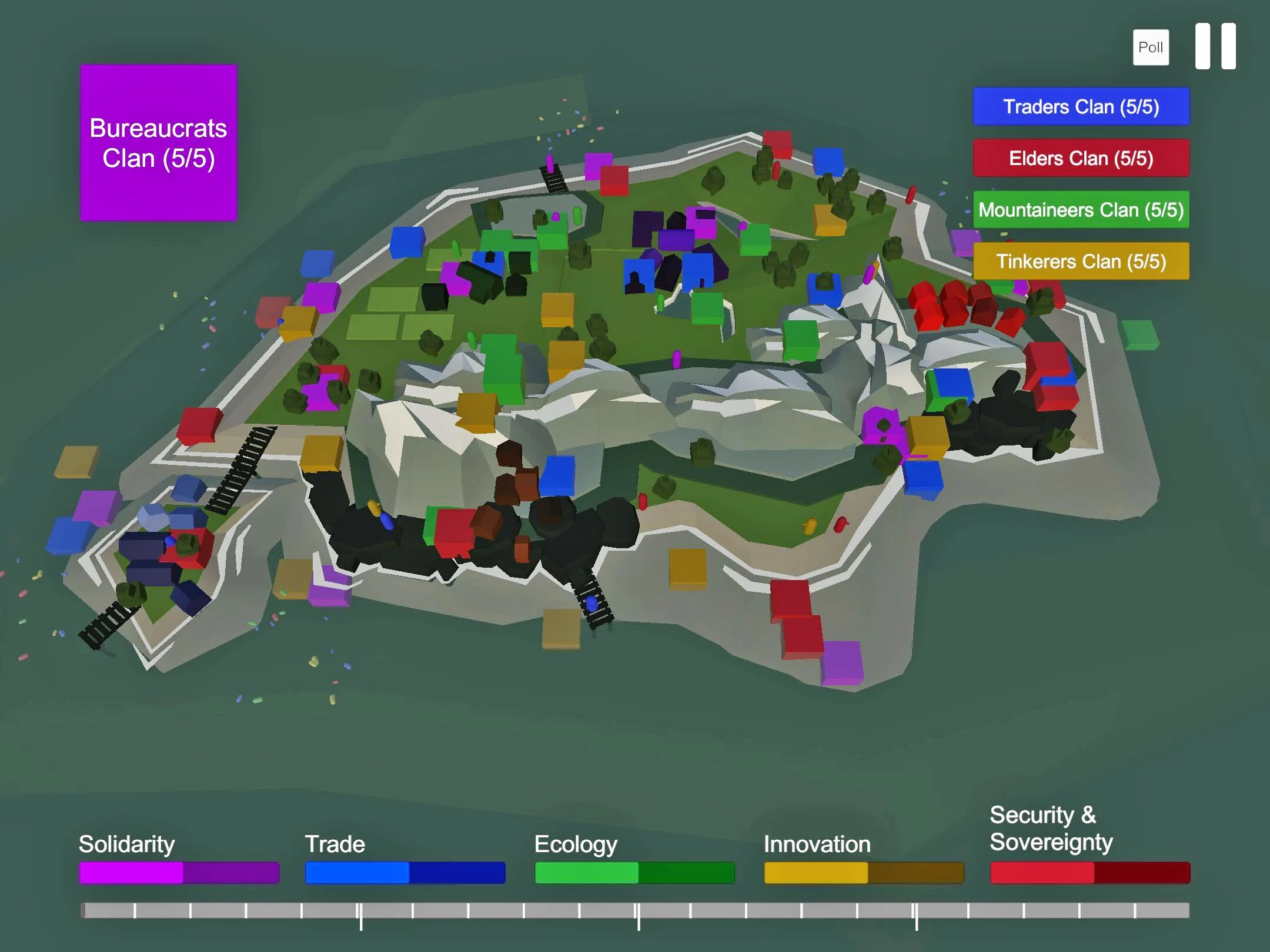
Our game design experts developed the following game concept based on the brainstorming session. It should be a virtual board game with up to five players, and everyone controls it on their own smartphone or tablet. You connect via the local Wi-Fi network to play with other players. Switzerland and its people will be simplified and represented by an island with five tribes, each living in a village. Each player leads one of these tribes and influences their members. However, the players should not just follow their own political bias, but also take over roles with different political mindsets. Hence, every tribe embodies a different political ideology typical for Switzerland, and they work towards different possible utopias for the future of the island.
The game itself consists of three main components:
In the core game, you let your tribe members gather resources. You can tap on a villager with your finger to “motivate” them to gather more efficiently. Each tribe has its own resource that reflects their mentality, such as “environment” for the environmentalist tribe and “innovation” for the tinkerer clan. At the end of the game, the player with the highest amount of their resource wins, and the island becomes their utopia.
But you can’t be too selfish! All five resources are essential for the continued existence of the island nation. The resources are constantly being used up, so they can fall to zero when a game round goes badly. When that happens to a tribe, the whole island and therefore everyone is doomed: Game over! That’s why collaboration and mutual help is needed to make the whole island prosper. To help each other, you can move a single villager with your finger and relocate them to another tribe. An endangered clan can replenish its resource with more members, and the island nation persists.
Twenty years elapse in the game world (which is equal to twenty minutes in real-time), and every few years, there are voting days as we know them from Swiss politics. On such a day, you, as the clan leader, distribute 100 votes for or against the referendums. These voting are mostly based on real questions the Swiss population had to deal with in the past or that it still has to ask itself – sometimes taken to extremes and with an ironic twist, like whether a border wall should be built around the island or whether veganism should become obligatory. The tribe members are happier and more productive when the vote is won in their interest, and sad or even angry when they lose. Thus, a referendum’s outcome directly affects resource gathering, and the players feel the consequences of their decisions. Together with the political change of perspective, this gameplay mechanic shows how the interactive level of the computer game medium can bring well-known political issues closer to the audience in a novel way. Only video games can offer this kind of close connection between medium and recipient.
The votes also affect incidents that will happen to and on the island. Random events occur between voting days that influence the lives on the island and clans’ resources. The events are partly based on real political events. They reflect what has already happened or can still happen in Switzerland. But to keep it funny, there are also rather absurd, special events, such as a UFO landing.
Due to the random and extensive selection of votes and events, every game round is different. This guarantees high replayability, and the players get constantly surprised. An event that had a devastating effect in the first round can be prevented in the second round by a different voting result.
The Blindflug team then prepared a pitch document to present it to Avenir Suisse. Our 3D and 2D artists created concept pictures and illustrations to help explain the game’s core concept and aesthetic.
With this material, Blindflug Studios impressed Avenir Suisse! Blindflug won the tender, and the official work on Democratia could start!
The cooperation – Avenir Suisse and Blindflug Studios together at the wheel
First, it was necessary to refine the game concept with Avenir Suisse, so that the finished game deals with the delicate topic of politics in the right way. Before the artists and programmers of Blindflug could get down to work, the experts of Avenir Suisse and the game designers had to work out the further details. In meetings and workshops, we defined the five clans and decided which events and votes should be included in the game. Weird ideas were just as welcome as current and more serious topics. The important thing was to find a good mixture of political relevance and ironic humour.
When defining the clans, these five groups and respective resources were agreed upon:
- Tellis, the conservative inhabitants in the east – Security
- Novatars, the inventive tinkerers in the north – Innovation
- Admins, the urban bureaucrats in the central lowlands – Solidarity
- Globos, the cosmopolitan traders in the west – Trade
- Vertis, the rural environmentalists in the south – Environment
During this refinement process, it became clearer how Avenir Suisse’s research can be creatively implemented in a game. The process of game development provided the Avenir Suisse team the chance to experiment and to “playfully” deal with their real data. For once, it was not necessary to stick to statistics to a hair’s breadth or to refer precisely to studies, but here their findings and theories could be presented in a new form.
Text material that does not concern the gameplay, but political or social content – i.e. the description of the events, the formulation of voting questions, or the explanation of the impact of resources – were contributed by Avenir Suisse. In addition, the think tank wrote a glossary entry for each event and each vote, in which one can read briefly how the topic applies to the real Switzerland. The glossary entries are also supplemented with links to articles and studies by Avenir Suisse. That enables interested people to explore the mentioned political issues further. In this way, Avenir Suisse’s research is directly integrated as bonus content. Furthermore, the glossary motivates players to replay Democratia several times to unlock all entries.
The working title of the project was initially quite simple: “The Island”. The final name was determined in cooperation of both partners. It was clear that the title had to reflect the thematic content. “Democratia” soon established itself as a favorite because it beautifully communicates the concept of democracy as a game principle and works well as a name for an island that looks so similar to our “Confoederatio Helvetica”.
Blindflug and Avenir Suisse stayed in touch throughout the entire development period, and we continuously incorporated the think tank’s feedback into the project. Thanks to the cooperation with Avenir Suisse, we were able to develop Democratia with a depth of content that would not have been possible on our own. Blindflug Studios, in turn, was able to show Avenir Suisse all the possibilities of transforming their content into entertaining game mechanics.
Part 2: Computer technology and art combined
A closer look at the technical and artistic world of game development.
Once the theoretical framework was established, the programmers and artists of Blindflug Studios could start their work: But how is a game actually developed? What is necessary to create a finished game at the end?
A critical foundation stone is the game engine. The engine is the software framework in which the actual game system is programmed and assembled. Our team of programmers works with the game engine “Unity”. The interaction system, the game structure, the user interface, the visual presentation, the multiplayer function – all of this is edited and implemented in the Unity engine.
Our programmer Lotte first created a prototype of the game, which allows you to test the game’s concept for the first time. Are the game mechanics fun? How does it feel to play it on a smartphone and tablet? Does the camera control work?
With the prototype, the developers can see early on what already works well and where there are still problems. For example, we noticed that the figures should move more around the island. Otherwise, it seems as if the respective clans only live completely isolated from each other. We changed the game code so that the characters walk around more and interact with each other.
For a game to be played properly, all the possible interactions and events must have well-balanced effects. Our game designer Jeremy created data tables with numerical values that control the game in the background. How quickly can resources be collected under which conditions? What effect does each vote and event have on which clan and which resources? These numbers are not directly visible to the players, but they are essential so that the game is not too easy and not too hard, and fair for everyone to enjoy.
Avenir Suisse also helped a lot with this task. For Blindflug Studios it happened for the first time that the clients were able to calculate the numbers for the “balancing” by themselves. It turned out: Economists can also make excellent game designers! Their thinking is not unlike that of game designers, and a talent for numbers is equally important in both areas.
Frédéric, our expert in 3D art, created the island’s 3D model and all the other objects in the game, such as the island population, houses, animals, tools, ships, and many more.
Our animation artist Rinaldo brought movement to the figures, the animals, and the special effects (like money that rains down the island). He also animated the final sequences of the game, which show spectacularly the achieved utopia or the downfall of the island.
Our 2D artist Dave was responsible for all the illustrations in the game. He painted the five clan leaders and the images illustrating the votes and events in pop-up windows and the glossary.
Dave also took care of the user interface design. It shouldn’t just look nice but also be easy to use and understand.
Of course, the game wouldn’t be complete without music and sound effects. The composer Michel Barengo, who set our earlier Blindflug games to music, cooperated with us once again. For the main menu and the actual game, he created songs that work especially well in a loop. There are also short musical interludes for the bad and good ending. Furthermore, an external sound studio provided the sound effects for us, such as the ambient noises that give more life to the island.
The public beta – the game gets tested!
Programming games is a complex matter. The deeper the core idea, the more complicated the code becomes and the more likely there are bugs. Some bugs are very obvious and can be eradicated quickly, and others only occur under very particular circumstances. It is especially important to eliminate the bugs that cause the game to crash. That’s why you need to test, test and test some more.
The quality assurance testers in the team, Sascha and Tim, had the task of putting the game through its paces. They methodically searched for and reported all problems in the game so that our programmers could go through the game code and clean up the bugs. Our programmer and build master Nicolò takes care of the studio’s internal computer systems and makes sure that the latest version of the game gets to the test devices through a “pipeline”.
For Avenir Suisse, there was an internal beta version of the game, so they could try Democratia early enough and send their feedback. “Beta” refers to the playable test version that exists before the final release.
When we were in the middle of this phase of refinement and testing, the national Covid-19 lockdown in Switzerland started. We all had to adapt to this new difficult situation and switched to the home office. Despite this predicament, Avenir Suisse and Blindflug saw here the chance to let a bigger audience test the game. During the lockdown, more people spent time at home and had more opportunities to play something together.
For Blindflug Studios, this was the first time we had a game tested so publicly, but it was a complete success! Thanks to an article in the Swiss newspaper Blick, many people learned about our project, and a lot of good feedback came back.
One element that was expanded based on the feedback from the beta testers was the direct impact of the votes on the islanders.
In the beta version of the game, the votes only changed the effect of the events on the resources. Now, the outcome of the votes also influences the mood of the clan members depending on how well the preferences of the clan have been met. This, in turn, influences the productivity of each tribe. Therefore, it is all the more important for players to vote according to their clan’s political preferences.
(Not so) fun fact: A pandemic occurs as an event in the game, but this was planned long before the Corona crisis. This coincidence shows how unexpectedly events in the game can actually become a reality for us…
And finally… – The finished anniversary gift for Avenir Suisse!
What do we have at the end after all this designing, programming, drawing, animating, and testing? The ideal gift to celebrate the 20th anniversary of Avenir Suisse! And a game that leads to exciting discussions among friends and hopefully inspires many to think more about the political future of their country.
The Swiss public will be able to enjoy the familiar characteristics of our Confederation, while non-Swiss citizens will finally be able to experience our direct democracy for themselves.