

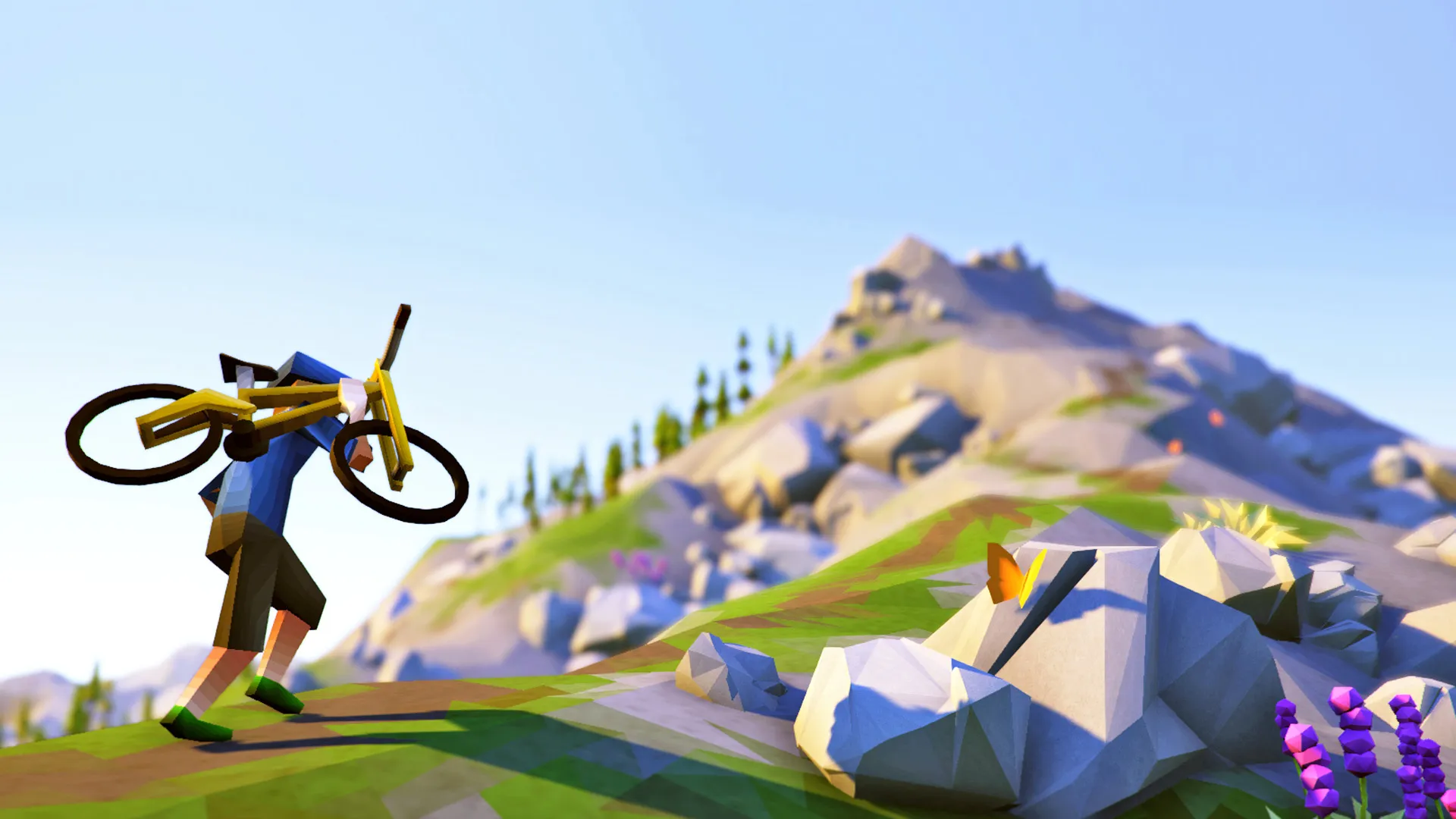
Finding a publishing partner for Lonely Mountains: Downhill.
In over four years of development of Lonely Mountains: Downhill we never actively pitched our game to a publisher. We luckily never had to participate in Meet-to-Match speed-dating or to fill out forms on a publisher’s website. Still, we had the great opportunity to talk and present the game to a large variety of publishers over the years. We talked to bigger and smaller ones, newly found publishers as well as industry veterans, and we even had an offer to become a second party studio.
In this article, we want to tell our story of finding a publishing partner without looking for one. We also want to talk about why we didn’t end up self-publishing our game, the mistakes we made, and the reasons we are happy to have partnered up with Swedish publisher Thunderful. But first a disclaimer: Most of this story happened between 2017 and 2018. A lot of the channels and opportunities that helped us do not exist in this form anymore. They have either lost a lot of their effectiveness or are way harder to reach, as they are now used by too many developers and publishers.
And although we are a very small team and started with little financial backing, we come from a privileged background. Before starting to work on Lonely Mountains: Downhill we already had multiple years of industry experience and enough financial savings to work full-time on our prototype for several months. Also living costs in Berlin are pretty cheap compared to a lot of other places in the world.
We also knew that if everything would fail and the game would be a total disaster, we could always come back to our freelance jobs.
So please take any advice in this article with a grain of salt as your game might have different needs and our situation at the time might not apply to your or your team’s current situation.
But now let the story begin
It was the spring of 2017 and we were absolutely sure that we didn’t need a publisher. Life was good. We had just finished our PC prototype for Lonely Mountains: Downhill and got amazing feedback for it at the Quo Vadis – a game developer conference in Berlin. We had just gone through the Steam Greenlight program where ~8.000 people voted in favour of the game. Our first public trailer made it on PC Gamer, Kotaku, and Rock Paper Shotgun without us ever writing a single press release. On top of it all, we were invited to show the game as a “Made with Unity” showcase at Unite Amsterdam.
This whole indie marketing thing seemed surprisingly easy! All it needed was a few good gifs in some Facebook groups, participating in #ScreenshotSaturdays on Twitter, submitting your game to events and suddenly everyone seemed to talk about it.
Looking back, we already made a lot of mistakes during these first important months. We never had a proper plan to announce Lonely Mountains: Downhill to the world. It kind of happened and we just went with the flow. When the very first gif of our game went viral (at least a little bit) the game didn’t have a name, no website, Facebook, or Twitter page. There was no way whatsoever for people to follow the development.
We made the same mistake with the Greenlight campaign. Our Discord-Server and newsletter didn’t exist yet and although 9,000 people voted for the game, we were never able to reach out to them again, as Greenlight closed a week later.
Publishing a game starts with the moment you publicly talk about it. But at the time we didn’t know that. The world of indie games had welcomed us, and our little biking game with open arms and the future was looking bright. We were in the process of getting state funding from the Medienboard Berlin-Brandenburg, and in our all-time high we had come up with an even more ambitious plan: we wanted to finance the development through Kickstarter. We also wanted to self-publish it as we thought that Greenlight had just proven that we could easily market the game ourselves.
It was shortly after the Greenlight campaign that the first publisher reached out to us – through a Twitter DM.
This would be a reoccurring theme for the next two years. Although we are pretty sceptical when it comes to the B2C effects of social media marketing, Twitter seems to be the place where every publisher hangs out to scout new projects, so we can recommend keeping those DMs open.
Our first talks with publishers weren’t going well and we want to deeply apologize to everyone who had to deal with us at that time. The main problem was that with state-funding and the upcoming Kickstarter we already had a plan to self-publish the game. But at the same time, we were curious to hear what a potential publisher might offer and to keep the door open in case the Kickstarter would fail. Unfortunately, this resulted in a lot of talks that could have been more productive as we were not able to give any definitive statement about a potential partnership. Speaking to every publisher also took a lot of time and mental energy.
In hindsight, the months before Kickstarter would have been the best time to close a deal with a publishing partner. Public interest in the game was high and we were financial-wise in a good position. The positive press and social media posts gave the game “social proof” and demonstrated that surprisingly there was a market for it. We had created a unique IP, strong visual identity, and had a great demo. We were in the rare position that when we talked to a publisher it was less about us needing money but more about the publisher who wanted in on the game.
Would we have known at the time that we would need another two and a half years to finish the game, we would have taken these discussions much more seriously.
But we were still going headstrong for self-publishing and it needed another six months of development until it slowly grew on us that we might have made a mistake. Unfortunately, our situation was now way worse than it was before. While the Kickstarter was successful, it “only” made €45,000, way less than a lot of people (publishers included) had predicted. Development was lacking behind, our targeted release date was completely unrealistic and our company bank account had seen better times.
Also, the hype about the game had cooled down dramatically. We had told people so much about it during the Kickstarter that there wasn’t anything newsworthy to show or talk about anymore – a problem that should accompany us till the release of the game. It didn’t look much better on the console development front – while we had managed to get approved as developers for all consoles, the dev-kits were just catching dust in our office as we were still working on the core game.
Although a few of our publishing contacts had endured, some of the initial interesting parties had closed the door on us in the meantime. While the reasons we heard varied, from keyboard controls that were not good enough to the game not being far enough in development, we felt that the common divisor was that people just sensed that we were not ready for a serious publishing partnership. It was time to change that.
Fortunately, talking to all the publishers over the year had helped us to understand what we were looking for in a partnership. While we never wrote it down at the time it boiled down to this:
We wanted the publisher
- to be willing to invest real money into the development (1 additional year) and marketing of the game. A lot of publishers who had approached us in the past wanted to have a 30% rev-share just for distributing the game and sending a PR through their mail list. This was not the partnership we were looking for.
- to take care of the console ports themselves or willing to give us an additional investment to build up an in-house porting team.
- to take care of the console submission and approval process as well as functional and console compliance testing.
- to market the game and have a different and more international press network than the one we had built up ourselves.
- to have good contacts with platform holders.
- to take care of localization.
- to understand how to market to content creators
We also wanted
- a general rev-share in our favor as we had already spent a lot of time and money to get the game to this point.
- a rev-share from day one after release. We wouldn’t do full recoupment deals, whether for the development costs nor marketing investment as we were scared that we would run out of money before the costs were recouped. Luckily this was also a requirement from the Medienboard Berlin-Brandenburg so we had some good arguments for it.
- an additional development budget after the release for bug-fixing and maintaining the game.
- to keep the IP – this was non-negotiable.
- to keep the creative control over the project, also non-negotiable.
- to keep documentation and project planning to a minimum. We were two people sitting side by side and we worried that involving another party into the development would slow down communication. Although looking back, little more documentation wouldn’t have hurt.
We also had a closer look at each publisher’s portfolio. We not only checked if the portfolio would fit our game but we took a look at the successful titles and especially the unsuccessful ones.
There are quite a few cases where a publisher only has one successful lighthouse game in their portfolio surrounded by a lot of titles that went by completely unnoticed. This always leaves the question if the game was just so good that it would have succeeded even without the publisher’s help. A publisher who can make the most out of a mediocre game can be a way better choice than one who has this one title that sold millions but is surrounded by a grave of dead indie games no one has ever seen or heard from.
Of all the publishers that remained and were still interested in talking to us, in the end only two fit the bill.
But as we now knew that we wanted to have a publishing partner and what it was that we were looking for, all discussions turned way more productive – even when it didn’t match.
The reason we finally decided to swipe right on Thunderful was not only that they ticked most of the boxes. We felt that we had found a business partner we could trust and who believed in the vision we had for the game. We already met Ed Valiente, who was Thunderful’s head of publishing at the time of the deal, years earlier at Indigo. It was one of the first events we ever presented Lonely Mountains: Downhill.
He was already an early fan of the game even when he didn’t work at a publisher. So when we finally met again, we already knew that his love for the game was genuine and not just a random business opportunity. So, in the end, all the time we had spent showing the game and talking to publishers even when we were still hellbent on self-publishing the game, turned out very valuable. It created the network and gave us the experience to find the right publisher when we finally came around and realized that self-publishing a multi-platform game with a team of two was a little bit too much for us.
To sum up our learnings
- Marketing the game starts the first time you talk about it. Have a Steam page, Discord, website, newsletter, and social media pages ready.
- If possible, spread the initial word about the game yourself. Concentrate early on really good looking gifs and get “social proof” for your game and IP. Ideally, you reach a point where publishers desperately want to talk to you instead of the other way around. But even if you want to reach out to publishers, it becomes way easier when you can show them that your last tweet got a few hundred or even more retweets.
- A lot of tools to make your game publicly known only have a limited lifespan. Facebook groups once worked well – now you can just completely ignore them. The same for self-promoting Reddit or Imgur posts. Greenlight now only exists in history books. But new things come up all the time, so be quick, keep an eye open, and experiment with different things.
- Be present on the show floor when you show the game at events. A lot of publishers reached out to us after seeing or playing the game at some event or talked to us in person. Showcasing the game at multiple events in a row often leads to a point where they simply can’t ignore you anymore.
- Build up your own community and marketing channels. Also, try to establish your own press and platform contacts. Otherwise, you’re back to zero after the game is released and you start working on your next title.
- If you simply can’t find a way to market your game there is a high chance that a publisher will have the same problem – as they use the same tools. A good publisher might improve your marketing material and multiply the reach but if your best gif doesn’t work at all then it won’t suddenly be successful if your publisher posts it (Except if the publisher is Devolver as it seems that they can just sell anything).
- Decide if you want to work with a publisher or not. In case you’re not interested let them know early. You can still schedule a meeting just to get to know each other but it’s better if both sides are on the same page.
- Start building your network to publishers and also other developers before you need it. People are way more open and relaxed if they feel like you’re not only talking to them for business reasons.
- See if there is the possibility to get state-funding (or any other kind of funding for that matter) before talking to a publisher. It’s way easier to talk about money if you know that you can still pay the rent next month if the deal falls through.
- Try to aggregate good looking numbers before talking to a publisher. Wishlist numbers, Discord members, social media followers. If you can demonstrate that you already reached potential customers by yourself, they will worry less about their own marketing capabilities.
- Talking with publishers takes a lot of time and is mentally exhausting. But it also helps to get through the process often. Each discussion clarifies your vision and lets you know better what you want to get out of a partnership. But carefully balance both things.
- Do your due diligence on a publisher. Ask yourself (or the publisher) why one title from their portfolio was successful while another one failed.
- If you start talks have a production plan prepared and know what budget you’re aiming at.
- Don’t plan the budget with the same bootstrapped salary you used to survive on your savings. Your publisher probably won’t bootstrap.
- Make sure that you have enough financial lean way after the release. It takes a long time until the money from Steam and especially consoles is paid out and even longer till you get it from the publisher.
- Make sure that any contract with the publisher covers the costs for bug-fixing and potential updates after the release.
Daniel Helbig – Co-Founder & Co-CEO
Daniel Helbig is Co-Founder/Co-CEO of Megagon Industries. Before spending most of his time on the Lonely Mountains, he worked as a Freelancer Game Designer and Creative Director/Co-Founder of Die Hobrechts.