

Solo developer Tomas Sala relives the journey of The Falconeer.
Skyrim came out back in 2011. I was working with Little Chicken; a game development company and we were doing an Action-RPG for a local theme park. We made this RPG for children, for young kids that tied into a story attraction at the theme park that dealt with all sorts of fancy stuff, and we’d created this entire system for kids with the theme on how to generate quests and the world.
So I created the world and all the tools were delivered to me for creating the story for the game. And I got a little bit curious about how those tools would work in a AAA game.
So then Skyrim came out that year. After two months, or so, they had released the creation kit, and in my spare time, I started fiddling around with the creation kit out of curiosity initially. But later on, when it was a little bit successful, just based off of the sheer enjoyment of making something that could be immediately enjoyed by an audience, it turned into the ‘Moonpath to Elsweyr’ mod series for Skyrim.
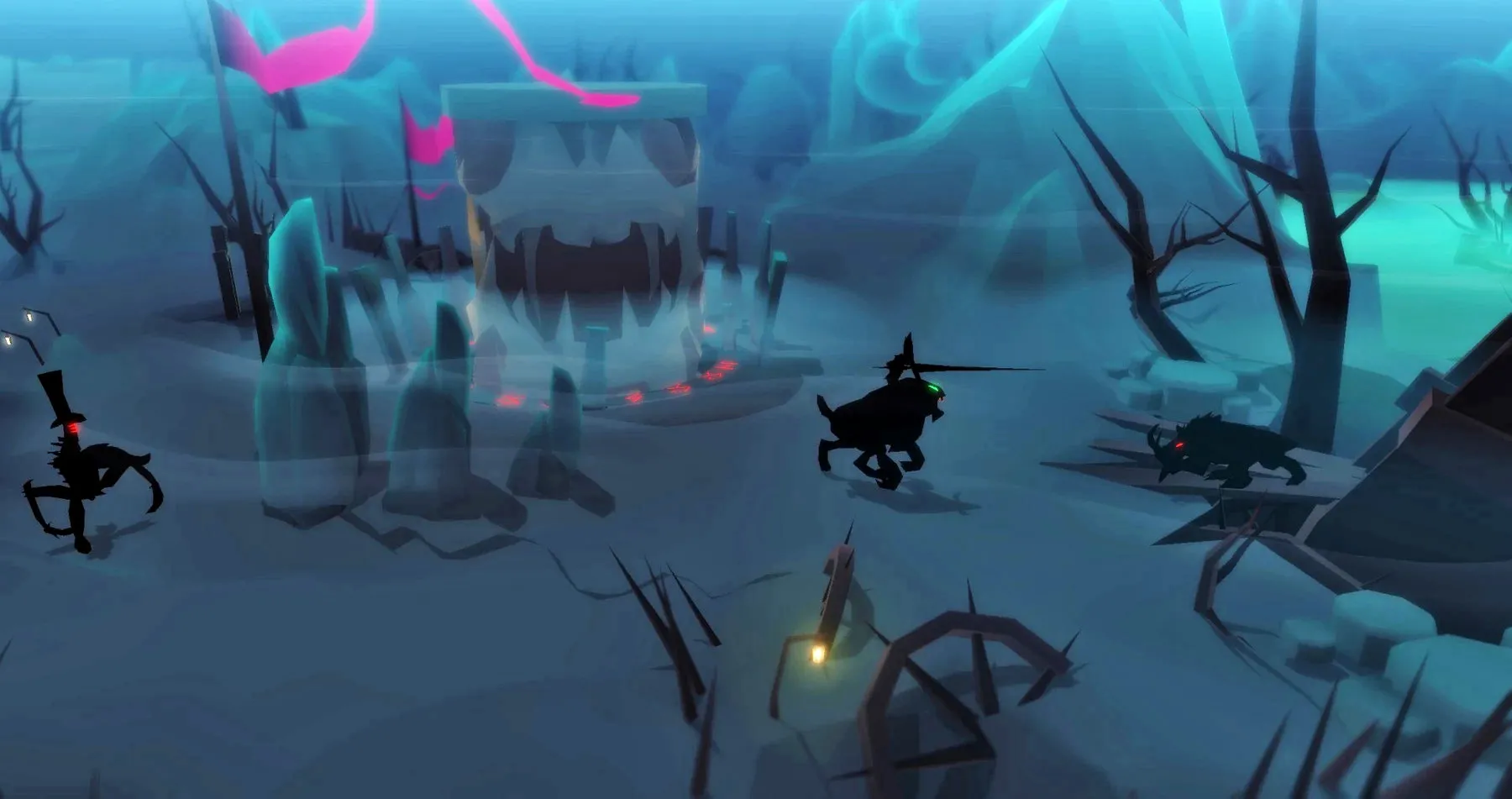
Originally a strategy game, the GUI in Oberon’s Court was vastly different to The Falconeer.
And because I was by trade a 3D artist, I was fooling around with the creation kit and figured out how to turn the snow into sand or moss, and that basically turned any Skyrim environment into a jungle or desert. Then I started to add trees and that went relatively stratospheric. I think there’s a couple of million installs of those mods over on the Steam workshop and on the Skyrim Nexus. And when I was done with those models, which were very haphazard and poorly designed, but looked cool, I started to make my own. I wanted to make an indie game by myself in my spare time.
I have always been like an artist who could program, so I’m not sure how common that is, but it’s something I’ve always done.
I wanted to do something different visually because, you know, Skyrim was a highly detailed texture scope thing, and it was very visually noisy. So I had always been fascinated with doing art without textures, just the geometry of things; make models and then having given the simplest amount of colour and shading required to make them look nice.
And that’s something I did for a game called Oberon’s Court which was a strategy game that I never finished. But I started to work without using any textures.
It’s all about monochromatic, very simple colour combinations, very saturated with very smooth gradients. But at some point, while making it, I had a burnout because I wasn’t enjoying working in teams anymore. It all felt very constrained and I am not a very organised person. I wanted to be free to make what I wanted to make, and it was all a lot of responsibility. In the end, it collapsed on me.
Once I got through that, I was looking at continuing but I couldn’t anymore because it was very dark and it was sort of tied in with this negative period of the burnout. So I left it. When I was starting to feel better, it sort of transformed into The Falconeer, which is a much more positive game because it’s about flying, swooping; much more fun.
Elements of Oberon’s Court can be seen in the Falconeer, including but not limited to character and world design.
Oberon’s Court becomes The Falconeer
Solo developer Tomas Sala relives the journey of The Falconeer.
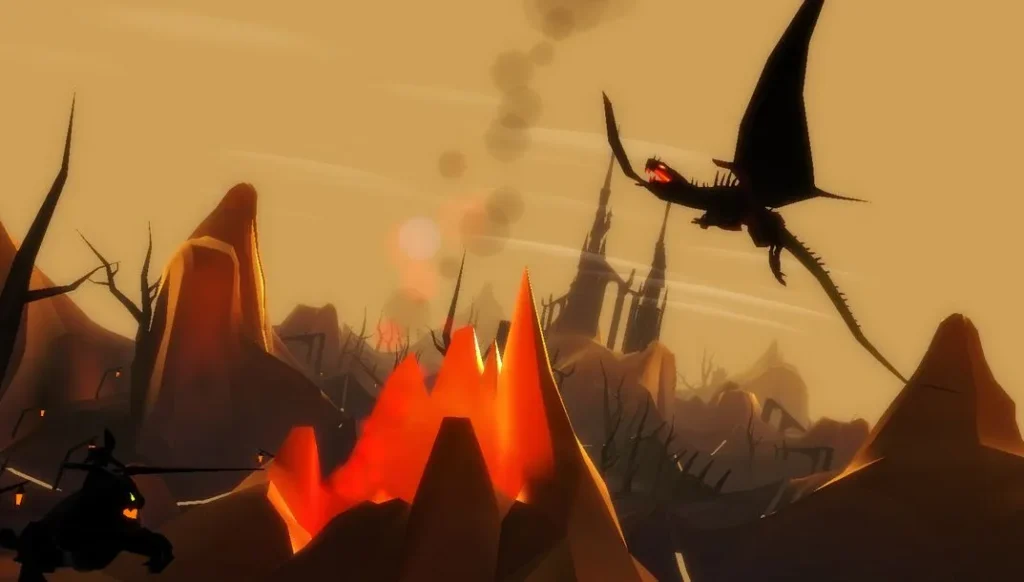
Before it became The Falconeer, the story of Oberon’s Court was really dark. It was about the afterlife and it was a more traumatic, self-expression of my person.
It was a very private hell, and it’s not that it can’t be visually very stunning or it can’t be very cathartic, or helpful for yourself to express your negative emotions. But it’s not interesting to anybody else because it’s just dark. And when something’s just dark, it leaves very little room for a player to hold on to get something that relates to them.
With The Falconeer, because I was becoming a dad and I was feeling a lot better and I decided to do that, doing stuff by myself is what I was enjoying. It was, on the whole, much more positive for someone on a bird flying up in the sky. It’s a very positive vibe.
I could see a layer in all the negative and darker aspects; it just became more interesting. So that’s a personal lesson for me; if you want relatable stories and if it’s just your negative side, it’s not relatable. But if it’s a story about trying to escape from something dark, it’s much more relatable because everybody has these moments in their life.
Imagery within Oberon’s Court was dark in many scenes, and is evident through world detail, and even in building constructions through sharp edges.
There were some real challenges for The Falconeer, though. I think the two main challenges for me are making a game that’s fun for someone else to play. And people would think that is the main, most important super challenge. But there is another one; making something that’s enjoyable to work on so you can complete the game. If it’s not enjoyable to work on it, you can’t finish it because it becomes a slog, and you get bored. You get stuck, you get demotivated. The other one is that you need to make something that someone else enjoys, be commercially successful, so you can live on what you’re making.
Oberon’s Court was a big, fat failure for me because I’m not sure it ever was fun for someone to play. It had a nice story and looked nice but it was also not fun to make because it was a strategy game. You can’t make a strategy game and then not have combat in it. Then once you have combat, you need a mission and the base building. OK, once you have the base building and the combat, then you need the balancing to make sure it’s fun. And then you need to have story goals to make it, epic.
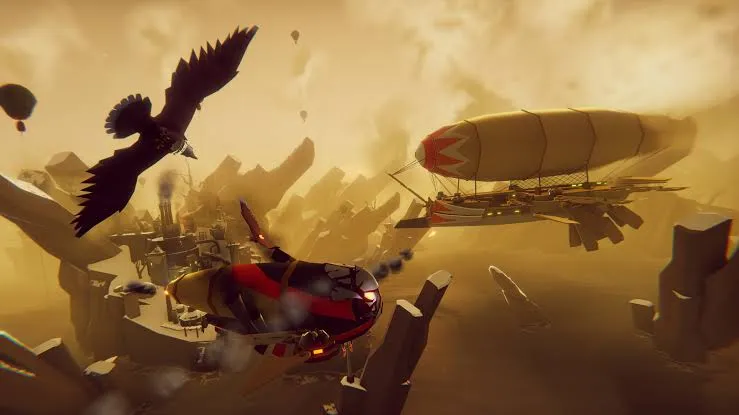
The Airships in The Falconeer go back a long way, almost nine years to Moonpath to Elsweyr.
If any of those things fail, you won’t be able to test the game because you know what? What we are used to in games – and films – is ‘we’ll make a grey box demo. We’ll make something that’s just grey boxes. And if it feels right, it’s a good game. But that’s utter bullshit. You can’t make a grey box demo for every genre or every type of game because it won’t be complete.
You know, if you were to make it grey box demo out of an adventure game, you won’t have the story. You won’t have the emotional attachment. You might not have, you know, the art that drives you through an environment. All those aspects will make your game.
So for me, I don’t believe in that. There’s this grey box walking around and the gameplay is fantastic, that it’s already fun? I have not seen many demos like that. And then a strategy game is tenfold that, because you need all these layers to be there for you to feel challenged. You need to have resources. The resources need to be transformed into interesting structures, strategical objects or defences or whatever. So that made Oberon’s Court a fucking nightmare to make because it’s it was never fun for me because you needed everything complete before you could test and then you need to balance.
How do you motivate yourself after several years of working on something and it’s still not fun? I think that is a big lesson.
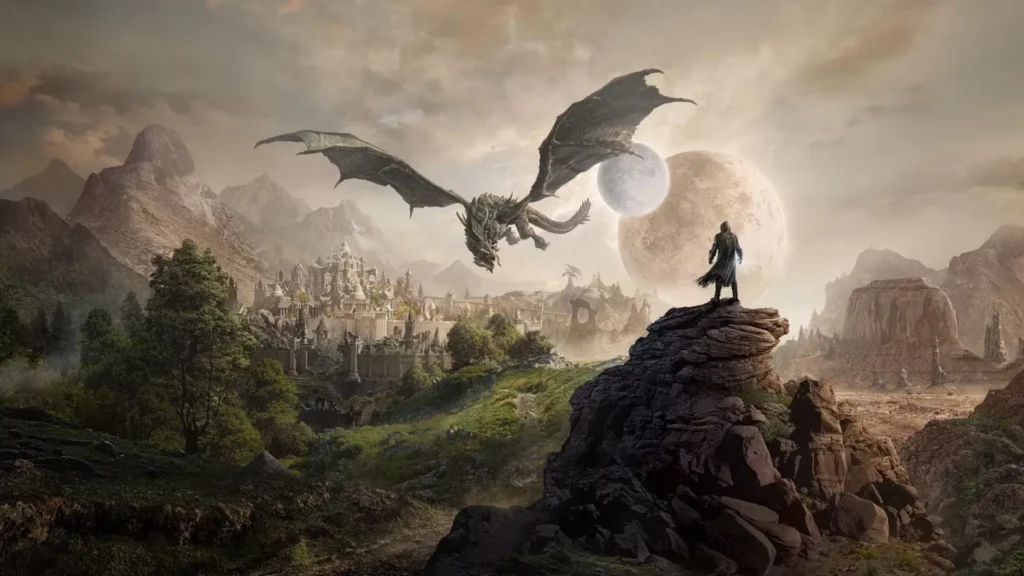
Elsweyr is vastly different in its design, following a standard art formula. Tomas longed to go for something cleaner.
Let’s talk about the art design
I started stripping down the art from the game. The things I did like was the visual design looked beautiful. Here was this interesting creature – so I took the dragon that was in the game. So initially I made a demo was just a world, and I thought, ‘I’ll do an ocean.’ Technically, that’s interesting and I’ll do some of the rocks.
That was nice because it was me just doing it for fun with the old art assets I had. And you’re starting to see how the lighting and fighting would work. Then I took the dragon models. ‘Well, let me fly through this little world of mine’, I thought. This is nice. This flying around is my favourite activity. It’s always been my favourite activity in games. Then came the realisation that this is the type of game I played when I was growing up, which I enjoyed the most. I enjoy making it.
So when you’re building the game and playing the game, you can always feel if you’re not flying right. The sensation of flying and it never gets tired. I love making landscapes. That’s one of my favourite things in the world; making landscapes. So here’s a mechanic about enjoying landscapes. It just came together. And then on a whim, I made a bird with a dude on it with a gun. This was so much cooler than dragons and after a little look on the Internet, I realised nothing like it exists. OK, so here’s an idea. Here’s a genre nobody’s working in. It’s a dead genre, but it’s a mechanic that I deeply enjoy. And that solved those two issues because I knew it would be fun for the players and was fun for me.
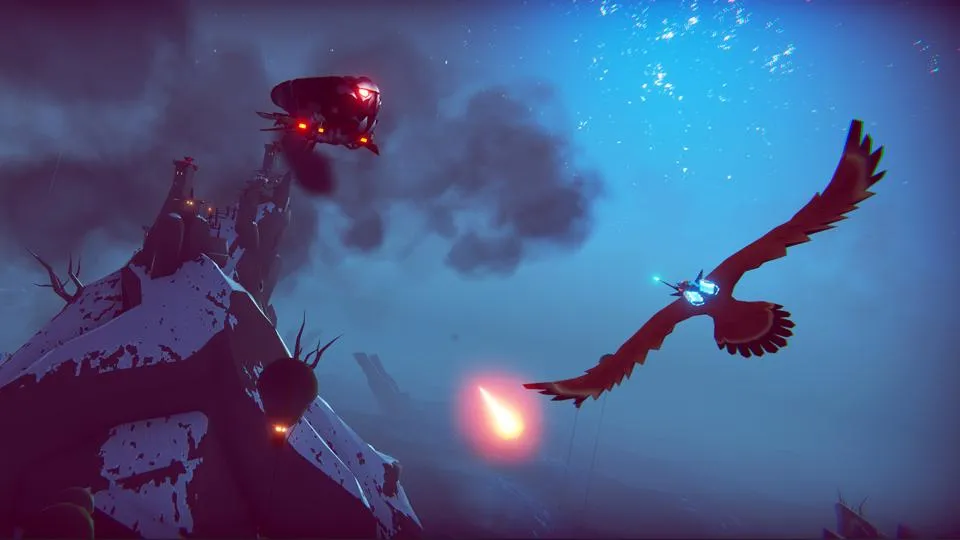
While markedly different, some of those original sharp edges and dark features from Oberon’s Court still make an appearance.
I sent the game to The Game Connection Awards, it’s a side event for GDC, and it got nominated. That gave me a reason to go to San Francisco with a free ticket for Game Connection and possibly win an award. I didn’t assume any of that would work.
The very first meeting I took, and it’s someone from Microsoft. The meeting was 15 minutes before the award ceremony, so I didn’t know if and when I sat down with them how it would go. But it was lovely and there was a great connection. Fifteen minutes later, I won two awards. That helped a lot!
The support from Microsoft has been incredible. They’ve given me access to the hardware. They’ve taken me to events, and they’ve been there while the game grows. It’s fantastic. And it is the best support I’ve ever had in 20 years in the game industry.
The Falconeer’s journey has been long, but it’s only just beginning. I’m excited about where we can take the game, and like any good artist, I don’t think I’ll ever be happy with it. It is released, but there’s always time for more tweaks.
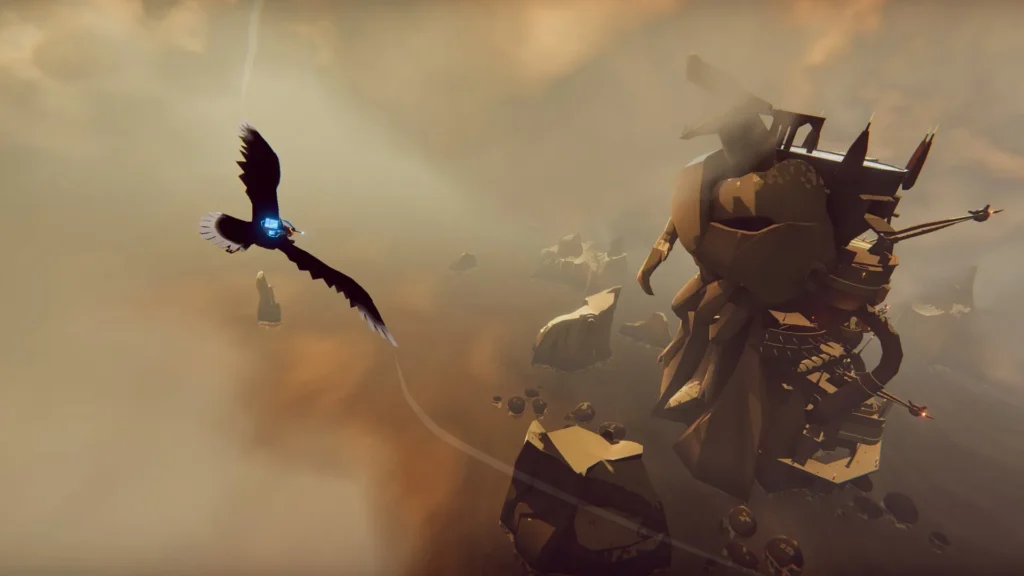
Flying is Tomas’ favourite in-game activity, so building this beautiful world without textures is something he considers a real achievement.