

You don’t need a lot of employees to develop a game that is a lot of fun.
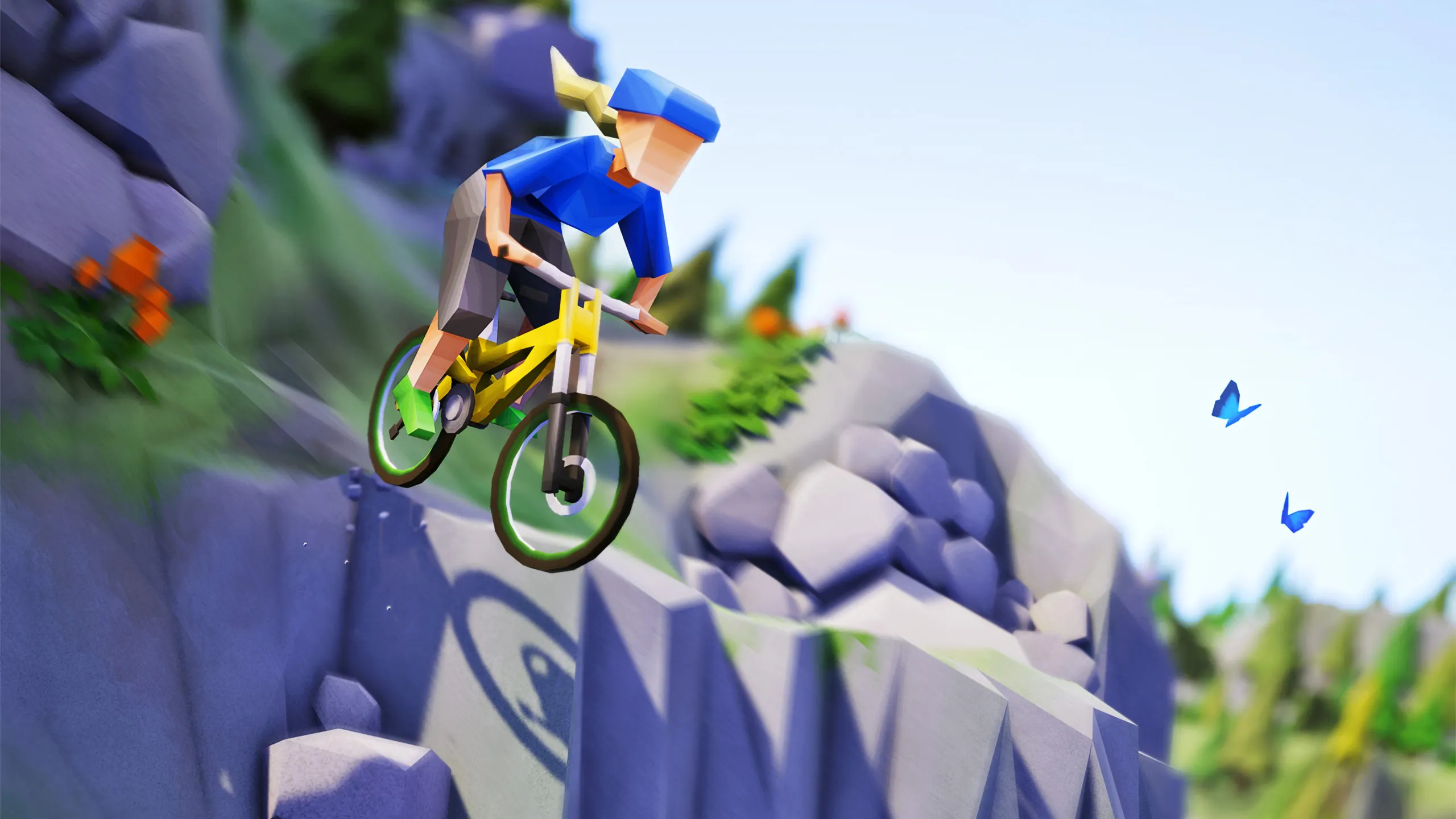
In December 2019 the ceremony of the German Developer Award (“Deutscher Entwicklerpreis”) took place in Cologne. There were many very good games nominated, but one game stood out as it received frenetic applause from the audience at every mention in the hall. In the end, this game was awarded as “Best Indie Game”. The name of the game – you guessed it – was Lonely Mountains: Downhill.
One year ago Berlin-based developer Megagon Industries released the downhill mountain biking game on Steam. By now it’s also available for PS4, Xbox One, Windows, Linux, Mac OS and Nintendo Switch, which is the strongest platform regarding sales.
With loving looks, excellent sound design, extremely tricky gaps and great controls, Lonely Mountains: Downhill could not only warm the hearts of many bike fans, but also of lovers of outstanding indie games.
Megagon Industries was founded by Game Designer Daniel Helbig and Programmer/Technical Artist Jan Bubenik in 2013. Their first two releases were the puzzle game “Twisted Lines” and the arcade game “… and then it rained”, both with a minimalist aesthetic, which Megagon has also retained for Lonely Mountains: Downhill. For this game Megagon just released the first DLC “Eldfjall Island”. The volcanic island of Eldfjall is the largest “Lonely Mountain” to date and offers four new routes, new effects (thunderstorm, erupting volcano), Viking-style outfits, a professional helmet and unlockable backpacks.
Lonely Mountains: Downhill was awarded for “Best Indie Game” at the Deutscher Entwicklerpreis 2019 (German Developer Award).
Later this year another (free) update is planned. It will introduce “Daily Rides” where players will compete across platforms for the top spot on the daily ranking. Each day a route with new obstacles and shortcuts will be randomly selected. The daily challenges take place over a three to eight week season, during which new rewards can be unlocked – depending on, among other things, your ranking at the end of a season.
We had the chance talking to Daniel Helbig, Co-Founder of Megagon Industries and Game Designer for Lonely Mountains: Downhill. More articles about this game are coming in the next few days!
Please tell us briefly about your career in the gaming industry.
Jan Bubenik and I have both been working in the industry for quite some time. After my graduation from the Games Academy, I worked as a game designer for Keen Games and remote control productions before co-founding Die Hobrechts in 2010. That’s where I met Jan who originally comes more from a CG/animation background and worked as a freelance developer on a wide range of different projects at that time.
Together we worked on a children’s game called “Karl’s Castle” (“Wimmelburg” in German). Since then we have collaborated on many more games and in 2013 decided to found Megagon Industries. Noah joined the team in 2018 after graduating from the S4G School 4 Games.
Did you expect Lonely Mountains: Downhill to be such a big success? How did you celebrate?
It’s really hard to say what our expectations were. When you show the game at a conference and the booth is packed all day you feel like the game will do really well. When you release an awesome gif of the game on social media and no one likes it, you suddenly fear that not a single person is going to buy it and the whole project will fail horribly. It’s a rocky road. I think, in the end, we still hoped that the game would do well, but we also mentally prepared for the worst case. When the game was finally released, we spent all day refreshing the store pages and watching Twitch streams. It took us a few days before we were calm enough to celebrate the release with some of our local indie dev friends.
Lonely Mountains Downhill is very different from your previous titles. How did you get the idea to make a mountain biking game? What inspired you?
The main inspiration was a mobile skiing game called “Skiing Yeti Mountain” from Featherweight Games, which influenced the very early prototype. Although it has super simple controls it really feels great and we wanted to have that kind of feeling for our game. Because when you sit on your real bike you don’t think about which button to press, you just ride. That’s the experience we wanted to have.
From an art perspective, Lara Croft Go and Monument Valley had a huge influence on the look of the game.
From your point of view, what is the greatest strength of the game?
We feel like the greatest strength of the game is that it was already fun to play right from the start – and luckily this never changed over the development. We have already put in several thousand hours of testing the game and it still happens that we start to actually play the game although we just wanted to quickly test something. Because the fun of the game is so easily understandable, it also makes it easy to communicate. You luckily don’t need an elaborate elevator pitch when people can grasp the concept by just looking at a single screenshot.
What would you do differently in hindsight?
Oh, that’s a difficult question. We made a lot of mistakes but they were also an important learning experience, so I wouldn’t want to miss them. But I do feel that we made some design decisions that might not have the best cost/benefit ratio. Maybe doing smaller mountains would have been smart because we really spent a huge part of the production just optimizing the game. I believe business-wise one of the things we would do differently next time would be to be more confident when it comes to things like project timelines and budget negotiations.
You are a very small core team. What advantages does that give you and do you want to keep it?
Being a small team definitely gives you the ability to iterate faster and it makes it less difficult to try out new ideas. You may take things into your own hands and do them quickly because there are not that many people to consult on. You can also keep documentation to a minimum and project management is easier because normally everyone knows what everyone else is working on anyway.
We definitely need and want to grow as a team (we’re hiring Unity programmers and level designers at the moment) but it would be nice if we could keep the speed and flexibility while at the same time improving our production workflows.
You have received funding from the Medienboard Berlin-Brandenburg. How difficult was it to get the funding? Can you give our readers a few tips?
Actually, it wasn’t that difficult. Not only because we already had some experience from previous application rounds but mainly because the team from the Medienboard Berlin-Brandenburg is really helpful and they guide you through most of the process. I believe it took something like 2-3 months from the initial contact till we got approved for the funding. What really helped was that we already got a good prototype and a clear vision.
So my main tip would be to reach out to your local funding institution really early so that they can help you to circuit some of the obstacles before you ride into them.
How long will you be busy with updates and extensions for Lonely Mountains: Downhill?
That’s hard to say, I guess as long as people are still interested in the game and as long as it makes sense economically. We still have a lot of nice-to-have things on our to-do list. We also have to see how well the Eldfjall Island DLC will perform and whether it will make sense to think about another DLC.
What comes after that?
We can’t say anything official yet but we started to work on something new and after more than five years of Lonely Mountains: Downhill it feels really nice!
Daniel Helbig – Co-Founder & Co-CEO
Daniel Helbig is Co-Founder/Co-CEO of Megagon Industries. Before spending most of his time on the Lonely Mountains, he worked as a Freelancer Game Designer and Creative Director/Co-Founder of Die Hobrechts.