

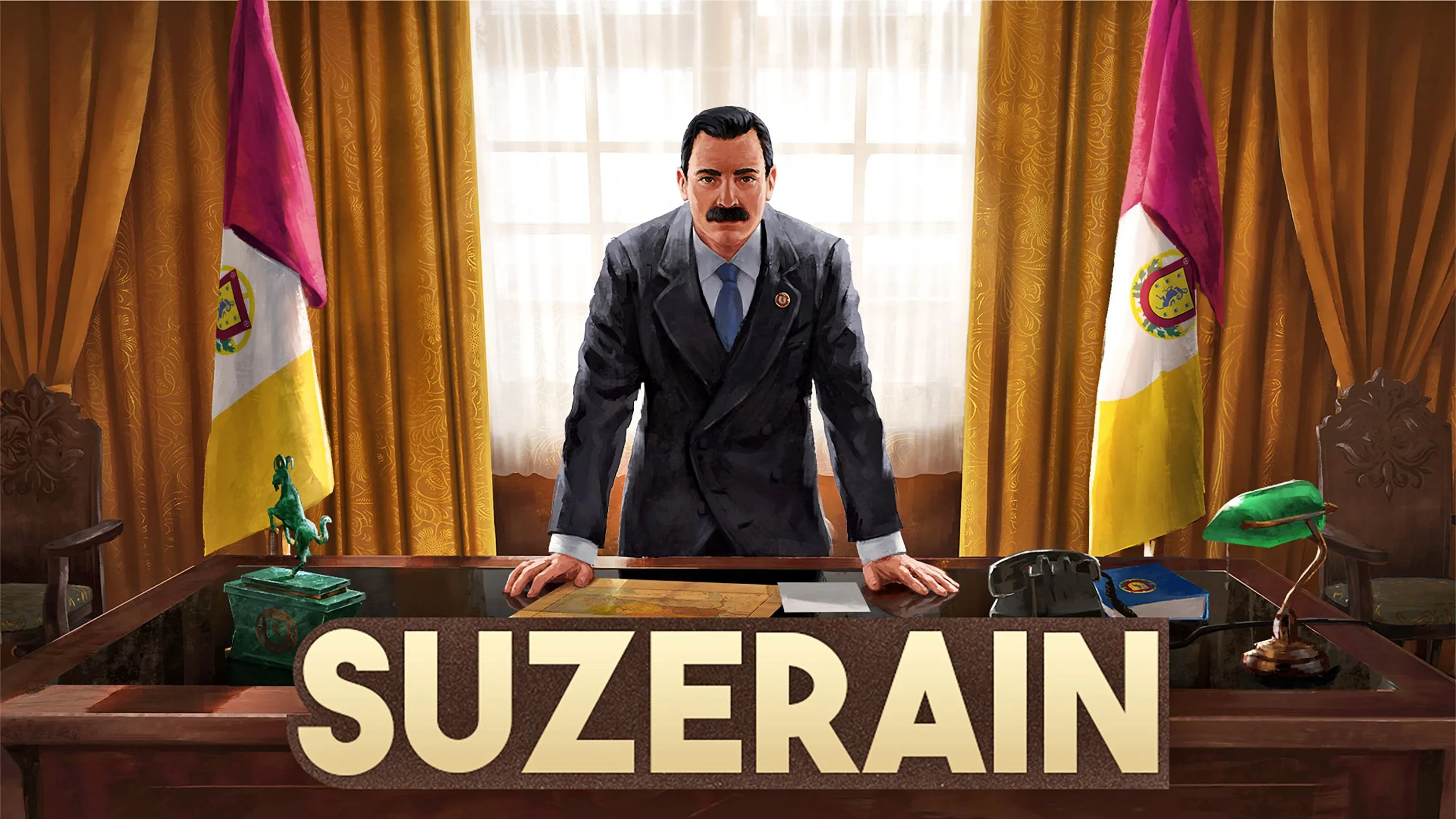
In the extraordinary RPG Suzerain you have to lead your country through a political crisis.
Hey, there fellow game developers and enthusiasts. I am Ata Sergey Nowak, the Managing Director of Torpor Games. I am a dual national who studied simultaneous translation, worked as an event and organization manager and a freelance game developer before starting our indie game studio. Before Suzerain, I worked on four game projects as a freelancer and gathered experience from these versatile games. We developed and released Suzerain; a narrative roleplaying game about politics that launched on Steam in December 2020 and received a very good reception. It takes place in a fictional universe set in the ‘50s where the player hops in the shoes of Anton Rayne, a new leader who is expected to bring reform to the country and fix the economy in recession. There are many learnings that the development of Suzerain has taught us so we would like to share our journey and learnings to help the industry as a whole.
Idea (The Rough Diamond)
Let’s start with the idea and conceptualization of a game and how our story began. The idea of a broad concept came to me on a fateful night in December 2016 when I had a movie-like Eureka moment. I didn’t believe in these until I experienced them myself. As a big fan of history, politics, and human nature, I wondered why there were no games that solely focused on the personal aspect of politics, which had the direction of something more of a dialogue-based experience in nature. It was the best method of delivering the perspective of a political leader. The array of strategy-esque games which were in the market were rather numbers-based and focused on values more than the people. Then it just “clicked”.
At the time, I was living in Turkey and the drastic societal and governmental change of the 2010s occupied my mind a lot. There was a significant back and forth in society that drove my circle to question many things. Then I thought to myself, why do we humans have such societal struggles throughout history and what are the basic instincts that guide us to influence others or shape society. What is going through the mind of the leaders like Allende, Castro, Kruschev, Kennedy, and even the modern ones we see today. What is the perspective they possess at the end of the day? Do their decisions make sense to them due to their background and circumstances? Aren’t we all creatures of our circumstances? It was a search for empathy and a more meta aspect that really interested me.
Late at night, my big question came. What about a game that focused on the human aspect of leadership and was played through dialogue rather than having a focus on values and stats? So I had to hit up my close friend Ilke who was studying game design at Cologne Game Lab at the time. The idea clicked with him and we started to formulate it more from there. The project’s codename was “Prince”, heavily inspired by Niccolo Machiavelli’s The Prince book. At the time, I was also reading many political books and was well-versed with political sciences. This was partly due to my translation background which had taught me to learn many foreign relations, trade, and historical details of nations but also out of massive personal curiosity.
The Execution (Not the bad kind)
Now everybody has ideas, right? It’s nothing special to have a brilliant thought, but it has to be executed at the highest efficiency from creative to technical aspects. Therefore my personal belief was that it wouldn’t be smart to enter this journey alone. I saw that I had weaknesses in traditional game design knowledge. This made me reach out to Ilke, for example, who was studying this field. Together we talked about our limitations and strengths. What we wanted to do and what we could do. This was the earliest focus. I always say General Sun Tzu’s philosophy applies all across the board. Know thyself, know thy enemy, a thousand battles and a thousand victories. Yes, it’s not meant to be in the literal sense but still applies. All in all, game dev doesn’t have too many victories, to be honest, but with this attitude, even if things don’t work out, you end up learning a lot.
Initially, our 3D limitations made us research examples of simple and beautiful visuals that we could still execute while also researching how to design the narrative and dialogue systems. Our earliest inspirations on the visual were Tyranny, and a strong story/narrative inspiration was 80 Days and Orwell. These games gave us a guiding light to be able to do our own unique thing.
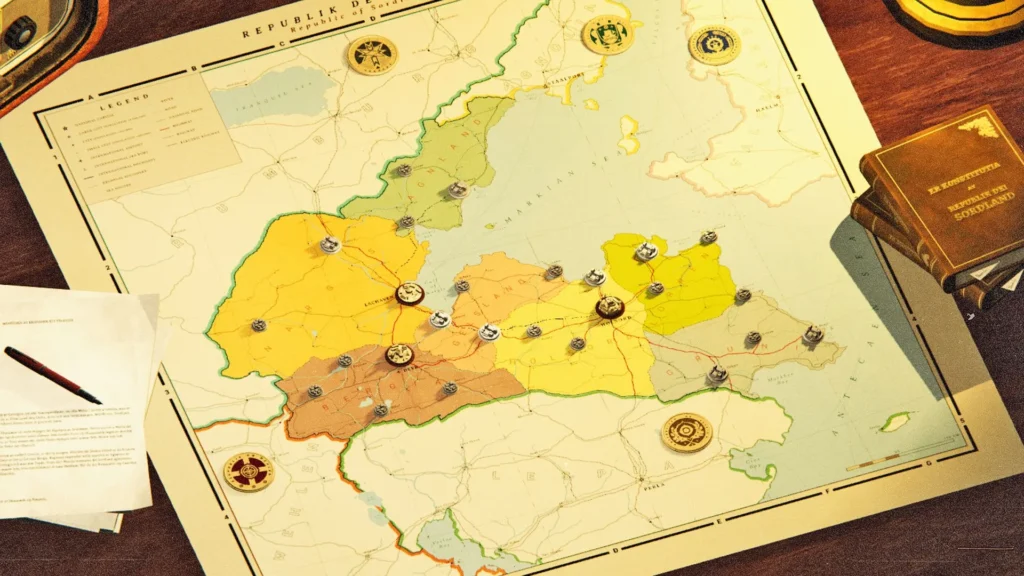
This is where we invited Ozgun, a close friend of mine, to join the project as a programmer. Slowly a core team started to take shape which could prototype rough ideas. We wanted to have the human aspect delivered and started doing early narrative design, dialogue examples, and other story elements like the Prologue. The idea started to take shape with a world map concept being created, placeholder tokens being placed as cities and the initial dialogues being implemented in the Pre-Alpha state.
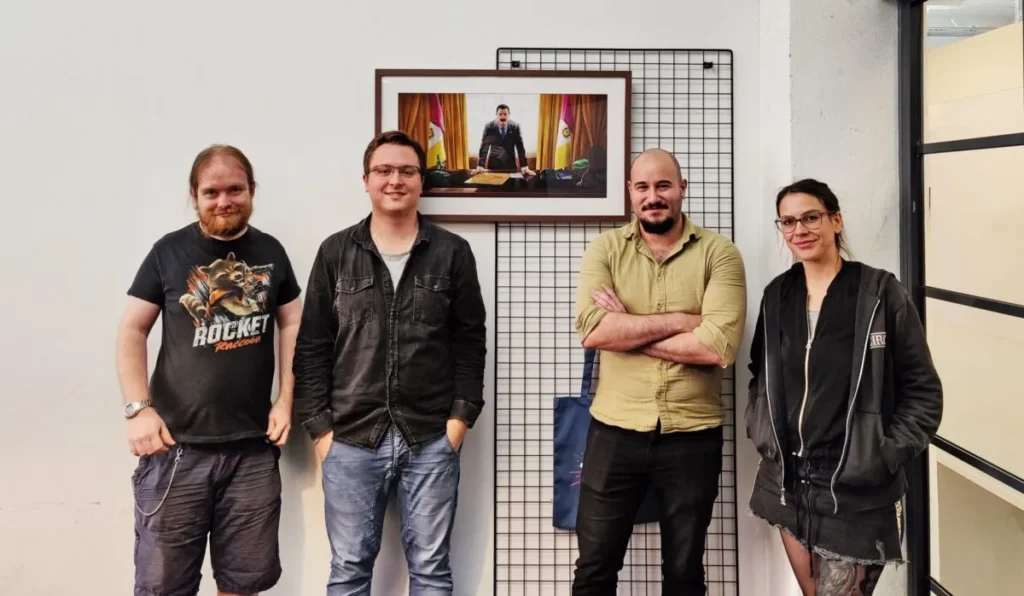
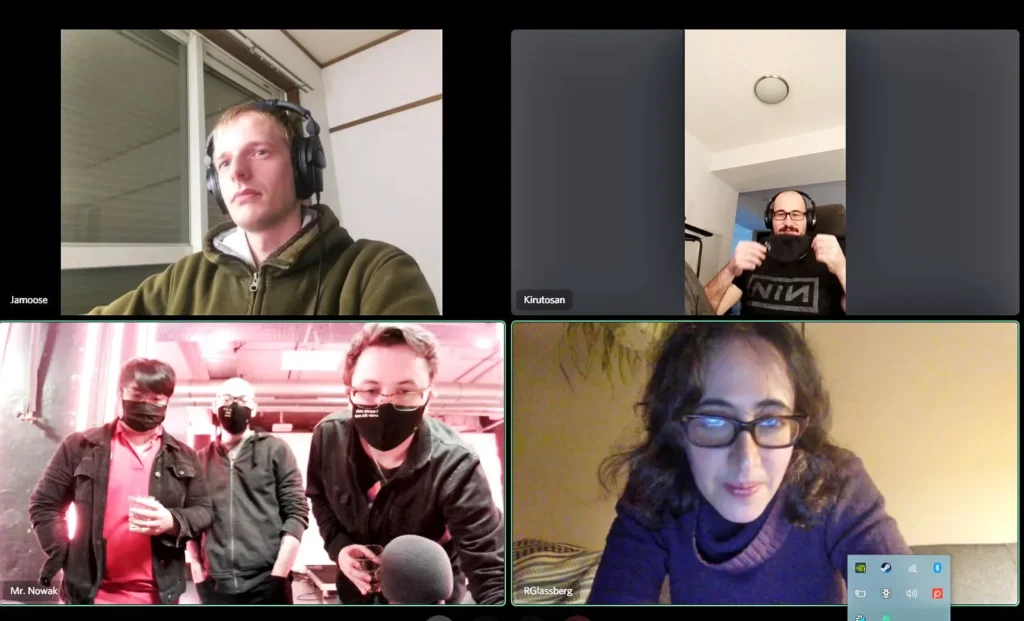
The first 2.5 years were spent prototyping and the majority of the challenge was dependent on getting the team together and keeping on iterating within our skill capacity. During this phase, we took Ipek Ünal as our character artist and James Spence as our composer & sound designer to flesh out the other aspects of the game. While they were volunteers at first, like most of us, they were one of the first ones to receive pay when we received investment in the future. During the last year of development, Tung joined as design support and QA while Rachel joined as a freelance writer to polish and improve the text. This completed the team of 7 who have worked on Suzerain from Torpor Games. Many contributed on the side of Fellow Traveller, our publisher too, of course.
To give an overall summary this was our product timeline:
- Concept: December 2016 – June 2017
- Pre-Alpha: August 2017 – February 2018
- Alpha: March 2018 – May 2020
- Beta: June 2020 – November 2020
- Release: December 2020
- Post-Release:
- January 2021 – September 2021
- Switch Version: September 2021
The first challenges have crept up on us after the initial concept phase concluded and I will try to explain the most important ones. No victory tastes good without struggles overcome. Game development also fits well the famous quote: it’s about the journey and not the destination. So to the challenges in the journey!
Challenges
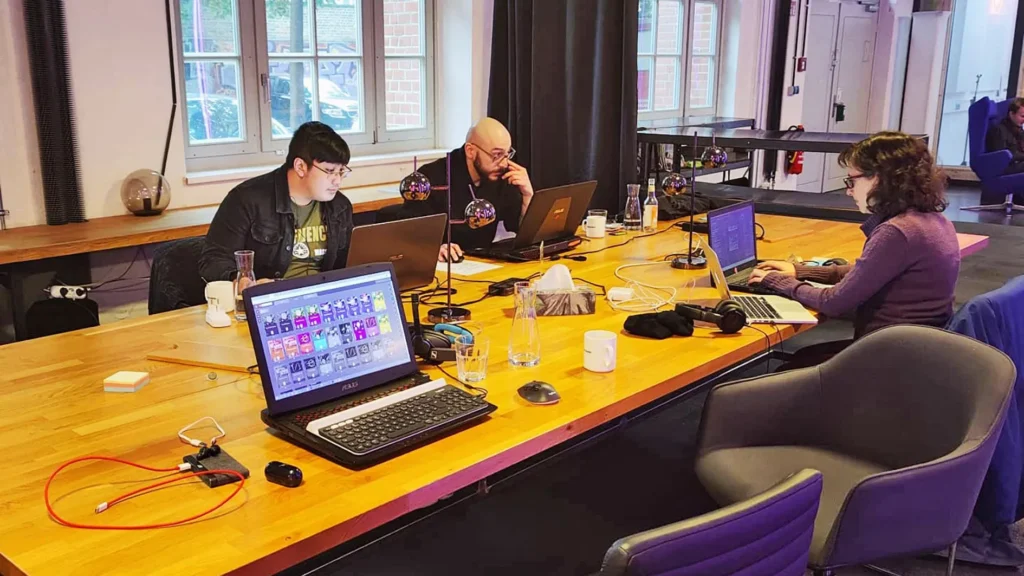
The primary challenge was finding the right team to execute the product vision which was more and more shaping up as the prototypes were advancing. Game development at the early hobbyist stages is very complicated because everybody already has their jobs or studies which they are focusing on. The major obstacle here is the commitment to something on the side. How do you keep a team together without pay, fake promises, without any future? The key aspect is to find people’s individual motivations and skill sets and make sure they align in a broader sense. Yes, they will never commit full time early on, but if a good job is delivered, there is a possibility of creative and financial rewards.
I still think to this day that my most valuable achievement was to form and maintain a team that worked so much for so little over so many years. This strong bond took us all the way to release with a strong effort and delivered a happy conclusion to it all. We all ended up reaping the benefits too, which was a great feeling — sharing the burdens and sharing the victories! Looking back, that was my greatest achievement.
Making something relatively unique and of good quality is a major challenge itself. There are several steps. Starting with the early iteration loops and drawing a start line where you commit to production. Seeing something to the end is a major challenge too. Reaching a healthy balance of skill sets and gathering the workforce another. Dozens of factors need to play into your hands, yet even then, the pitfalls are many. One needs to overcome most if not all of them and they might still fail to succeed.
I will start with something simple, presence. One of our weaknesses was that nobody knew us and even though we had entered the industry here and there we only had a few years of real experience. This meant that we needed a strong partner besides the need for an investor after we had reached that Alpha state.
We drew a list of the best indie publishers who shared a common DNA with us and hoped we would end up working with Fellow Traveller which aligned with most of our narrative vision. And after 2.5 years of deliberating on our own, by some luck and some good negotiation skills, we ended up getting in touch with Chris Wright, the Managing Director of Fellow Traveller. I want to explain what I mean by luck here. Midway through the journey, I moved to Germany to found the studio and focus on the product. Seeing that GDC 2019 was happening made me realize that this was a great opportunity to meet publishers and investors. But the problem was that the GDC ticket was over my budget. I could only cover flights and hostel stays. So I applied for the GDC lottery and, by some sheer luck, won the ticket.
That took me to San Francisco where I met Chris and got an investment for Suzerain through a fair publishing agreement. This was a great thing for a couple of reasons. It would cover our weakness of the lack of presence we had in the market while also fitting to the line-up of narrative games well due to our dialogue-driven mostly by branching story structure.
Signing an investment for Suzerain also meant that we could move out of the part-time structures by hiring more full-timers and freelancers to finish the project in the quality we wanted to.
So it is very important to pick whom you work with. We wouldn’t have been as successful if we didn’t partner up with the right people at the right time. Failing to raise the money would have also led to a freeze of the project and even a cancellation because we were stalling at the time. In this section I must stress the importance of working with a lawyer or an experienced game developer which can help you understand the details of a publishing agreement. One must thoroughly understand or even negotiate these types of agreements. So beware and don’t sign something that isn’t right. Trust me, it’s never worth it.
There were also some more product-related challenges. Throughout the prototyping phase, we found out that Unity did not meet our dialogue needs out of the box or even the Dialogue System tool we had used initially. Yes, it worked well and did the trick for limitedly scoped content examples, but it simply wasn’t enough when things got complicated. Our output speed was also seriously hampered and the limited tool restricted our creativity.
We ended up researching what to use as an industry-standard after hitting this obstacle. Then we found Articy v2, which helped us immensely. We could create entities and dialogues quickly and could structure conversations at a much faster pace. I also wrote an article on the Articy website that goes into a bit more detail. To summarize, the visual scripting and easier database access made a complicated narrative game like ours possible. After a while, we even switched to the multi-user version as more writers joined the project. The 450k words and thousands of variables were also stored in an accessible fashion where we could design, utilize and edit them as we wanted.
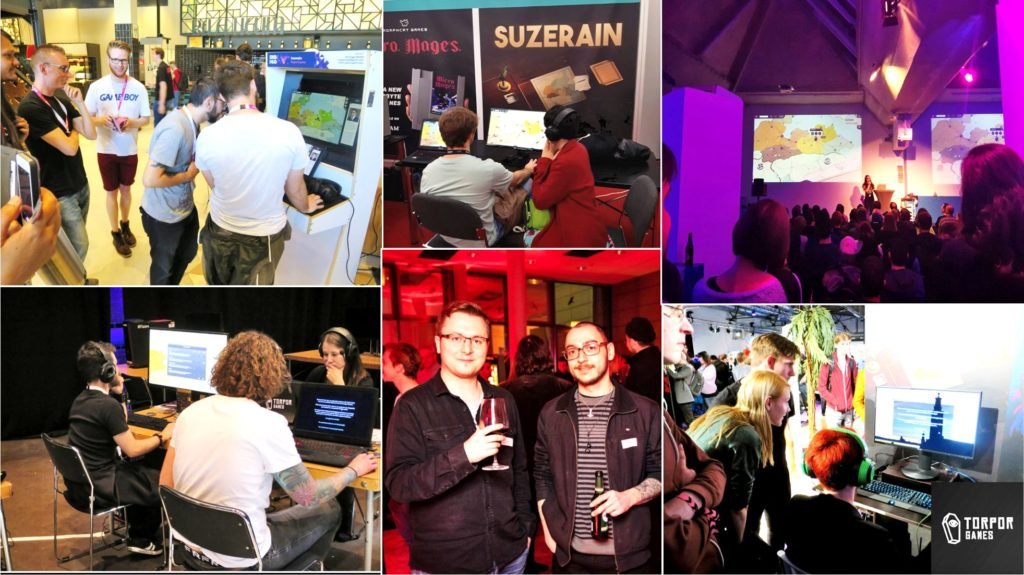
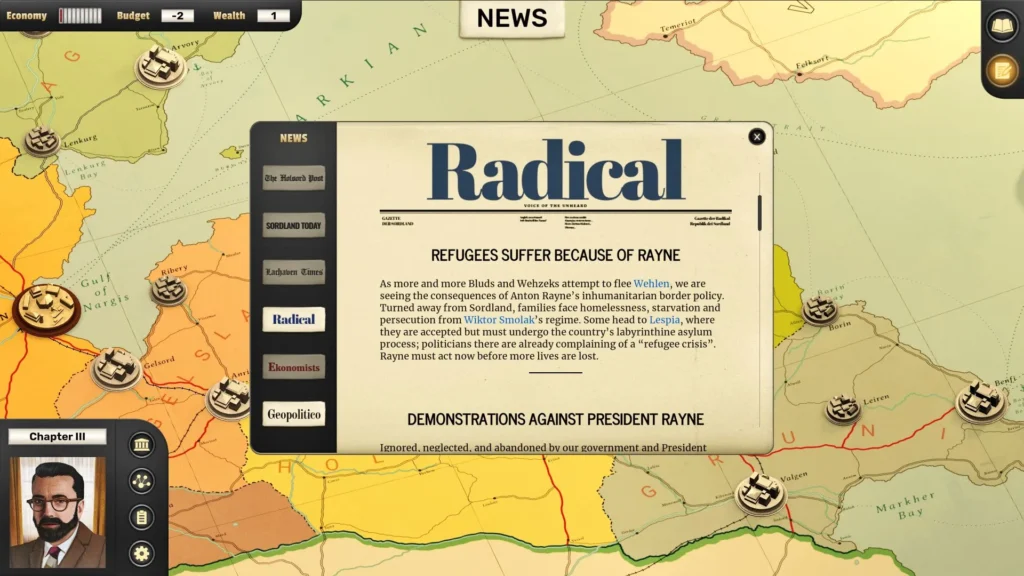
Suzerain is also a very UI-driven game that is constantly developed through the prototypes and Alpha with early user feedback. We didn’t add features at the start, but we added them step by step as we trialed the product with random gamers at events or our friends. This resulted in an organic but, at the same time, high-maintenance development style. Our technical skills were pushed to the limit when we found ourselves creating many different interacting UI elements which we had never developed before. These were so game-specific and feedback-driven that we couldn’t take our knowledge from other projects into the development. The process also taught us a lot. Besides, due to the mostly part-time focus of the game early on we never had the luxury of sitting down and designing the game completely for a year and then starting production anyway.
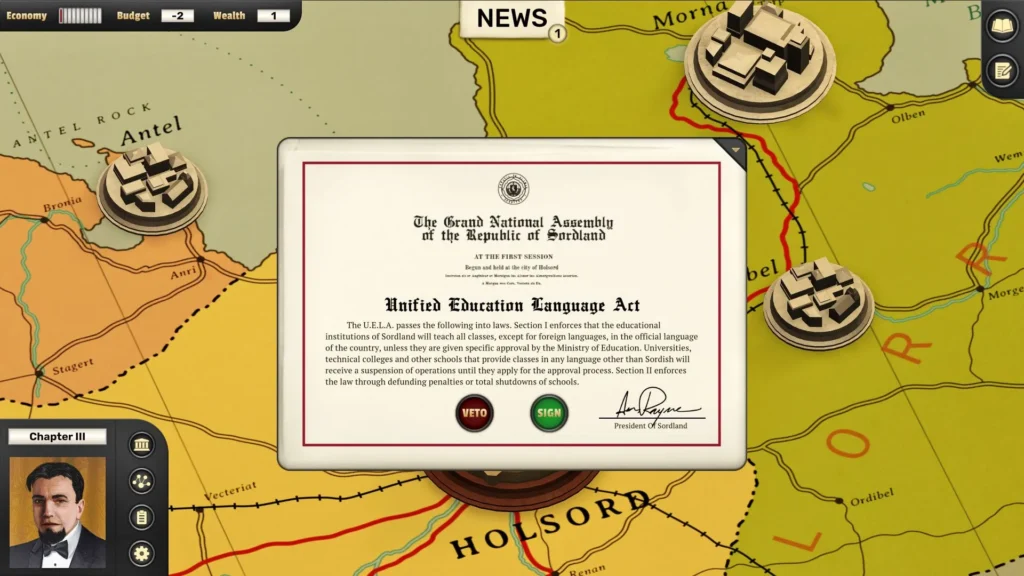
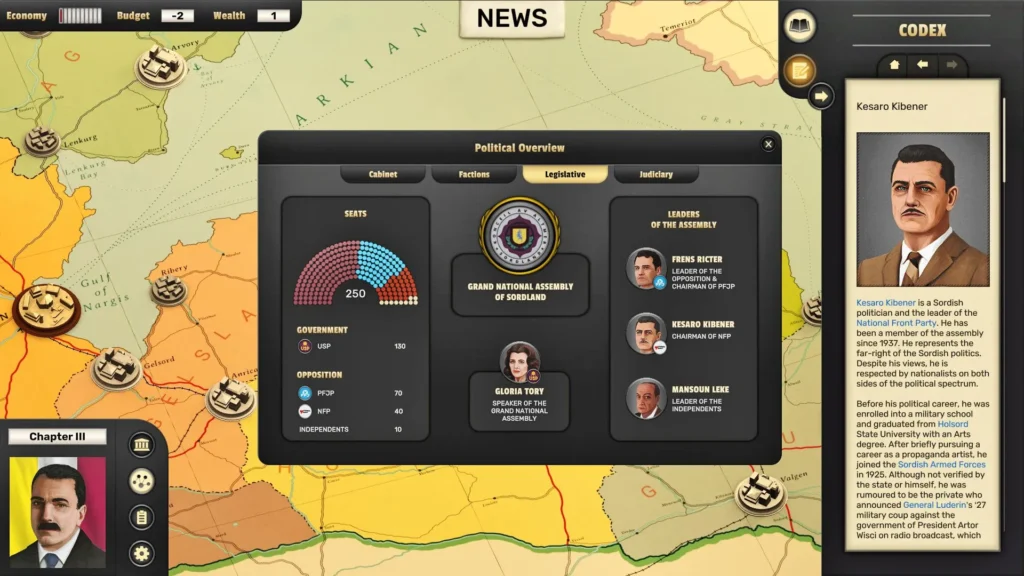
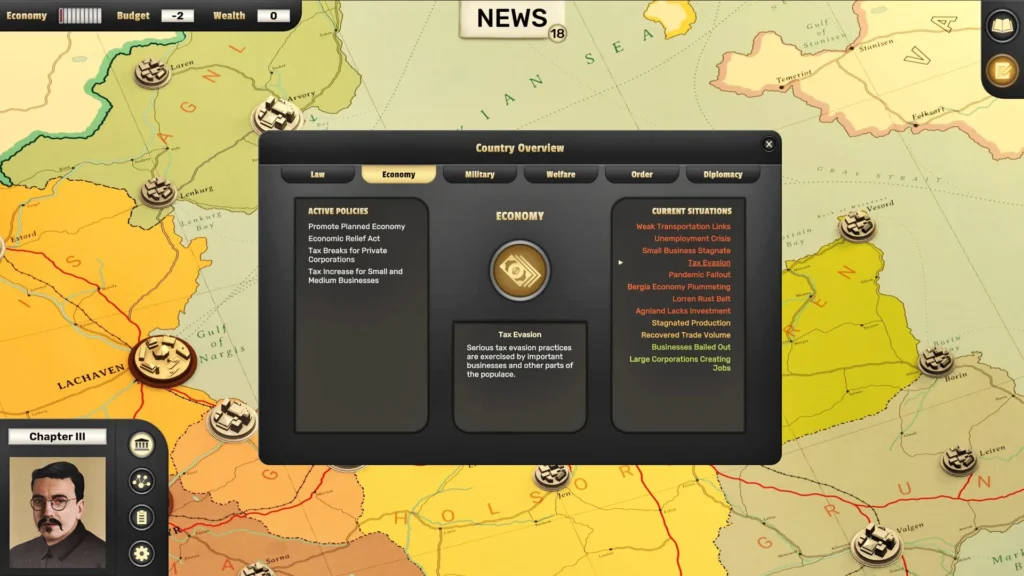
One of the aspects that set Suzerain apart from most visual novels was the many UI interfaces that communicated the elements that happen in the storyline in an easy-to-read way. For example, our overview tab displays law, security, diplomacy, public services, and the military clearly in two main categories called active policies and situations. These are a direct reflection of the start situation and the changes you make as President immediately update in these menus. The same goes for the Assembly makeup, Judiciary members, and many other things. Another good example would be the six different newspapers giving feedback on the developments of the country based on your choices. This is all displayed visually with unique fonts etc to break the usual dialogue flow of the game.
Another aspect that set us apart from some visual novels was how reactive and snappy the dialogue is in Suzerain. There are sometimes several characters speaking at the same time and their portraits are displayed dynamically in a way where the whole experience is more reactive and flows easier even though the political and dramatic topics could be perceived as non-exciting by some. Another aspect of the visual draw was the hand-drawn and realistic map of the game world which made the entire universe be realized in the mind of the player. So the quality of the visual aspect though simple helped make the game more approachable and interesting.
A massive obstacle was the narrative design. Striking the right balance between the quality and the number of choices was difficult. The overlapping storylines that sometimes were disjointed, connected, and even disconnected were also a major challenge that took a long time to improve. For example, we broke the game down into several storylines like the family, bludish minority, defense, economy, reforms, etc. These different categories all advance in interesting ways but their interactions with each other were very complex at certain levels. Since the game was based on hundreds of choices, it meant that one part of the storyline could heavily influence the others.
We tackled this issue by building the game in 11 turns with groups of three turn chunks which helped us oversee some overall hooks and peaks in the story. Since the story wasn’t too free we could add divergences within the main flow. Most of the topics would come to some conclusion towards the third and fourth chapter of the story which resulted in several climax moments but the build-up of different elements contributed to the feeling of the interactive storyline of Suzerain.
There are many subjects that are tackled and learned throughout the development. I have explained some but I want to summarize with a bullet point list so the dissemination of knowledge gained can be easily understood. I will break these down by category.
Team
- Finding and maintaining a team of ideal skill-sets and harmony for the execution of a project in which individuals share their own goals fulfilled and collective goals aligned.
- Incentivizing people to stay by offering them shares, future pay promises, and/or other non-paid elements like gaining experience and being in the industry they want to work in. At the start, the team should be there for the long run.
- Increasing team cohesion and making sure a nice friendly environment remains. This is also key to surviving when the idea is early since being nearly like a family helps understand each other’s problems.
Design
- Try to embrace non-traditional design thoughts after truly understanding what exists in the industry and why it works. One of the reasons Suzerain succeeded was that it used many elements of games that existed but combined them in a completely different way.
- Don’t be shy to iterate later on in the game development process and scrap game design ideas outright if it will make a massive improvement. Separate from bad game design flaws early since the financial situations can be damaging.
- Planning is everything and designing a game from gameplay to narrative to UI is very important at the start. Yet no plan survives contact with the enemy. Gather early feedback sessions and figure out what doesn’t work in the design docs and iterate as soon as you can.
Writing
- When working on a fictional universe documenting the timeline and key interest points of the lore is very important as the web of complexities/inconsistencies become incomprehensible the more writers work on the project.
- Writers should have high autonomy under the overall narrative design where they can let their creativity flourish with inputs that could alter some story arcs and improve them.
- Characters, places, moments need to have a soul or identity which reflects from the writer or the designers of a game. The writer has a huge responsibility for this and communicates with the player directly.
Content
- The story must come from the heart; it must have real emotional elements to make an impact. If the game is narratively driven it must provide something either by topic or by a perspective that makes the content unique and enjoyable.
- The main content must rely on the creativity and skill strength of the team. In our case, it was creating a text-based story that the entire game revolved around.
- Displaying your content is very important. Complex information must be presented in a readable and beautiful way.
- Scope creep with content is only survivable if you can create content fast. In our case, we had to do some overtime to execute the amount of content we wished for but it would have crashed the project if our pipeline was slow and interest in creating written content was low.
Programming
- Using useful tools which apply well to your game structure can speed up the development speed. We relied on tools like Dialogue System and Articy and saved years worth of programming time.
- The programmer in the team should ideally have some game development knowledge. In our case, this wasn’t fully the case but their web dev knowledge still applied well due to the style of the game. Make sure the technical people can tackle the backend complications.
- Optimization is a massive challenge as a game grows and only experienced game developers can tackle this. If you don’t care about optimization for too long, it will come back to bite you close to launch where you won’t have time to tackle it.
Testing
- For smaller indie teams community testing can make or break. If we hadn’t launched a series of community testing rounds before our launch we would have had a very terrible experience on launch day.
- The higher the complexity, the more testing a game requires. Suzerain has so many dialogue branches which could break with a missing link. We tested the game thousands of times to make sure we eliminated most of the issues early.
- Our experiences with external QA studios haven’t been great. Internal QA has always provided higher value. For small studios, it might be expensive so you can rely on part-time freelance QA help.
Business
- The more niche and indie you are, the more business savvy you need to be to understand what can go wrong to avoid pitfalls. Indie gamedev survival is very low and there are a lot of reasons for it. Research tooth and nail about why studios succeed and fail etc.
- Utilize government grants, local funds, and any kind of financial support you can get your hands on to increase your chances of success. Making risky and more niche projects means that you have a harder time relying on traditional commercial interest from investors.
- Raise 25% plus of the expected budget always. Game development is hardly ever on time and you need to account for that if you have the luxury, of course. This will allow you to choose quality over a rushed release when the time comes.
- Share risk with trustworthy partners. Co-found your company with the right people if they have the dedication and skill sets necessary to bring the company forward. If the cake is worth nothing, it doesn’t matter if you own all of it.
- Dare to create a brand and present yourself as a company above its products. That way your products might fail but your company could go on. Don’t rely on the reputation of a single game. Rely on the creativity, productivity, and vision of your team members.
Marketing & Sales
- Market the soul of the game rather than what you want your game to be. Stay true and honest to the core experience.
- Underpromise and overdeliver as much as you can. Be honest with your customers and they will respect you for it.
- Selling a game that you are proud and passionate about is the easiest thing.Good games sell a lot through viral word of mouth. Good reviews and nice comments are the best sellers.
- Steam’s algorithm-driven system can be your friend if you plan it well. Gather wishlists, make posts, interact in comments. Develop Steam features too since they boost activity!
Community Support and Growth
- Grow your community from the start. A Discord server is a key to gathering the community at a central node. Reddit also has been successful for us.
- Interact with the community regularly on a human level where they feel connected to the dev team. The journey of game development is special for both sides, so why not share the excitements and downs with your community? The more you share while delivering something good, the more they will appreciate you.
- Grow the community through events and contests which increase interactivity.
I hope this article will have delivered some insight to the intricacies of Suzerain’s development and our learnings as Torpor Games. There are way too many to put down to words. I may have just covered half of what we learned. Our team is very happy and privileged to be a part of this creative industry that combines so many disciplines. Suzerain came from the heart with a gargantuan effort between a team of seven people. It is our utmost privilege to have won the German Game Awards 2021 for Best Expert Game and the Games 4 Change People’s Choice Awards. More recently, we’ve worked on the Switch version of Suzerain which also has its challenges. If you want to support us and have a Switch, you can purchase Suzerain there too now!
We also want to thank the BMVI and Medienboard for supporting our niche creative endeavors. Our quest of questioning our reality through thought-provoking entertainment will continue. All we can ask from anyone is acknowledgment and support. Many thanks to the hundreds of people who made Suzerain and Torpor Games a reality.

Ata Sergey Nowak
Co-Founder & Managing Director
Ata worked on several games like Hearts of Iron 3: Their Finest Hour, East vs West, Squad, Terminal Conflict and acclaimed mods like Black ICE and Project Reality. After 2017, Ata’s focus shifted towards creating Suzerain and guiding it to a commercial release with the talented team of Torpor Games.