

Why it makes sense considering a level rework during development.
On a certain point of the development process, we felt it was time to revisit one of the first levels ever made for the game: It’s the first time our heroes travel to an ancient underground temple in search of a magical shard. The previous version of the level was made a long time ago, and it felt like the focus and pacing was not quite right for that point in the game and story anymore. The game has come a long way since then, especially with recent visual and AI changes that make the gameplay much deeper.
The temples are an important part of the game both in terms of mechanics and story so the first temple should introduce a variety of mechanics but also show the player this part of the Iron Danger world for the first time.
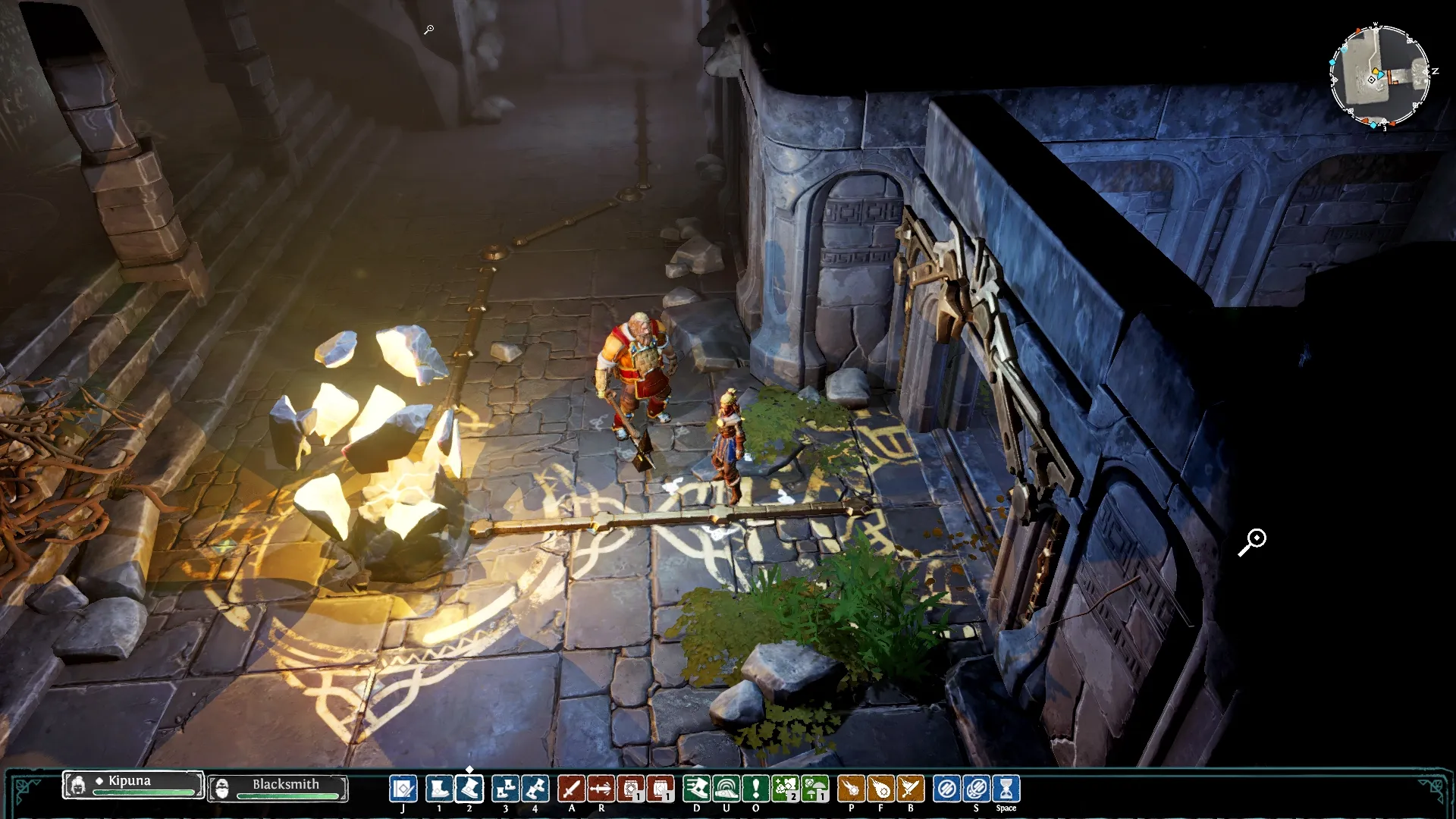
The end of the previous level is an intense battle against the rotspirit Keyus on an abandoned farm, and the chaos can reach quite heights, so it felt natural to begin the temple level with a more peaceful atmosphere. Give the player time to breathe and have a look around. I used the entry hall from the old version of the level as I quite liked the moose head sculpture and natural stone of it. Still, instead of putting the player in small rooms and tight corridors, I decided to have the entry hall open up to a larger hall, lit by a lightstone operated by ancient magic.
The new revive mechanic brings a nice addition to the fairly simple battle with Keyus.
Environment Introduction
This space has only the function of introducing the temple environment to the player with enough room that it feels safe to explore for a moment. These first steps also introduce a door mechanism with levers that the player must operate in order to open paths. As the kind of player that likes to explore all the nooks and crannies of every game in search of loot, I put a small room to the side with some health and other types of items for those who wish to veer off the path.
The large room seemed a bit empty, so carvings and statues were added to the walls. Also, pillars and a staircase to a slightly higher platform were made. We even explored paintings for floors and walls. The look of the painted elements might still evolve before the game is released, but they instantly added something very important to the feel of the scene. The paintings seemed like a great way to point out certain gameplay elements, and I went around adding the art everywhere.
Adding New Enemies
The introduction to the part of the game and gameworld felt like a success. The space felt mysterious, abandoned or empty and old, with a nice creepy touch. This was the easy part of the process, though. The main function of the level was to introduce a few mechanics and even a couple of new enemies. First, one of the new enemies was the Keyu Shaman. A rotspirit bubbling out of a corpse with the power to revive fallen Keyus in battle. I wanted to create an area or two where no matter how the player played the game, a Keyu Shaman would be able to revive a Keyu at least once. Making sure the player knew of their ability and how it would affect future battles against the fairly easy to kill Keyus.
I wanted to create a scenario where the player does not know what to expect and got drawn into a simple and easy battle against two Keyus. But a Shaman would be nearby to revive them if the player killed one. I tried a few solutions and found that the Shaman should be easily visible to the player but not as easy to get to as the regular Keyu Brawlers.
The solution was to make a room split in two by a broken floor. A path at the back of the room can be used to run up to the Shaman. But the player would need to face the Keyus to get there. After some testing, I felt the room worked nicely. The battle is easy, and the new revive mechanic brings a new twist to the simple fight with Keyus. I felt clarity was king in the design here and wanted to make sure every player knew what the Shaman was capable of after the encounter.
Some rooms grew much larger, and areas were included that the player could not reach, to ensure that the environment would look mysterious.
Expanding Game Mechanics
I took similar steps designing the few remaining battles of the level. I put in a possibility try to avoid all-out combat for the next encounter. Then I made a larger combat where the player would face two Shamans. Suddenly the battle requires a completely different tactic from the Keyus in the previous level. It seems that a more challenging variation of the big Keyu-battle should be put into another later dungeon in the game, where the player has more skills at their disposal.
Usually, when I make a level, I focus on giving options and paths, but this time as we were introducing new mechanics, I tried to keep the areas simple. Open spaces and just the player party against the rotspirits, not too much else to avoid adding more chaos. I felt like the first third of the game needed a bit of this clear and laid out style of design just so that players would feel like they aren’t making the wrong decisions. Later the levels open up and allow for many types of approaches, but at this early stage, it can be intimidating. However, the big battle against the Keyus and two Shamans is definitely not a breeze even though the layout is simple and clear as you can see from the carnage.
Bring In Some Mystery
I also spent some time thinking about how to make a temple with such a linear layout feel mysterious and like there was a function to the space a long time ago. So I made some spaces appear much larger and added areas the player could not reach such as seen on the left screenshot, where the characters are not able to cross the bridge.
After this reworking of the structure of the level, I felt confident it was doing its function in the bigger picture of the game a lot better. Guiding the player but letting them figure out for themselves how to solve the encounters best. The next step is working on the other temple levels and taking them visually to the same level as the first one while making sure each one has their own mood and feel.
It’s always fun to revisit old work and make sure it’s still up to par and sometimes the changes are small, sometimes huge. There’s one thing I hardly touched at all in the level compared to the first version of the entry hall, and it’s quite huge too. It’s a bird. It’s a huge bird, all right. Huge bird fight!
Antti Kemppainen – Senior Designer
Antti has worked both as a level designer and a concept artist at Action Squad. He has a background as an artist at Rovio animation in addition to having years of experience as a freelancer. He got into game design at Rovio where he worked together with both Joel and Jussi creating numerous prototypes.