

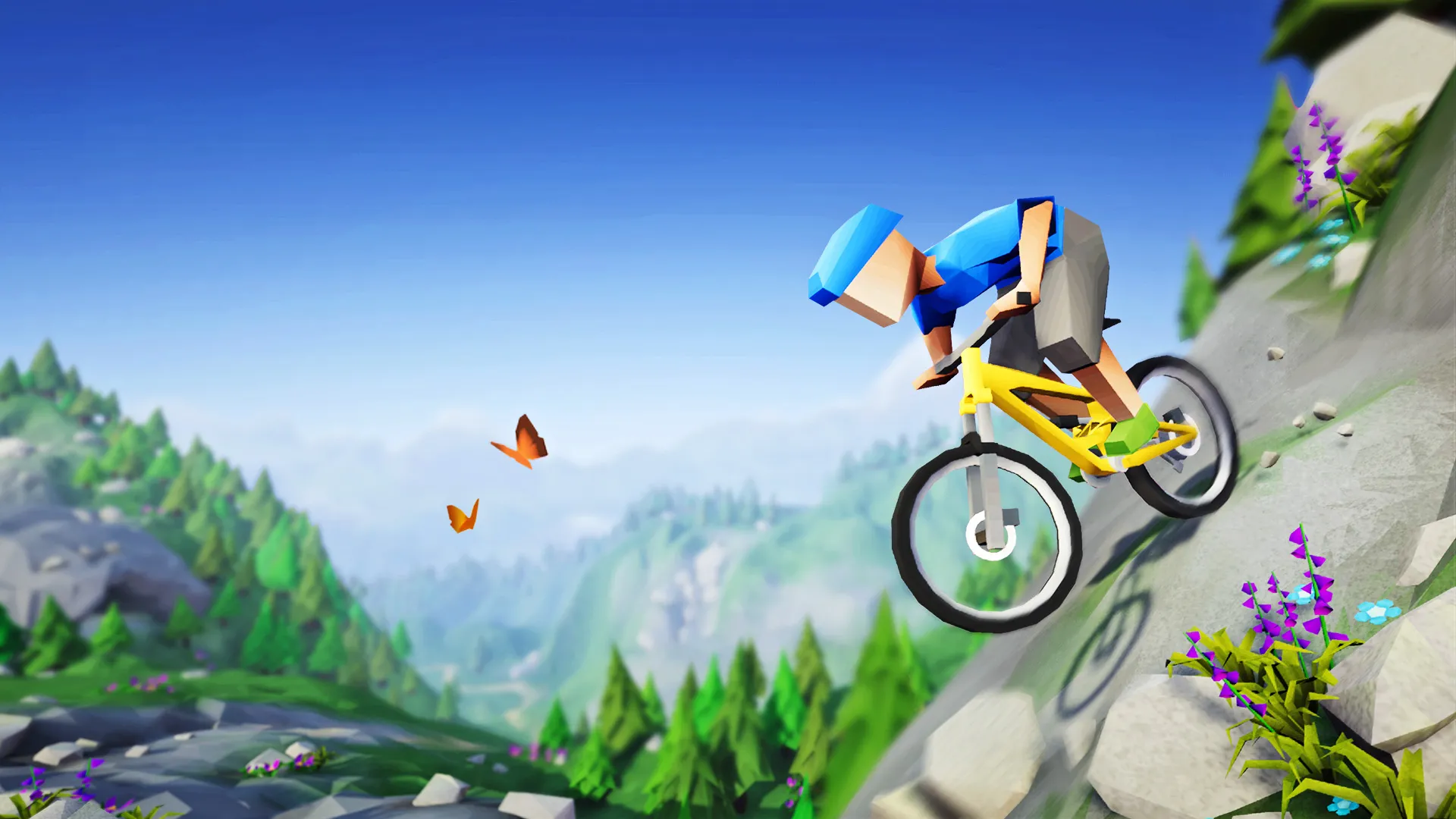
The rocky history of Lonely Mountains: Downhill.
When we released Lonely Mountains: Downhill on October the 23rd 2019 for Steam, Xbox One, and PS4 it was the end of a development ride that took us more than four years. Nearly a year after release the game has now sold more than 60.000 units across all platforms (including Switch which was released half a year later). By now more than a million players have played the game. Let us take a look back at the start of the ride and highlight some of the things that we learned along the way.
Although we released the game on consoles and PC, Lonely Mountains: Downhill started as a small mobile game in the summer of 2015. At the time Megagon Industries was a very different company.
It was founded in 2014 by Severin Brettmeister, Jan Bubenik, and Daniel Helbig in Berlin, Germany. All of us were freelancers at the time, knowing each other from Die Hobrechts – a previous company we worked at together. Although we had a shared office, we worked individually on separate projects. But besides our day jobs, we also cooperated on different private game prototypes in our spare-time. One of them was the premium mobile puzzle game “…and then it rained” which was released in May 2014 for iOS. At that time we founded Megagon Industries not because we wanted to found and run a game studio. We simply needed a legal entity to publish the game on the AppStore.
“…and then it rained” got a lot of love from the Apple editorial team and surprisingly became a modest hit (at least compared to our initial expectations). It wasn’t successful enough for us to quit our day-jobs but it motivated us to start working on a second premium mobile game that grew up to become Twisted Lines.
Although Twisted Lines was in a lot of aspects the better game, it wasn’t nearly as successful when it got released in September 2016. You could also say it pretty much tanked.
In hindsight, the mistakes we made are pretty easy to spot – but to cut it short the root of all of them was that we still worked as freelancers, splitting the time between work-for-hire jobs and our games. The result was a release without proper marketing and preparation. This was important learning as it heavily affected the future development approach of our next game.
Close view
Lonely Mountains: Downhill is a downhill mountain biking game. The vision for it was always clear. We wanted to build a fun arcade biking game where you had to find your own way down the mountain. Instead of racing against other players, these mountains would be your antagonists. The game started as Jan’s pet project somewhere in the middle of 2015 while Severin and Daniel were working on Twisted Lines. It was initially planned as a small mobile game with a 6-12 months development cycle. But because we still worked as freelancers, the actual work on the prototype cooked on a low heat for most of the first year.
This started to change after we put out some gifs of the game on social media (mainly Facebook groups, Twitter, and some private developer forums). The reaction of the community was pretty much overwhelming. The numbers of likes and shares (and even a small Rock Paper Shotgun article) were on a totally different level than any reaction we ever got for our previous games. From that moment on, we knew that this game had the chance to become something special.
Although our mobile version was really fun, most players thought that the game would even be better to play with gamepad controls. After implementing it, we quickly agreed. Without really thinking through all the consequences we shifted the development from mobile to PC. Luckily this was probably one of our better decisions as we don’t think the game would have had the same impact as a premium mobile game. But it also led us on a development path that would take years longer and be more demanding than we ever planned for.
As we had just burned ourselves with the unsuccessful release of Twisted Lines, Jan and Daniel decided that for the game to get its proper chance, we had to do it full-time. Unfortunately, Severin had to leave the company shortly before due to private circumstances. So we scraped together our savings and started to develop a proper PC prototype. Our goal was to show it for the first time at Quo Vadis, a game developer event in Berlin. The feedback on the finished prototype was amazing and it marked the beginning of a year that we spent in total exhilaration.
We made our first trailer and put up a Greenlight campaign on Steam. After four days, we had ~8.000 votes with a 93% positive rating.
We continued to show the game at several events (Unite, Indigo, Amaze, gamescom, PGA) and always got great feedback.
As our savings were running out we got a 50.000€ government funding by the Medienboard Berlin-Brandenburg.
To pay our half of the funding we ran a Kickstarter campaign which closed at 45.000€ (which came down to 30.000€ on our bank account due to fees and taxes)
So in late 2017, the future was looking bright and sunny. We had funding, an active Kickstarter community, very positive press, some awards and nominations. Although a lot of publishers approached us, we were pretty much hellbent on publishing the game on our own. We were motivated, hopeful – and naive.
With the start of 2018, we crawled deep into the development trenches. But as the game started to grow we came to realize that some of the systems we had built didn’t scale well in full production. Especially the way we created the levels was not only limiting (which can be a good thing) but required a lot of switching between Unity scenes, which was just a pain to work with on bigger trails. So we scratched what we had and instead of using the Unity terrain system, we decided to build our own.
Looking back, this was the moment our initial planning started to go off the rails.
Forwarding a couple of weeks the new terrain system turned out to be pretty swell. Not only allowed it for fast changes and iterations, but it also lifted the restrictions on map sizes. Suddenly we had the power to build huge full-fledged mountains containing multiple trails that were all connected and intertwined.
Our original release goal during the Kickstarter campaign was mid of 2018. But with great level design power comes… bad performance!
Bumpy times
Instead of working on gameplay features, we spend the first part of the year working on technical solutions to keep the performance playable. We ended up building a custom pooling, culling and LOD systems to handle the hundreds of thousands of objects that now formed our mountains. At this point, our planning wasn’t just off the rails – we were in no-man’s-land.
Summer went by and we set a new deadline for September but soon realized that we wouldn’t be able to keep this one either – and that the funding we had wouldn’t carry us over the finish line. Also, another infectious thought had started to grow: maybe self-publishing was not the best idea for us?
Although we had spread the word about the game pretty well in the past, we had now gone completely quiet on social media. Worse, we had started to neglect our community because the development of the game had consumed us completely. And the amount of work that still needed to be done – content and feature-wise – was a mountain of its own.
It was time to swallow our pride and look for help.
We were contacted by a dozen publishers since we shared the first initial gif. But in the end, there were only two that met the criteria we had set for ourselves, and that in turn wanted to go all the way with us. The newly found Swedish publisher Thunderful was one of them.
Partnering up with Thunderful not only promised to give us another round of funding to finish the game, but they also would take some of the marketing and PR responsibilities off our plate and offered to handle the console ports. We closed the deal at gamescom 2018.
After a pretty exhausting year that didn’t go the way we planned, things again took a turn in the right direction. Most of the performance problems were solved, we had new money in the bank and a new partner to take care of all the things we strongly neglected over the past year. We also were able to hire our first employee Noah, who joined the team as our first proper artist in October 2018. Everything was looking good and we set on a new goal: We wanted to release on all four platforms the same day in April 2019. What could go wrong?
It turned out that you can have too much of a good thing. In our case our Achilles heel were events. Knowing that the release of the game was only half a year away and equipped with the Thunderful war chest, we wanted to raise the awareness for the game again. Therefore we started to showcase Lonely Mountains: Downhill wherever possible. We went to MAG, EGX Berlin, Day of the Devs, EGX rezzed, GDC, TwitchCon, and took part in an Xbox press tour.
Being”on tour” with the game felt awesome but it would have been even more so if the game we showed would have actually been finished. Every event meant no development progress at all and required us to make new builds and marketing material. Travelling and jet-lag started to take a big toll on us and the development. We had soon again arrived at the point where our newly set release target was already too close.
So we decided to cut every nice-to-have feature that was still on the list. Animals, ghost system, replays, Twitch integration – it all went on the post-release update list (where they remain till this day). But being on the road all the time wasn’t our only problem. If you ever think about porting a game that is still in constant development, learn from our mistakes: don’t do it or, at least, plan twice the time it would take to port a finished game. Together with Thunderful and the porting studio we decided to drop the Switch port for now. But even with the new smaller scope and one platform less, it didn’t look like the game would be ready for an all-platform release anytime soon.
So another gamescom arrived and we showed the game at the Indie Arena Booth for the third time in a row. Although development was nearly finished at this point, the console versions were stuck in submission limbo. As no one knew how long it would take to get every version approved, we still had no release date. No release date meant that we had nothing news-worthy to say about the game as we had already burned through every other marketing message in the past years. We were physically and mentally exhausted from all the attended events, and we had a nearly finished game that no one seemed to care about anymore.
But there was one upside. Shortly before gamescom, a deal was made with Microsoft that Lonely Mountains: Downhill would be available on Game Pass from day one. Without going into details, this at least meant that we would be financially safe for a while when the game would come out – no matter if it would be a success or not.
But even without the financial pressure, everyone just wanted to have the game out the door.
Turning into the final straight
Our targeted release date changed all the time as out of nowhere new bugs, performance issues, and problems with the console submissions emerged. Finding a good release date between constant Steam Sales, huge game events, and big AAA releases is already hard. Finding a new one every two weeks because something again took longer than expected destroyed the last bit of mental sanity we had left.
When the console versions finally made it through the approval process, we settled for a release date two weeks later on October the 23rd – nearly 1.5 years later than what we promised our Kickstarter backers and more than four years after we started our mobile prototype.
Having two weeks for your release PR isn’t a lot of time. The trailer has to be finalized and you need to create gifs, texts, and images for social media. Press statements have to be written and keys distributed. You need to reach out to streamers, Let’s Players and Steam curators. And most importantly, you have to connect with the platform holders to hope for some kind of store feature.
Being already mentally on the edge, the two-week crunch before release nearly pushed us over the cliff. When we finally hit the publish button we were just happy that the ride had, at last, come to an end.
Luckily people loved the game. Although our leaderboards servers went down shortly after we went live, Steam reviews settled on 90%. Sony and Microsoft both posted our release trailer via their official channels. Most of the press seemed to dig the game and enough big and small streamers picked it up so that the game even entered the “most played games on Twitch”-list for a short while (it peaked at 42k concurrent viewers). It still had some technical problems and crashed here and there, but overall it ran pretty stable and most bugs were fixed the weeks after release. Although we were still tired, our burnt-out developer souls were beginning to heal.
In the months after the release, Lonely Mountains: Downhill won multiple awards and was even nominated for two IGF awards. Despite the obvious fact that it wouldn’t be the next big indie hit (although a lot of people told us that over the years), sales numbers were solid enough. We knew that we would be able to continue with Megagon Industries and that our ride wouldn’t be over yet.
Skipping forward a year. Although Switch was released six months later it is our strongest selling platform now. It even triggered a small second press wave that also pulled the other platforms in its wake. We have a strong and active speed-running community that despite all odds still manages to make new record times daily. As we want to make Lonely Mountains: Downhill a long-term success, we’re still updating the game with new features like daily challenges and also built our first DLC – Eldfjall Island.
We’re often talking about how the development of the game went off the planned path – not only once but multiple times – and whether we should have cut content and features way earlier. But in the end – although development had a lot of ups and downs – we believe the resulting game was worth it as we not only learned from every crash but also found friends, business partners and a community of crazy speedrunners and mountain bike enthusiasts along the way.
Daniel Helbig – Co-Founder & Co-CEO
Daniel Helbig is Co-Founder/Co-CEO of Megagon Industries. Before spending most of his time on the Lonely Mountains, he worked as a Freelancer Game Designer and Creative Director/Co-Founder of Die Hobrechts.