

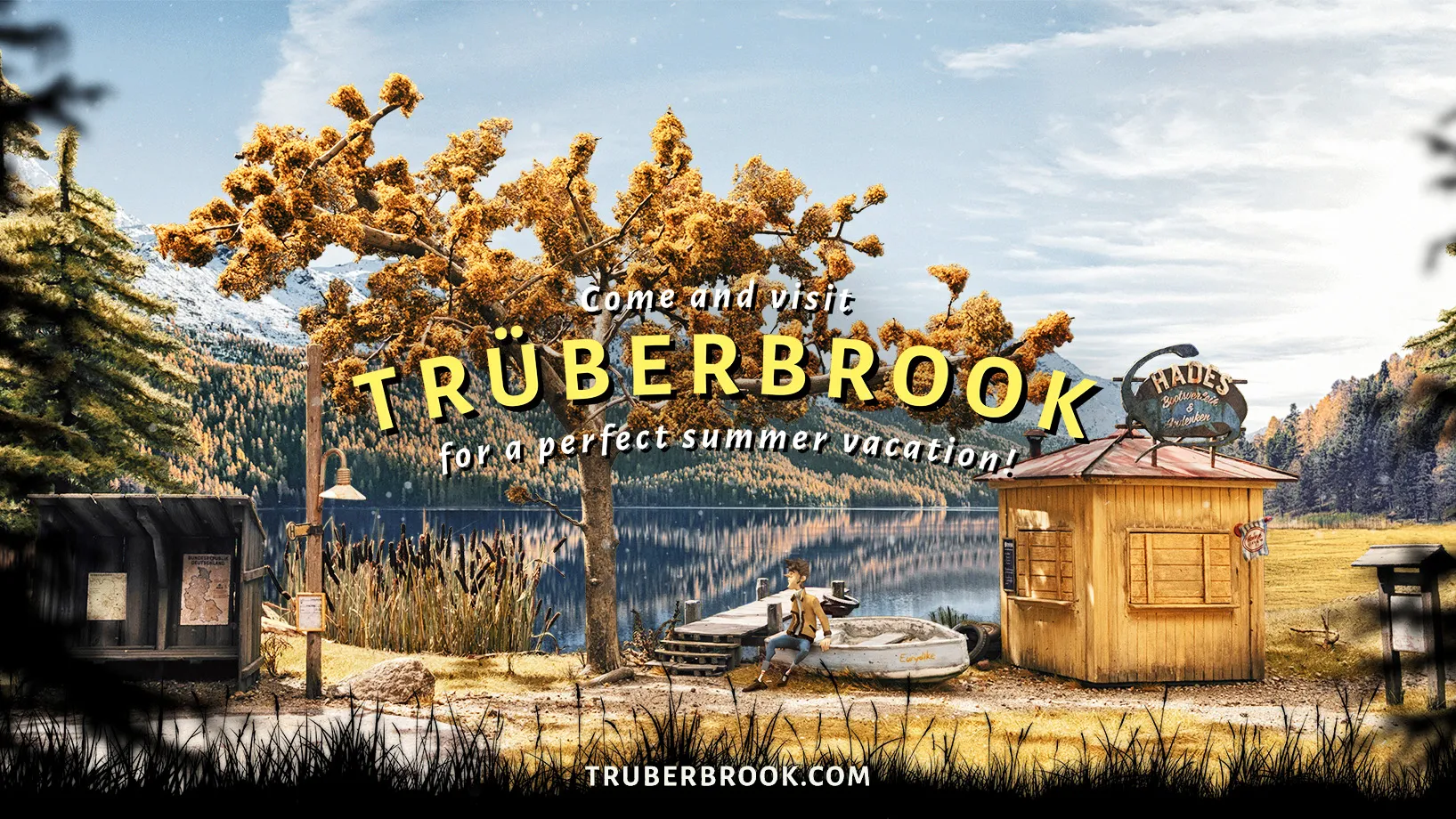
Creating an adventure game based on hand-crafted miniatures.
A lot of lighting equipment was rented in order to create the unique and kind of magical looks for each of the sets.Trüberbrook was released one and a half years ago, published by Headup Games. It was our first “big” indie game title as a team and kind of a jump into the deep end. As a company, btf likes to lay hands on different genres and media, ranging from TV and film to music videos and exhibition design. So parallel to the development of Trüberbrook, other departments worked on projects such as the German late-night satire show “Neo Magazin Royale” and the Netflix series “How to Sell Drugs Online (fast)”. So you can imagine that there was always plenty going on there simultaneously.
Since our professional backgrounds were actually in film, animation and graphic design, we only knew video games from the player’s perspective. That meant we had to acquire the necessary skills and processes in the course of development. Therefore, in retrospect, not everything about the game may be perfect, but this game and the time of its creation will always hold a special place in our hearts.
The decision to make an adventure game came to us quite naturally, as the workflows of this particular narrative genre come very close to what we are used from our work in film and television. From the first draft in 2015, the development of Trüberbrook stretched over the course of roughly four years, with regional funding by the Medienboard Berlin-Brandenburg in early 2016, followed by a surprisingly successful Kickstarter in late 2017, and finally shipping the game in spring 2019.
All this time, we worked in a small core team of four from our Berlin offices, occasionally reinforced with people from the parent company’s nucleus of artists, animators, sound designers and set designers. We also brought a lot of friends and former classmates to work on and contribute to the game, so it always kept a somewhat family-like atmosphere.
If there’s something that makes Trüberbrook special in its own way, apart from the rather unusual structure of the team and the company, it’s probably its somewhat unique setting and its visual style. Both aspects are strongly influenced by our previous works, share a somewhat cineastic approach and we like to believe that both these aspects influence, inspire and depend on one another.
Welcome to Trüberbrook, Germany
The year is 1967. The game is set in the eponymous village of Trüberbrook, a run-down health resort somewhere in rural Germany. American physicist Tannhauser, the main protagonist, arrives on a beautiful summer’s day, hoping for a relaxing vacation and a well-deserved break from university. But as soon as he falls asleep in his cosy bedroom in the folksy guesthouse Waldeslust, his precious paper on quantum physics is stolen by a mysterious burglar. Tannhauser soon teams up with Gretchen, a student of paleoanthropology, who herself is on a hunt for a spine-tingling ritualistic site in the area. It soon becomes clear that there is more about the village than meets the eye.
The intriguing atmosphere of the game was inspired in parts by TV series like The X-Files, Twin Peaks and Star Trek, poured into a solid basis of German folklore and a so-called Heimatfilm. It also draws a lot of inspiration from the great classics in adventure game history, as well as many personal experiences from growing up in parts of Germany that are much like Trüberbrook.
We immediately liked this somewhat bizarre mixture. It gave us the opportunity to look at places that we are familiar with, places we can tell stories about, and to turn this familiarity into something exotic, something that might be appealing for people who haven’t seen this before. Like, isn’t the German province bizarre and strange enough for someone who didn’t grow up with it?
Doesn’t it look weird from the outside, through the eyes of an international visitor who was just dropped off there? Well, that’s basically Trüberbrook.
This approach, in particular, is borrowed from various extremely successful television series, especially from Scandinavia, which work very well internationally despite very rural settings.
So you can imagine the town of Trüberbrook as kind of a stylized, condensed version of different small German villages like it could also be seen in romanticized German Heimatfilms. Of course, this conveys a cliché image of Germany, which was intended to transport the idea a bit better.
During the creation, we visited a lot of these small towns in some of the more remote German mountainous areas, like the Harz and the Eifel, and Trüberbrook became a fusion of different features one could find there.
The temporal setting in the sixties, during the cold-war, provides an interesting background for a mystery story, as there’s the smouldering conflict between two very different post-war German countries, the constant dangers of a foreign threat, competing intelligence agencies, the race to the moon and so on.
Of course, all these events happening on a global level stand in interesting contrast to the atmosphere and the feeling of seclusion in that little village and the more personal story of Tannhauser, though that is still influenced by subtle motives of the time’s zeitgeist, like radical scientific progress.
So taking these premises and mixing them up with a plot that could be straight out of a sci-fi movie was very tempting and probably not done so often before. We wanted to mix different genres, to make the game entertaining yet exciting, funny and a bit scary as well.
But no matter how bizarre and strange the environment and the setting might be, we believe that it was important to have relatable characters that players can connect to. In our case, the main character Tannhauser, an American, is kind of a “fish out of water”, allowing players to see the strangeness of a (for us) familiar place through their eyes. This helps a lot to emphasize all the little details, and some of them would probably go unnoticed by someone who is too familiar with the setting they’re in.
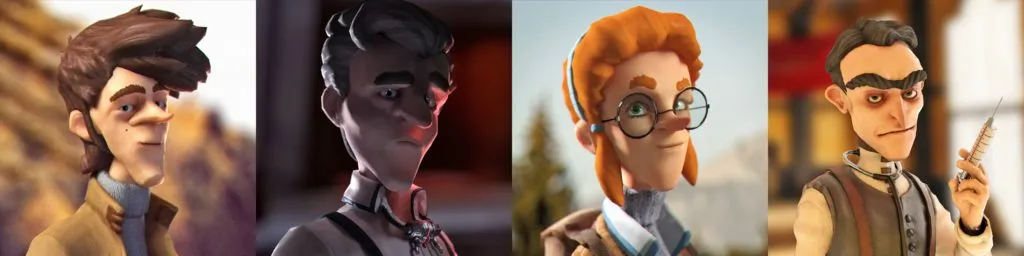
The characters, by the way, designed by our character designer Benjamin Denkert, were all voiced by German voice actors in both their German and English version. Since the game is set in a small German village, we liked this idea to preserve the original accents. Here, our background in the media industry came in handy, as we were able to recruit some speakers from the company’s surroundings for our project. Accordingly, some of them were not so much working as full-time voice actors for a living, but are better known as musicians or actors.
As already mentioned, the other aspect we’d like to shed a bit of light onto goes hand in hand with the setting: The visual style that is based on hand-crafted, real miniature sceneries.
From hand-crafted miniatures to digital game worlds
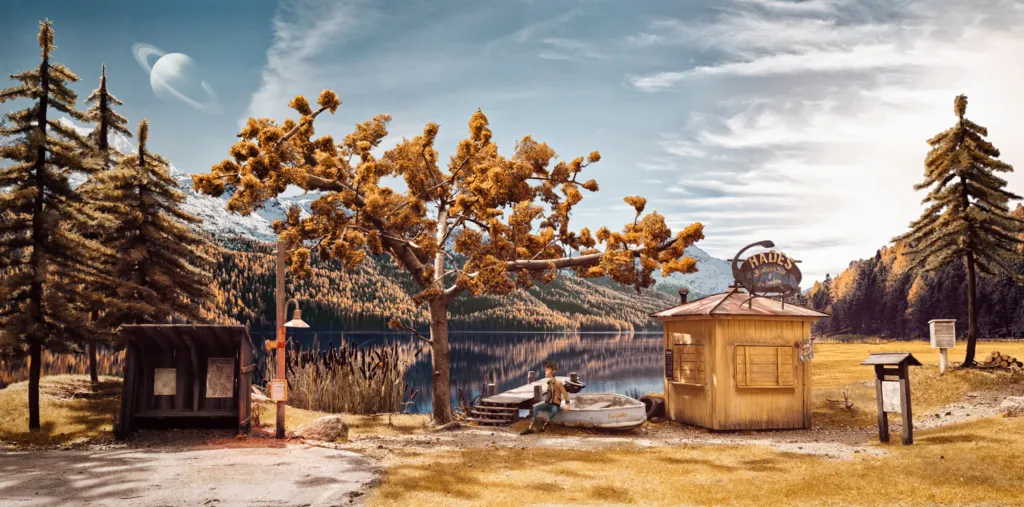
Trüberbrook’s distinctive look is likely the game’s most prominent feature. But, we didn’t pick this visual style for the sake of looks alone, but rather consider it an integral part of Trüberbrook’s storytelling. The town itself is kind of a decelerated scenery of positive resonance, a cosy home and a peaceful retreat – all of which we wanted to emphasize through the visuals. The hand-crafted, colourful and almost toy-like character of our scenery conveys a certain feeling or atmosphere quite beautifully. A kind of nostalgia that goes well with our dusty 1960s setting. Here and there the scenery reminds of a dollhouse or a small diorama, and we like to think that it makes our world seem somewhat magical at times.
Before working on Trüberbrook, most of our team was involved in other projects at btf, some of which involved miniature scenery and stop motion animation. Some of us had the chance to work with these techniques already during our studies, so the idea to create a game that would make use of hand-made environments, puppets and stop motion wasn’t really that far-fetched.
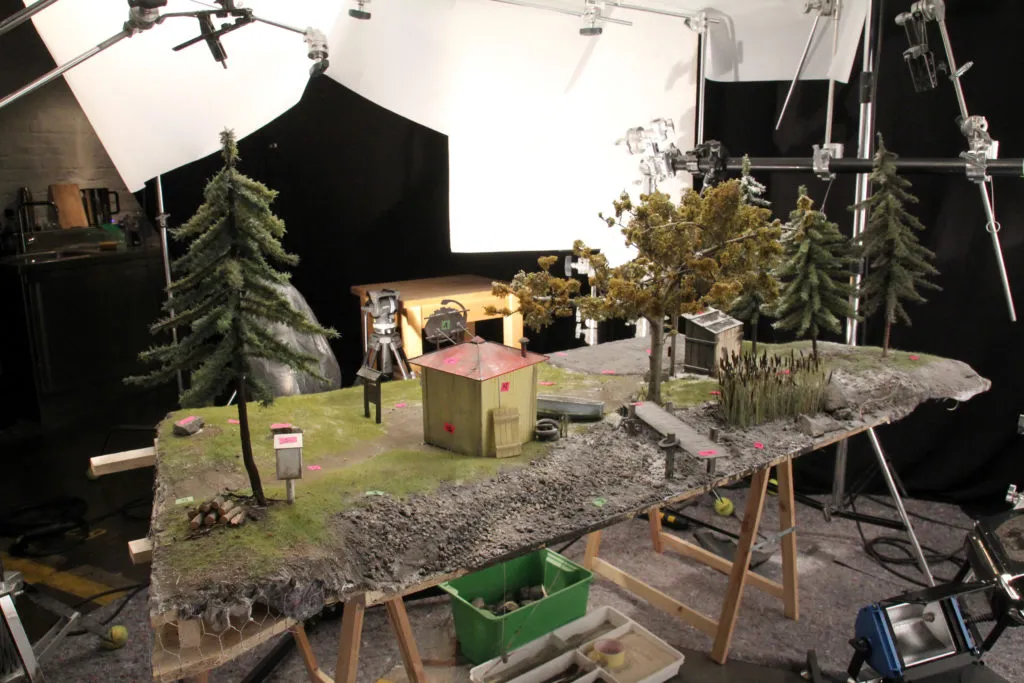
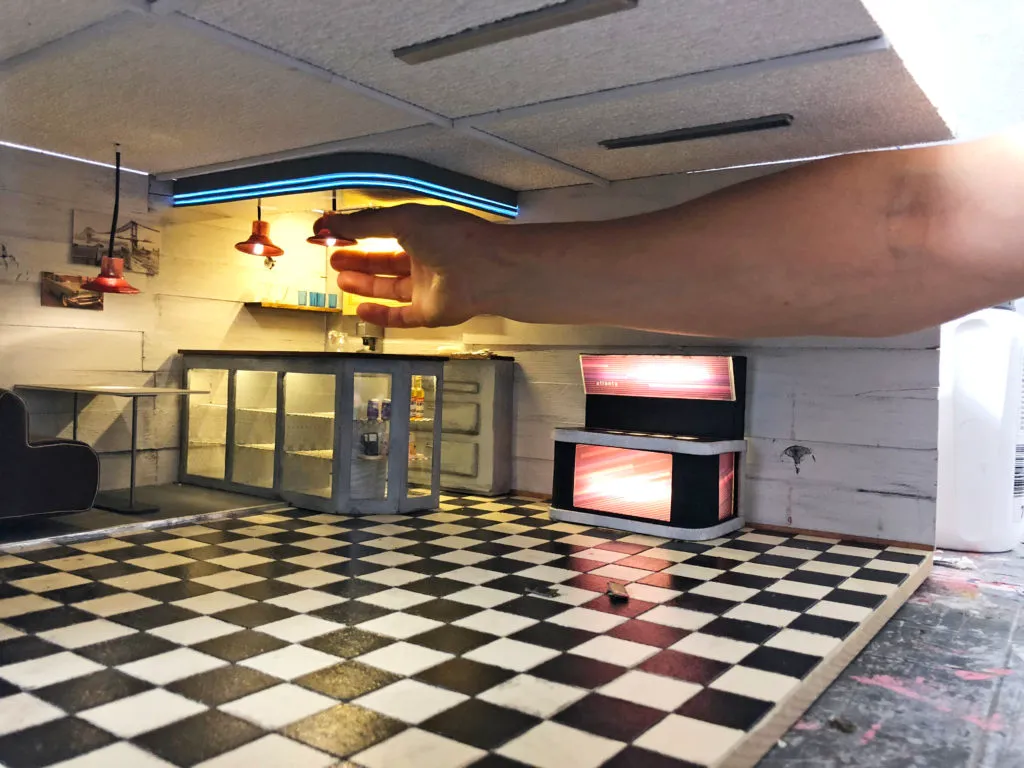
Each of the more than twenty miniature models presented us with its own challenges: Some of them show interiors, others exteriors; many models show familiar everyday objects, while a few of them are filled with rather strange elements originating from the realms of fantasy or science fiction. Our set designers built a lot of the individual pieces from scratch, using wood, cardboard, paper mâché, wire and modelling clay. More conventional model making materials were also used in the process, in order to create trees, grass, bushes, windows or lamps. For the many signs, pictures and paintings, tiny sheets were printed, carefully cut out and placed in the miniatures. Other elements are alienated everyday objects: A box package for chewing gum became an ice cream freezer, a compressed air bottle was transformed into a giant gas tank, and toothpicks formed the legs of tables and chairs.
On a side note, one of the first finished pieces of the game was the soundtrack, conducted by Sebastian Nagel and Albrecht Schrader. The idea might appear somewhat unusual, but we had decided for this approach in order to give the set designers a better opportunity to envision the village of Trüberbrook and its atmosphere in their minds already while working on the miniatures. So in a way, the music influenced a lot of what you can see later in the game.
Half of the scenery was built in Berlin in an old factory building that we’d rented from a friend. The other half was created in our studios in Cologne. The scale in which they were created ranges from the size of a shoebox to the size of a couch which could only be moved by at least 4 people. Though we managed to keep most of the tiny and intricately crafted pieces, we also underestimated how much storage space the larger models would need and therefore had to destroy some of them immediately after shooting.
However, transforming those miniature models into a believable game world posed a whole different challenge for us. After testing out different ways to digitalize the sets and transfer their uniqueness into digital game levels, it became clear to us early in the project that cinematic staging of the miniature models and using real lighting would capture the atmosphere of Trüberbrook best. Since many team members had a background in post-production for film, we borrowed a few techniques we knew from this area of work to achieve the look we had in mind.
Photogrammetry, a photo-based technique of 3D-scanning becoming more and more popular in game development, was an integral but not the only part of our workflow to digitize these miniature models. First, we staged the different miniature sets with atmospheric lighting, just like you would stage tiny film sets, and photographed them from an angle that was about the same as later seen in the game. Those were our “beauty shots” and they made up most of what can later be seen in the game.
Next, we switched to a more neutral lighting setup with an even light distribution across the whole miniature model, in which no part of it was too dark or too bright. We then took around 100 to 300 photos of that particular set from different positions and angles around the model. This second set of images contained the actual photogrammetry images that were later used in specialized software to calculate a digital 3D model. Such photogrammetry software compares pixel data across images, which is why there shouldn’t be any parts in the image that are too bright or too dark, as those hold no detailed information and are hard for the software to connect to other images. The results of the photogrammetry process were highly detailed 3D models of the miniature sets which were made up of millions of triangles. This amount of detail is fine for renderings in film, but of course too much for a game engine that has to render an image at least 30 times a second. To make the 3D model “game ready”, we had to reduce this triangle count down to a few thousand polygons per set.
The following steps in our pipeline are more commonly used in matte painting workflows for films: We projected the “beauty shots” of a miniature set taken earlier back onto the simplified 3D geometry and captured these projections as textures for the 3D model. As a result, all the details and lighting information of the 3D models came from the beauty shots and thus from the real lighting of the miniature sets. You can imagine the result as being basically photographs that were displaced in 3D space, which allowed us to utilize subtle camera movement through the levels.
By fading between such images or textures we were able to simulate changing lighting scenarios. For example, a beauty shot of a dark room and another one with the light switched on were used to fade back and forth in a way that gives the impression of a flickering light – a technique that is often used in stop motion films, too.
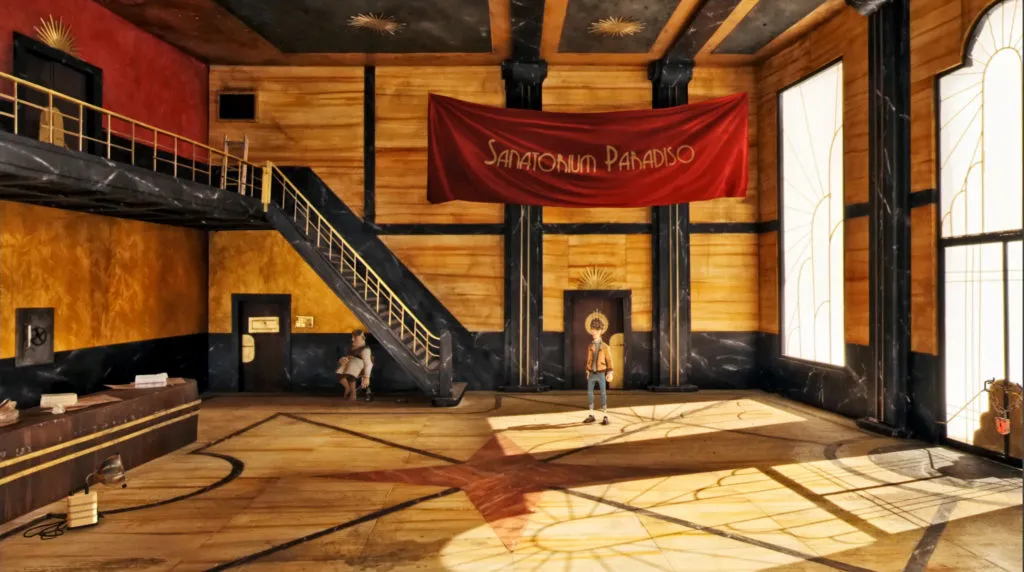
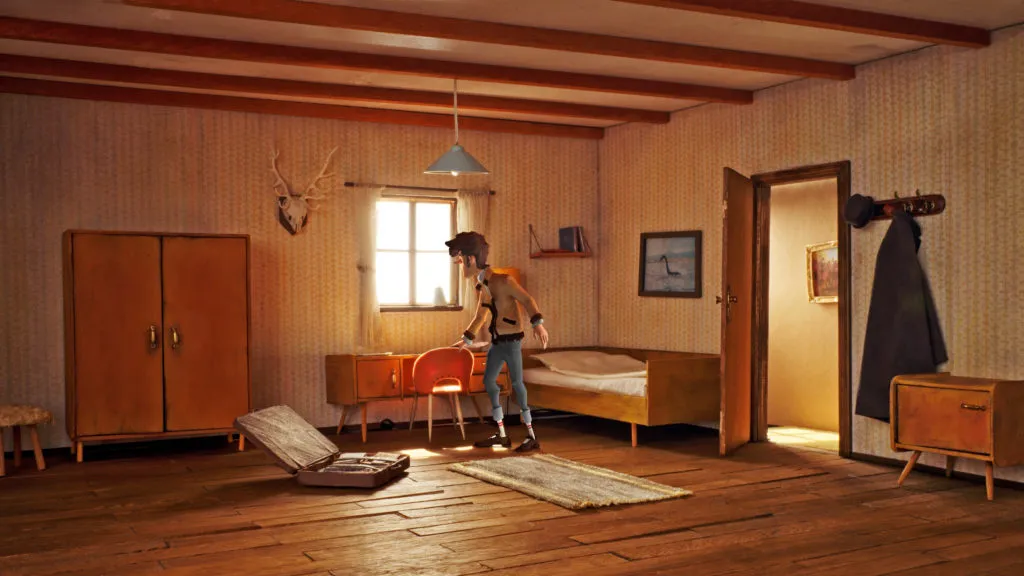
Finally, these finished 3D models are to be combined with characters and assets in the game engine. The characters were created in a bit more conventional video game pipeline. They needed the ability to move through the sets interactively and had to be able to react to different lighting situations — for example standing in the shadow of another object, standing on one side of a light source, standing on the other side and so on. This wouldn’t have been possible, or at least not easy, using hand-crafted and animated puppets. So we decided for a more conventional workflow here, eventually recreating the lighting setups from the real sets with digital lights in the game engine (Unity 3D) and trying to match the look of the characters as close to the miniatures as possible. Initially, our greatest fear was that our digital characters would not match our hand-created environments and that the game would look like a cheap bluescreen or like a collage. So we did quite a few experiments to prove that it was possible to make the digitally rendered characters fit in with the hand-crafted miniatures.
This set up of digital lighting for dynamic characters and objects also allowed the characters to cast shadows back into the scenery in real-time. We used shadow masks derived from the “beauty shot” image sets to determine where the shadows of characters could be cast onto the 3D model and where the texture of the scenery had an already pre-baked shadow from the real-world lighting. In a final step we added digital effects like particles and light shafts to further blend the characters with the backgrounds and to emphasize the spatial dimensions of the level. However, we also used some effects that were captured on set, like real water reflections cast onto a cave wall or light coming from a light bulb in the miniature that we later just masked out interactively in the engine to give the impression of a flashlight being pivoted around.
This is, in a condensed version, our rather unusual approach to create a workflow for a rather unusual visual style.
What we learned along the way
While we had to come up with unique workflows for our visual style, we also approached other aspects of the game in rather unusual ways. With the bold naivety of a newcomer we took the freedom to question established game mechanics and ideas on how a game should be and tried to make a game that we truly believed in, accepting that some, if not many players might not be all too happy with it. As expected, this resulted in sometimes strongly polarized opinions among players, with some questioning our sanity, while others seemed to approve our approach.
The bottom line is that the miniature models have given us the biggest headache, as this unique way to digitize our models came with quite a few obstacles during the production. We tested our workflow of baking photographs and then matching the digital lighting of the characters in the engine on a few set pieces early on in the production process.
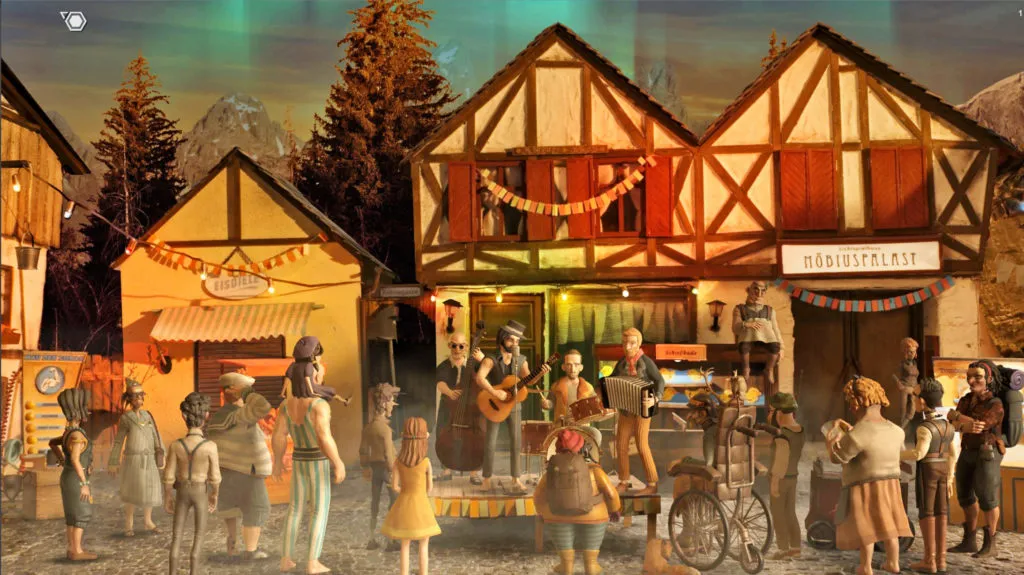
The band playing the concert in one of the later scenes was modelled after friends of ours, who in reality are also a band.However, we could not be sure if this somewhat “hacky” approach worked for all of the sets since the lighting situation and atmosphere varied a lot between the different stages. We found that smaller indoor scenes with a few practicals were the easiest to reproduce and in general resulted in the best match between characters and environment. Often large outdoor sets posed a bit more of a challenge because more lights had to be used on set and thus more factors played a role in recreating the lighting in the engine. We learned something new with each miniature set, and that being said, the last scene we worked on – which is actually the first one to be seen in the game as a result of reaching a stretch goal with our Kickstarter – turned out quite well. Despite the fact that, with an exterior and an interior being shown at the same time, this scene is probably one of the more complex ones in the game.
But all in all, we managed to polish even the scenes we are the least proud of to such an extent that the characters, even though they may not exactly look like the miniature model backgrounds, do fit in good enough to not being recognized as alien elements in the levels.
Of course, we also found a lot of ways to improve or automate our workflows further during production, for example by taking projection images from multiple sides, taking reference images of the surroundings with a chrome ball or capturing HDRI panoramas to recreate the lighting. Some of those ideas were too costly for us, but others actually found their way into our pipeline during production.
So above all, Trüberbrook was one big experiment, with origins that are probably closer to arthouse cinema or the German film d’auteur than to traditional video game production. Could we create a unique game world from miniature models and populate it with digitally created and yet believable characters? Could we tell a story in a world that seems familiar to some and exotic to others? Could we join the dusty surface of the Heimatfilm genre with an outlandish science-fiction story? We basically asked ourselves these questions from day one until the release and are still doing so today.
In any case, we hope to find these answers while working on our next game.
Florian Köhne & Hans Böhme – Designers and Creators of Trüberbrook
Florian (l.) has a background in graphic and motion design and has been working on various projects at btf, ranging from animation and film to game development. Hans joined the company for the development of Trüberbrook as an animator and artist. Together, they are half of the company’s game department.