


How a former The Witcher developer has had enough of AAA Games and is inventing a whole new genre.
Artur Ganszyniec was Lead Story Designer and one of the most influential people in the development of The Witcher. At some point, however, he was tired of the stress and pressure. He left CD Projekt Red and founded Different Tales, the somewhat different studio in 2018. A studio exploring the idea of slow gaming. A studio that wants to tell other stories. Stories rooted in the common human experience. Stories that you discover at your own pace. Stories with the potential to bring about change.
Their first game is Wanderlust Travel Stories. This isn’t a typical game; Different Tales name it a “digital travel experience”. You take the role of various modern travellers, live their adventures and shape their stories. Each character has his own whishes, hopes, and fears. You’re both the reader and the storyteller. You guide the characters’ actions and experience their emotions. With every choice you make, you create a journey of your own.
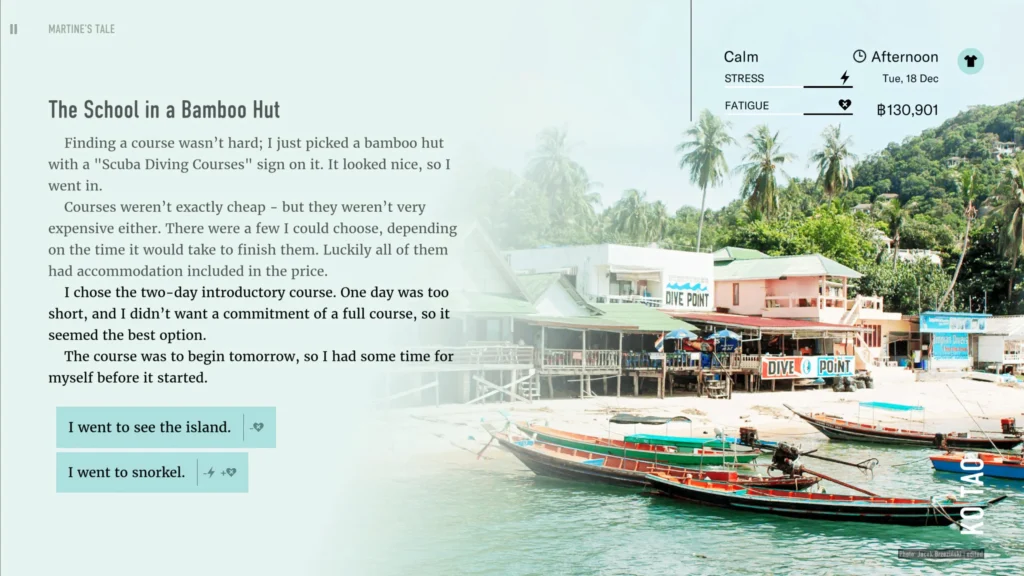
During his many travels Jacek spent some time in Thailand, and brought back the picture.
Wanderlust Travel Stories was created by a team of travelers, journalists, artists, and game makers and was inspired by real-life experiences. There are over 300,000 words of text in this adventure including four novels and five short stories. Relish in discovery and awe, longing and hope as you journey from Africa to Antarctica, from Europe to Asia. The change brought by this odyssey will be your own. A bridge between literary experiences and gaming.
Slow Gaming Movement is a response to the rising need for deeper, more grounded games and healthier practices in the game development industry. The goal of Slow Games isn’t to challenge skills and reflexes, but assumptions and feelings. Driven by emotions more complex than anxiety and fear of losing, they allow gamers to play at their own pace — and grow. Slow Games stem from views and ideas important to the team. They aren’t designed as toys. They are tales of common human experience. Wanderlust Travel Stories, available for PC, iOS and Android, is such a game. We had the chance to talk with Co-Founder and Game Designer Artur Ganszyniec about Wanderlust and his studio Different Tales.
Making Games: Please tell us briefly about your career in the gaming industry.
Artur Ganszyniec: I started working on the first Witcher game as a dialogue writer, later became the Lead Story Designer for the franchise, and I left CD Projekt Red a year or so before the release of The Witcher 2. For the next six years I worked on mobile games like Puzzle Craft or Another Case Solved. Then I spend some time in 11 bit studios, designing a prototype for a new project. And since June 2018 I am a part of Different Tales, and our first release is a playable documentary called Wanderlust Travel Stories. I also teach Game Design on Lodz University of Technology.
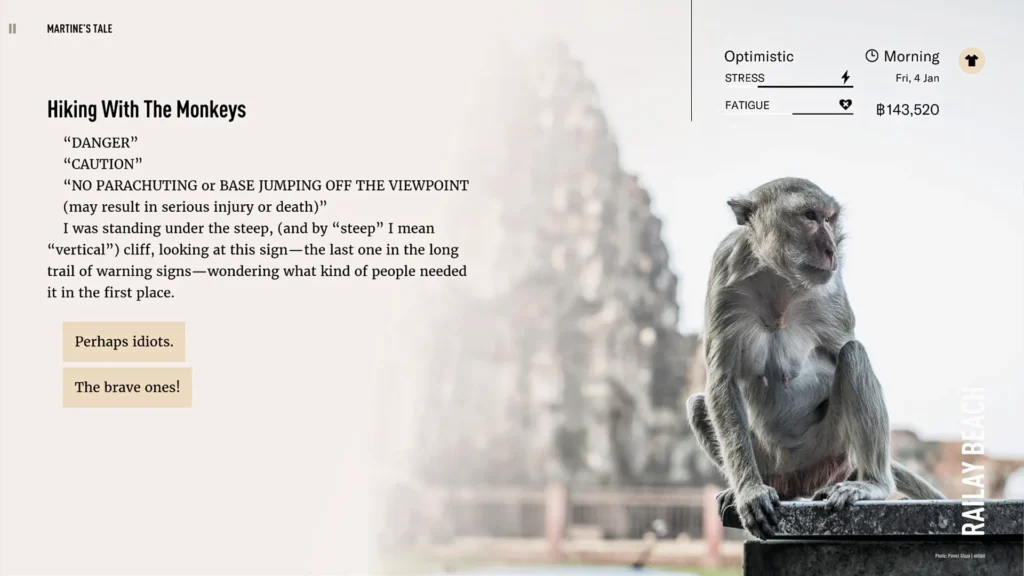
Monkeys are quite photogenic, but they can also be aggressive. If you’re not a professional photographer, proceed with care.
Why did you turn away from AAA games and make Indie Games now? Have you ever regretted your decision?
Making AAA games became just too much for me – the crunch, the constant stress of working in a big organization, the emotional cost of working on the same project for many years. One day I realized that I need something different, and quit. Making smaller games provides the same, or even more, opportunities to experiment and learn. The difference is that I manage to work on smaller projects in a way that is not damaging to my personal life and mental health. I failed to do that when working on AAA games. Have I regretted my decision? Sure, there were moments when I missed the thrill and adrenaline rush of working on high budget games, but overall I think it was a good decision for me.
You call your game Wanderlust a „Slow Game“. What does this mean and why is this your preferred genre now?
We had this idea of games that play on emotions other than fear, frustration and triumph, games that give you space to reflect on how you feel and what you think. When we started exploring the idea, we noticed many similarities to the Slow Living movement (Slow Food, Slow Fashion etc.), so we started using the term Slow Gaming, to talk about games like ours. I mean games that are grounded in local inspirations and personal experiences, games that do not exploit fears but encourage growth, games that trust you and treat you like an adult, games that are made in a way that is not harmful to the team. That are the ideals we strive for, and now we are discussing them with the industry, players, press, to see how others see Slow Games and what they need from such a movement.
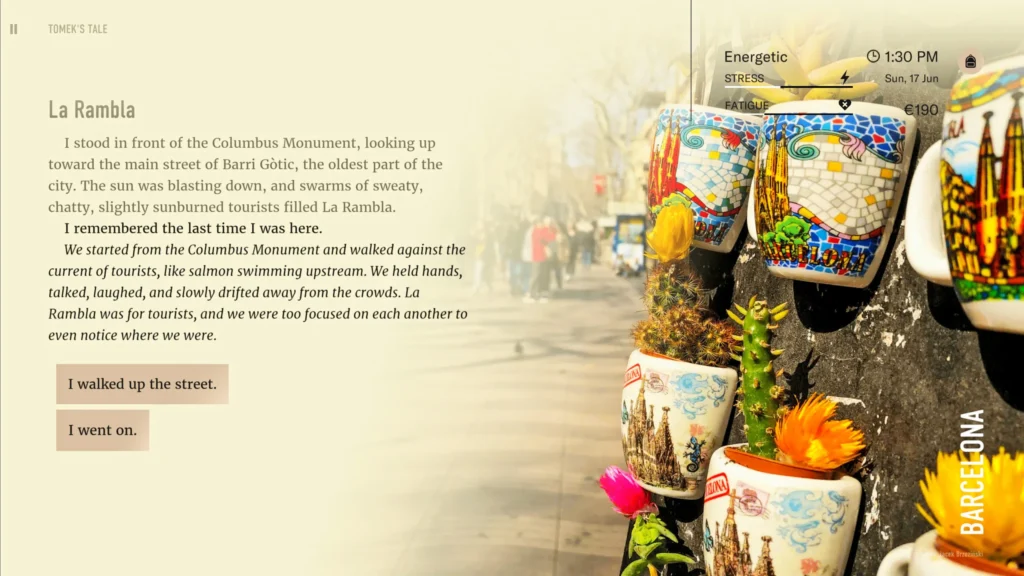
Joanna, who wrote about Barcelona, had lived there years ago, and Jacek flew there, especially to take the pictures for the game.
What inspired you to Wanderlust?
The inspiration was very personal. My business partner, Jacek Brzezinski (which whom I worked on the first Witcher, where he was the Project Lead), is a traveller. He visited over 110 countries, went around the globe, and travelling is a very important part of his life. When we met and started Different Tales, Jacek was working on a game about travelling – a backpacker simulator. We took this idea and after a few prototypes, we knew that we were more interested in simulating the feelings and experiences of travelling, not only the boring logistics of the process. And so Wanderlust Travel Stories was born – a playable documentary, something between gaming and literary experience, a collection of stories inspired by the common human need to learn about distant places.
Talking about the development process: What problems did you encounter in general and how did you deal with them?
The most interesting problem we encountered was that we had no benchmarks on the market. We knew that we wanted to make a playable documentary, so travel magazines, travelogues and interactive fiction were points of reference, but we had no idea, how to combine showing the world as it was, with a story shaped by player’s choices. We gathered a team of travel journalists, writers and translators, and started with research. Only when we knew what places and what problems we wanted to document, we started designing the stories. The solution we found was that we created fictional characters with their own engaging narratives, and we placed them in a real, well-researched world. Players, by making choices, shape the experience and the emotions of the characters, while learning about the world through the characters’ eyes.
This is the magic of games as a medium – the story moves forward only because I, the player, make decisions and then experience the consequences first hand. I am no longer an observer, but an actor and the story is no longer something I read or saw, but something that happened to me. This is a powerful learning tool.
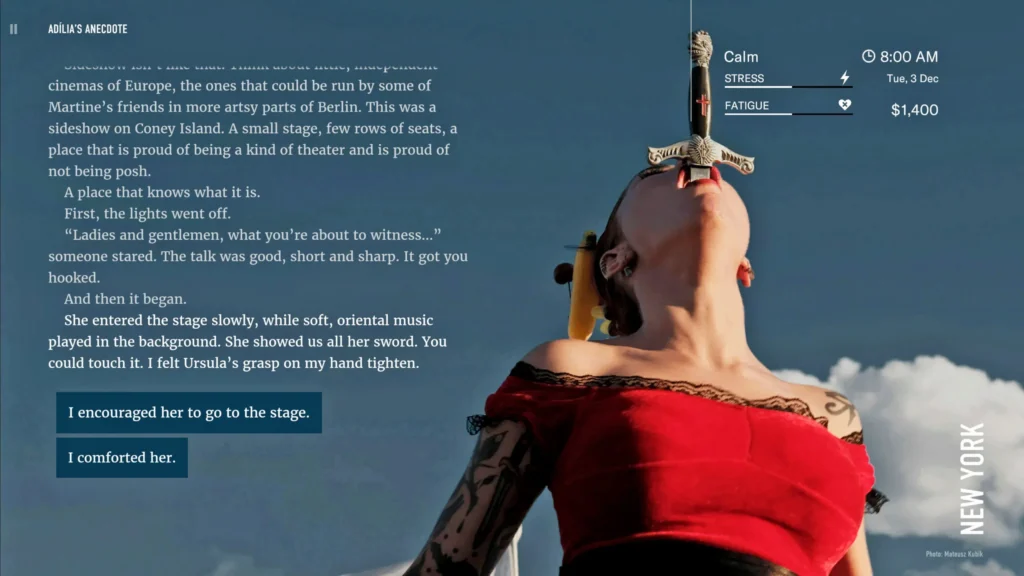
The American short story is based on Karolina’s documentary book about Coney Island.
Which feature are you particularly proud of?
I think the whole team made a great job and I’m very proud to be a part of this production. Personally I like how we managed to show that what we see when we travel, is coloured by our emotions. In the game, the player’s choices influence the character’s mood, and the mood changes large portions of the text. So, for example, Paris can be a beautiful city when the hero is optimistic, and a dirty, overwhelming metropolis, when the hero is sad. The system works in the background, almost unnoticed, but I really like how it makes every story unique and personally aligned with the player’s choices.
How did you finance the development?
We were financed by Walkabout Games — a Polish game dev studio incubator. We pitched them the idea, and they helped us with the business side of the production and also acted as the publisher for Wanderlust.
The (lack of) state support for the games industry is a much-discussed topic in Germany. What about it in Poland?
The game industry in Poland is still growing, at least that is what I see, and games are becoming a hot topic for Polish politicians. There are some financing programs you can apply to, but I think that the state is still trying to figure out how to approach the matter, as the biggest state-funded program GameINN, doesn’t work very well, at least in my opinion. Most of the devs reach for private funding, try their luck on the stock exchange, or work with various accelerators or investment companies.
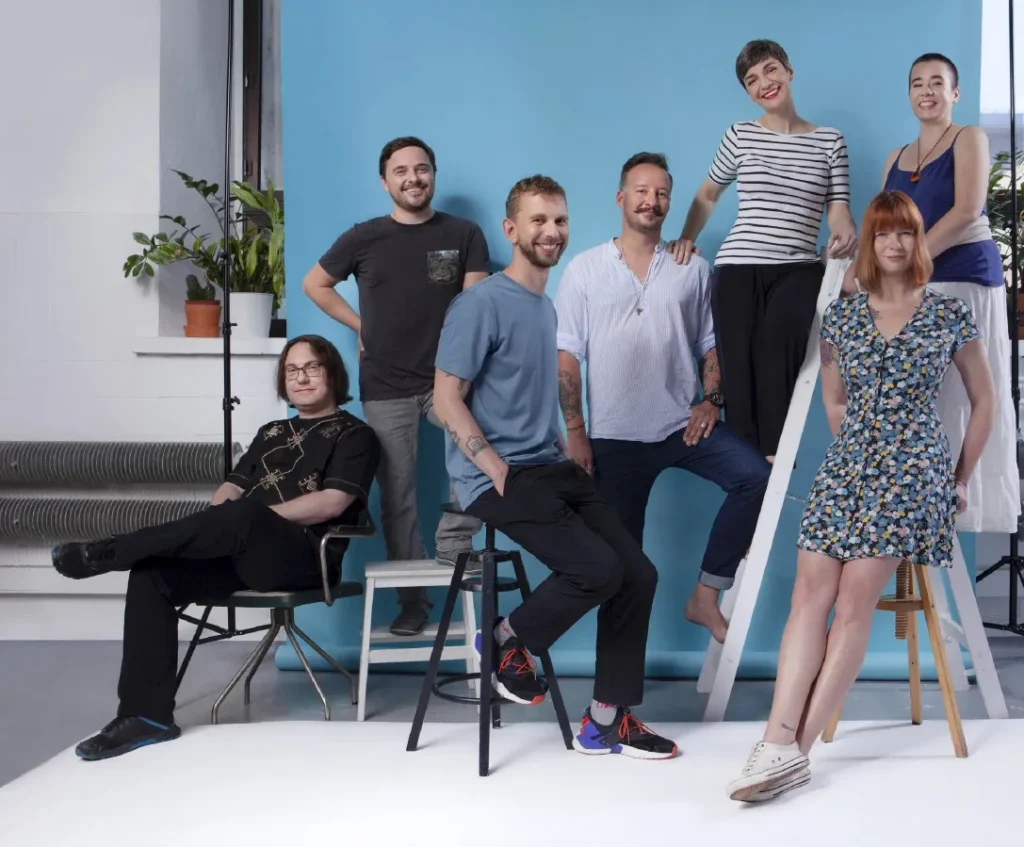
The Wanderlust team. From left: Jacek, Artur, Piotr, Mateusz, Joanna, Karolina and Marta.
How satisfied are you with the reviews, the feedback from the community and the sales so far?
We knew — when we were working on Wanderlust — that this would be a tough product to sell. Many of our perfect customers are not gamers, but consumers of culture in general, and reaching them is a tricky thing when you come from a gaming background. We managed to reach outside the gaming market in Poland, but not in the USA, at least not yet. The reviews we received were great, and so is the feedback from the community, so we keep working to bring Wanderlust Travel Stories to as many platforms as we can, and hope for the best.
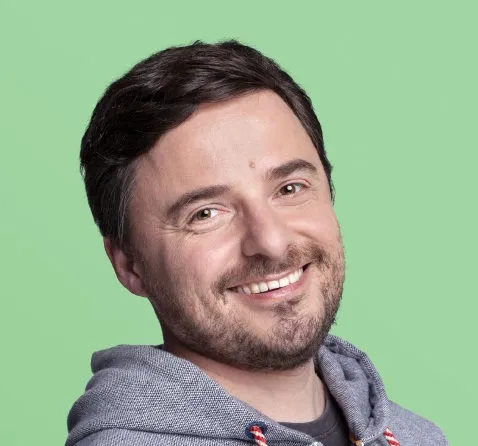
Artur Ganszyniec – Co-Founder and Game Designer
Having grown up isolated behind the Iron Curtain, Artur was fascinated with books about the wonders of the world. He was the Lead Story Designer on The Witcher – a game awarded for its immersive narrative. Artur is also the person behind Puzzle Craft, the winner of Best of App Store 2012 in New Ways to Play. Now he’s crafting the Wanderlust experience.