

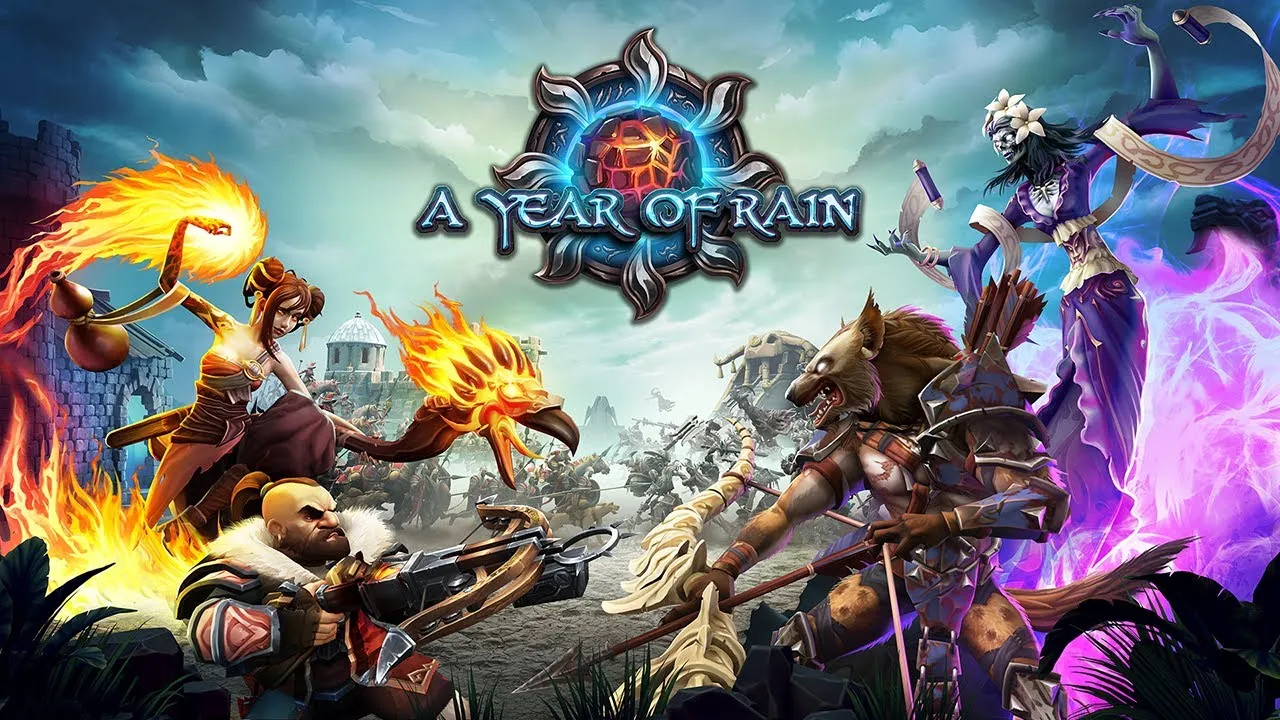
Creating a clear mix for RTS games.
Have you ever had the feeling that a game’s sound was just too overwhelming? And that you would rather turn down the sound or mute the game altogether?
To not lose the interest of players, it is essential for sound designers like us to create immersive soundscapes to keep our players excited and engaged.
Every game has its own set of challenges that can be solved differently according to what we aim to portrait to the players. One thing is almost certain – if a game has any explosions and involves any warfare, it is expected that the soundscape translates this feeling of being right on the battlefield. Some games like the Battlefield and Call of Duty franchises along with modern-day blockbuster cinema have raised the expectation level of quality very high and have focused on delivering high impact immersive experiences. But what about games that are in the 3rd person and look down on the battlefield? Do you still expect to hear less than when you are playing in first person? Do you want to listen to the same amount of detail, or would you expect to hear only the essential sounds?
Working on a real-time strategy game has been a big learning curve in terms of finding the right way of approaching the soundscape. There are many RTS games on the market that adhere to a certain standard when it comes to the sound mix. But to what extent should the existing model be followed and when should something different be used? In the following passages, I narrow down the key elements that we have established as necessary for a clear mix.
A Year Of Rain is an RTS game that draws influences from both the RTS and MOBA genres, and it relies heavily on team play with a focus on powerful heroes.
As stated right before we heavily rely on engaging, competitive team play, and therefore, the sound needs to be accurate, first and foremost. Some companies use phrases such as “Gameplay first” or “Gameplay is King” to outline the importance of laying down gameplay foundations first. Your target audience will, in a way dictate the outcome of this question – are you making a game that is more for a casual gamer market, or are you aiming at the more competitive games market? A casual game can be more forgiving when it comes to sound and doesn’t necessarily require as much active listening on behalf of the player then in a competitive game. Active listening is crucial when there are relevant sound cues that the player needs to pick up on.
Placing the Listener – Spatialization
Let me start by introducing the ears of the game: the listener.
All sounds we hear in-game are being listened to by a virtual sphere that follows us across the battlefield, picking up sounds around it that make use of a technology called Spatialization. Spatialization is a term that comes up quite often in the RTS realm. In essence, it is the distance between the sound object that is producing/emitting sound and the listener.
Finding the right listener placement was not an easy task in A Year Of Rain, and we tried out a couple of positions to test results. Eventually, we decided to place it down the middle of the screen on the ground and attached it to the player’s viewport. So wherever the player navigates, the listener will follow and provide the reference point for every sound that is playing.
Although not every sound needs to be spatialized. For example, many sounds are left unspatialized on purpose, such as user interface sounds or speech lines, that need to be heard in all locations on the battlefield. This is crucial because some information needs to be communicated urgently, like when your builder finishes constructing a new expansion building and is waiting for further instructions while you are still off fighting a battle somewhere else.
From the start, I wanted to place a greater focus on sounds for spells and heroes, making them appear more powerful. To achieve this, the heroes’ sound sets have received a slightly different spatial treatment to the other combat-related sounds to highlight their importance in the mix.
It is important to know the scale of your game and how many sounds will be playing at the same time.
Creating Distinct Sound Sets
Distinction is a key value of mine that I believe is vital for the players to identify sounds quickly, and therefore, each unit needed to have a unique set of sounds. My theory is that if you can distinguish a sound without looking at the screen, particularly which characters are on-screen and what they are doing – then you have done a good job.
This is a very high bar to reach, and I certainly do not take this value lightheartedly. There are many assets that need to be produced in an RTS game and making sounds unique while retaining relatability and having the player understand what every sound means is not so easy. For example, the sound of a metal sword hitting a wooden structure in our minds will sound a certain way, and if you approach this sound with too much abstraction and create a completely unrelated sound for this interaction, the player will be confused.
Each hero’s sound set consists of a unique attack and impact sound, a set of 4 spell sounds, a spawn and despawn sound and a unique death sound. While I was making every set, I had to stay within the bounds of each hero’s style and keep a sense of continuity so that every sound fits the designed character.
For the standard units in our three factions, we have created a globalized system for the attack impacts heard in combat. We have created a tag system that compares the attacker’s tag, the “Audio.Weapon” and the attacked unit’s tag, the “Audio.Armor” and plays the corresponding impact sound. Currently, we have four main armour/weapon types, including metal, wood, magic, and bone. There are variations of impacts for each armour/weapon combination such as metal on metal, magic on wood, or wood on bone.
Additionally, all heroes have a separate audio weapon tag that is unique to their character that plays on top of the primary impact system so that you can clearly distinguish between standard units and hero impact sounds while in action. You could argue that having a unique impact sound for every unit can be a benefit in terms of distinction, but what is important to know is that each unit has not only an impact sound but also an attack sound. What I have learned during the production of these sounds is that creating so much diversification in the sounds you are potentially doubling your content production load and creating twice as many files as a result, which all have to be loaded in the engine – something that could impact the overall performance. So it is crucial to draw the line at the point where further diversification only has a marginal benefit to the overall experience. Sometimes less is more.
Whenever I am in a new place, I try to capture the sound with a light portable recorder. Using diverse sounds from many locations is very rewarding.
Voices with Cooldowns
Another crucial aspect of the sound designer’s task is creating believable voices that make the standard units/heroes come to life. This process starts in the casting process, where our author chooses the appropriate voice-over artists to act out the units’ lines. When the voice recordings have been recorded and arrive at my doorstep, I choose
which effects should be applied.
As you may imagine, these voice actors put a lot of effort into delivering their lines, so it seems fair that every voice should be heard. Sadly, this is simply not possible in our format, as we do not want to have multiple people speaking at the same time. Mainly we just want to hear the things that are most important at any given moment. Therefore we need a system that creates priorities for certain lines that need to be heard above everything else. This, unfortunately, means that we have to fade out and sometimes stop lines even if they haven’t finished the sentence. Here we needed to evaluate what we wanted to prioritize, and in our case, I needed to make the decision of hearing the line right away and not only after the unit has finished speaking.
An exception is the death sound that each unit makes, which is usually a short gasp or cry that the player needs to hear to know that the unit has been killed.
Death sounds fall into the category of unit barks. When issuing orders to a unit, a unit bark is triggered, which is a line that a unit says when given an instruction, for example, when a unit is told to attack a target. In RTS/MOBA games, there is usually a frequent rate of clicks per minute, which is part of the player making a lot of tiny micro moves with their units. These micro moves would, in theory, trigger unit barks every time the player clicks, so a limit (cooldown) is placed on how often such a bark can be played. Some games do not have a limit and simply cycle through variations of that unit bark every time an order is issued. This is something that might feel more responsive to the player, but it also means that you hear the unit barks non stop, which can get annoying very quickly. We have setup cooldowns between the barks to avoid repetition and to create breathing space in between the lines.
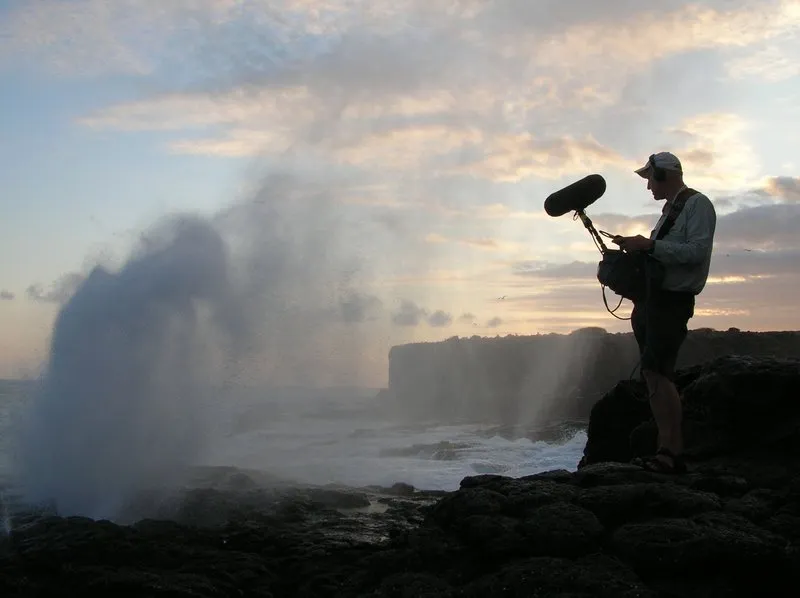
Sometimes you need to go out and record source material – and often the more unconventional, the more fun you will have later in the studio!
Audio Occlusion in Fog of War
What about sounds that are not visible, that are covered by this layer of darkness, what about those?
How do you deal with a mysteriously dark veil that spreads itself across the map? Fog of war is a subject that can be seen in a very (excuse the pun) black and white way.
There is a binary approach of making sounds that are visible and audible and sounds that are not visible and covered by the fog as inaudible.
The upside to this approach is that you are clearly defining the borders of where sounds start and where they end. The downside is that you risk having half of the map sound lively while the other side sounds completely quiet.
An option to compromise here would be to have several sound cues that can be heard through the fog. These cues may act as hints or warnings to the player that there could be danger lurking – this is something that would require more active listening on the part of the player but in turn would create more opportunities to use audio as part of the player’s decision making. For example, you could have just heard the activation sound of a spell from the enemy hero in the fog that might tell you that they are in your vicinity.
The way that we have set up our fog of war system in Wwise is that we created a parameter that occludes the playing sound, making it inaudible when it is inside the fog. When returning to vision, the parameter reset, and the sound is made audible again. This applies mostly to all unit related sounds and not to the ambience which ignores this occlusion.
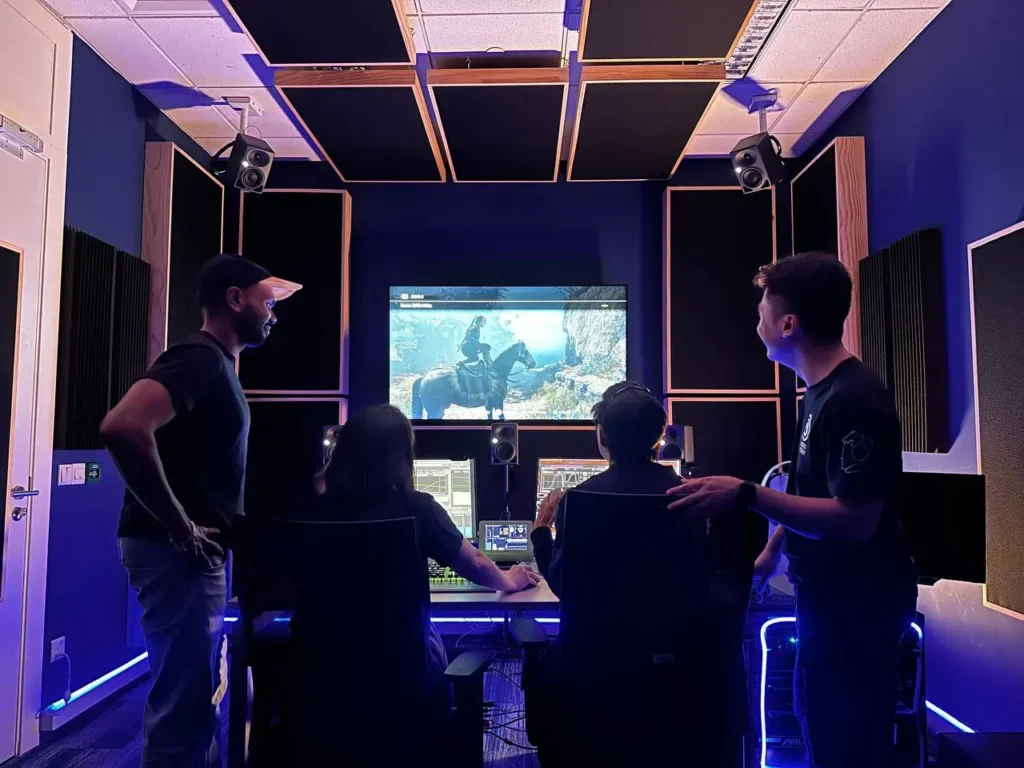
I have colleagues that own training weapons and sometimes I ask them for a duel in the recording room!
Dynamic Mixing in Wwise
As our sound engine, we have chosen to use Wwise, which has made it incredibly easy to adjust and control the mixing of the game’s sound.
What has really helped me adjust and set the levels of the mix is the remote connection feature in Wwise, which allows me to play the game and make changes in real time. This is a handy tool that saves time in the mixing stages.
Wwise also lets you switch between specific mixes using states, and this is another excellent feature to improve gameplay by accentuating the sounds of the heroes when they are in action. By default setting the game is in a non-combat state but as soon as you enter into combat with a hero there is a change in the mix, and all hero sounds are slightly raised while most other unit sounds are lowered. Simultaneously the sounds of the heroes’ actions are ducking the output level of these other sounds using Wwise’s Auto-Ducking feature. This makes sure that you can hear all of the hero’s moves among everything else that is happening.
Lastly, it is vital that you control the number of instances in which a sound can occur. The difference between hearing one knight attacking and five knights attacking is clearly audible, but if ten knights attack all at once you can generally get away with firing only five attack sounds and don’t need to play that sound ten times. This helps control the soundscape and avoids sound cluttering.
So, summing up here are five takeaways from what I have learned from the process of mixing an RTS game:
Distinction – creating sound sets that can be easily recognized by the player and are easily understood.
Spatialization – find the right place for your listener and how the listener perceives the sound (i.e., spread, focus, and attenuation).
Cooldowns/Limits – having cooldowns in between sound cues that can often trigger, like speech lines, adds breathing space in the mix. Limit the instances of your sounds to avoid sound clutter.
Audio occlusion – choose which sounds you want to occlude and how the sounds change from fog of war to vision.
Dynamic mixing – set up states and use auto-ducking to create a dynamic battlefield soundscape.
Ivo Sissolak – Audio lead at DaedalicEntertainment
Before joining Daedalic Entertainment in 2017, Ivo worked in the South African games industry with local indie developers as a sound designer and a music composer. Since entering the industry, he is constantly experimenting with new sound design techniques while recording sounds from all over the world to use on his projects.