

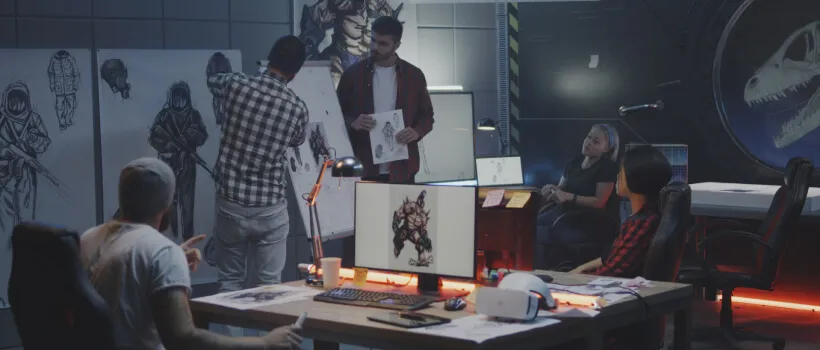
Why it’s crucial in game development to spend enough time figuring everything out before you actually starting to build it.
The main objective of a pre-production is to define all the requirements and goals for the actual production phase of the game. It is the time when you write the design specs, do the overall planning and prove that your core game mechanics are fun by creating prototypes. You should also try to address any potential risks and open issues you still have and find solutions or mitigating actions for them before moving forward.
Although I personally think that we do not have too much in common with the movie industry, pre-production is perhaps one of the few parts where a comparison works, at least to a certain extent. During the pre-production of a film, the script is finalized, the storyboard is created and the budget is planned. In addition, the main actors, director and cinematographer are hired and location scouts look for filming sites for each scene.
In terms of the general concept, this is a great analogy to what we do in games. If you look it up in wikipedia the respective article says: “Pre-production ends when the planning ends and the content starts being produced.” You can hardly phrase it any better.
Why is a Pre-Production so essential?
During pre-production, you only work with a small group of dedicated people. This allows the creative process to be much more focused and purposeful than in production, when development is already full steam ahead with a large crew.
It is more efficient and cost effective to first specify all the requirements and the overall scope before starting the actual implementation. And it‘s also better for team motivation, rather than rushing into production without a clear vision and shared goals. If team members are constantly working on things that are repeatedly revised or even discarded due to poor planning, their frustration level and demotivation will skyrocket within a few weeks.
In his highly recommended book “Software Project Survival Guide”, author Steve McConnell cites a 1988 study that says it costs 50 to 200 times as much to fix an error late in a project than to correct it at the point it originally occurred. He calls this phenomenon “Upstream vs. downstream costs”, and although this study may be more than 30 years old, it still applies today.
So, for example, if the definition of your “Camera, Character and Controls” (CCC) was not worked out sufficiently in pre-production and not tested thoroughly enough with early prototypes, you can easily run into serious problems later. Making changes to such essential underlying systems while other mechanics and even entire levels of the game are already built on them becomes a very frustrating, error-prone and time-consuming (=expensive) exercise.
The same applies to all technical implementations, of course. If you start writing thousands of lines of code without even having a clearly outlined or finalized technical architecture, that’s a sure recipe for disaster. It is like trying to build a skyscraper on quicksand.
Duration and Team Size
The length of a pre-production can depend on many factors, such as the complexity of the game itself, the experience of the individual team members and the many different project requirements that affect the overall planning. And while – as with everything I write in this article – there is no Holy Grail, in my experience a good rule of thumb is that at least ~1/3 of the total production time should be spent in pre-production.
If the overall project is rather small or the studio is very experienced because they have worked on a similar game or genre before, it can go down to ¼, but anything less than that can be extremely dangerous. Remember: it is not about completing this phase as quickly as possible, even though it may seem tempting to jump straight into content creation to produce supposedly “cool shit” that you can show to your stakeholders (or the players out there).
Apart from a few initial benchmark art assets, pre-production does not produce too many spectacular visual results that will impress marketing. Even your core playable, the essence of your all your prototyping efforts, will most likely consist of placeholder or prefab store assets. But patience and a careful approach are key here to lay a solid foundation for a smooth and efficient production phase.
Also, as mentioned earlier, one of the key factors for a successful pre-production is to have only a small but dedicated team focusing on all the deliverables. This is not the time yet when you want to work with your full studio and produce tons of content. Ideally, it is mainly your senior staff who set up the new project, as they are the most experienced when it comes to the potential implications any decision can have at this early stage.
Onboarding the rest of the team, official kick-offs and getting everyone excited is of course important too, but only when the project gets the final greenlight – and not during a phase where it could still be cancelled for good (or bad) reasons.
When to do what in Pre-Production
But not only the time you need to create all these deliverables is crucial for the success of your pre-production. Another decisive factor that is often completely ignored is the chronological order in which you should tackle the different matters.
A great mnemonic trick to describe when to do what in pre-production (and project planning in general) is what I call the „Hitchcock method“: In his book “Le Cinéma selon Hitchcock”, French Nouvelle Vague director François Truffaut interviewed Sir Alfred Hitchcock about his unique approach to filmmaking.
One special method described in the book (using the intro sequence of “Psycho”) is Hitchcock’s montage technique of starting with a wide-shot and then moving into a series of more and more close-up shots, for example, zooming in on an actor or a special object. In “Psycho” you first see an establishing shot of the city of Phoenix, then the camera continues down to street level, approaches a building, zooms in on a window, flies through the window and ends on Marion Crane, lying on a bed.
And in a nutshell that is exactly how you should approach your pre-production and all your planning efforts: Always go from the big picture to the smaller, more granular details.
I have seen studios start task estimates of individual user stories before they even had a clear Vision Statement for their game. Or even worse – and in such cases often dictated by either a very inexperienced or very ignorant publisher – final milestones were defined before any planning had even taken place. This then led to a development team attempting to create a production plan with tasks and time estimates based on these predetermined milestones. Which obviously never ever worked – not even close.