

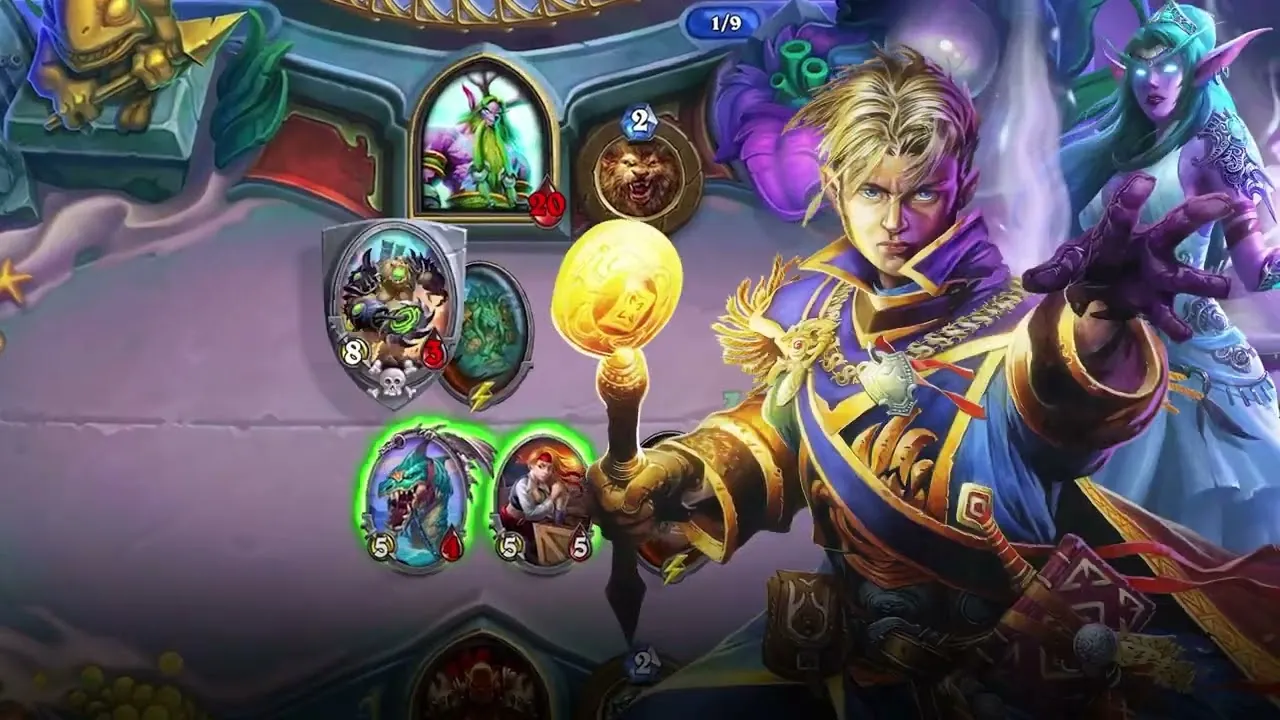
The card game »Hearthstone« started as an experiment with just a small team of developers but quickly became a hit played by millions of people. In this interview Blizzard shares insights about the development and the secret why the game is successful.
UnityContainer According to reports, »Hearthstone« had 10 million active players. Did you ever think the game would be this successful, or were you just as surprised?
Jason Chayes We generally try not to have any particular expectations on how big the game will be or could be. Our focus is really more on creating the game that we’re all excited about, the one that we always wanted to play. We usually get pretty good feedback through the beta; whether people love our projects as much as we do. This system works really well and helps getting a sense about whether this could be a big game, but overall we never know just how big a hit with the players it will be in the end. We are certainly thrilled with how many people out there play »Hearthstone« today.
UnityContainer What do you think is it that makes »Hearthstone« so popular, and where do you think the fascination for card games like this comes from?
Jason Chayes Everybody in Team 5 – that’s the group that develops »Hearthstone« – has been a fan of card games for a long time. Some of us have been playing them for more than 20 years, simply because we feel that there are some awesome sides to this particular genre, even though some parts are almost too deep. Every time we talked to friends about it, we got the feedback that although they liked the games overall, they thought a lot of them weren’t suited for the mass market. It was a big challenge for us to find a way to take this fun genre that has been inaccessible and try to turn it into something that anybody could just pick it up and play. And that’s what »Hearthstone« was all about: We wanted to take our passion and create a game that anybody could learn within five minutes. I think that’s been a big part of the success of »Hearthstone«.
UnityContainer How did you make sure that literally everybody was able to quickly understand the principle of the game? Were there any game elements that needed to be changed during development in order to guarantee easy access to the game?
Mike Donais One of the things other card games struggled with was waiting for your opponent to respond during your turn. That interaction was really slowing down the game, making it less fun. We took this out for our game and came up with a system where you take your whole turn and when you’re done, it’s your opponent’s turn. That way it makes it really easy to play and offers a very relaxing and smooth gameplay. That’s only one of the many things we tackled. All the other streamlining during gameplay like not having to declare your blockers has really made it faster and easier to play. The other thing is that »Hearthstone« has a very good sound and animation team, so every card in the game has its own sound and animation for when you attack or when you die. That alone makes »Hearthstone« a fun experience to just watch and see what happens during a turn.
Jason Chayes That’s right, and also the cards themselves play an important role. We invested a lot of time making sure that they are easy to read and it’s obvious what they do. The player can just look at them very quickly to get an understanding of what’s going to happen. So it’s this plus all the things Mike mentioned that make »Hearthstone« a very accessible game.
UnityContainer Don’t you think the fact that Blizzard was the developer and the »Warcraft« universe the basis for »Hearthstone« was the actual key to success?
Jason Chayes The »Warcraft« universe is definitely an important aspect of what makes »Hearthstone«. For people who are used to playing »World of Warcraft« or who love the »Warcraft« strategy games, there’s been a lot of déjà vu in terms of the cards in »Hearthstone«. But apart from that gamer group, we got a lot of people for whom »Hearthstone« was their very first Blizzard game; who haven’t been playing »World of Warcraft« or any of our other games. The fact that »Hearthstone« appeals to them and reaches players who have come to Blizzard for the first time, is a huge part of the success of how »Hearthstone« actually got bigger than it might have been otherwise.
UnityContainer So that means you’re trying to use »Hearthstone« primarily to attract players who haven’t been exposed to Blizzard or your games yet?
Jason Chayes Absolutely. And as I said we think that has happened already. Once people get introduced to »Hearthstone«, they are often really interested to try out our other games that are related to »Warcraft«. For instance, they may give »World of Warcraft« a try and like the fact that there are the same spells, character classes or minions that they already know from »Hearthstone«. So we definitely think »Hearthstone« could be an entry into the world of Blizzard for some people.
UnityContainer Do you think it’s beneficial for the development of a card game like »Hearthstone« to completely rule out trading cards amongst players?
Jason Chayes That was indeed a very conscious decision for us. We discussed it a lot in the beginning whether we should allow the players to trade cards or not. In the end there were a lot of reasons why we decided not to include that feature. Since most of us already had a lot of experience with trading card games in the past, we knew it would be hard especially for new players to know the value of a card that they just got out of the card pack. In all these card games, there are different levels of rarity – there are common cards, epic cards, legendary cards – and a new player simply can’t know the exact value of a particular card. From our experience we can tell that it can happen that you may have a really good card and be offered two other cards for that, and while it seems like a good trade, if you know what you’re doing you might realize that the trade is not in your favor after all. We really wanted to make sure that everybody had a good time with »Hearthstone« without having to worry about the value of a card. That was one of the biggest factors for the crafting system as a means to improve your collection rather than having to trade with other players.
UnityContainer So trading cards among players won’t be an option you may consider for the future either?
Jason Chayes No, at this point we have no plans to add trading to the game.
UnityContainer How did »Hearthstone« change during the development in general? Have there been a lot of modifications over time?
Jason Chayes I would say that the core of the game was largely understood from the very beginning. We knew what key elements and game mechanics we wanted to focus on; we also knew which character classes we wanted to design and what their skills should be, like what abilities the mage, the priest or the warrior should have. All of that we understood pretty early on. The big changes that happened were more along the lines of how we tweaked their abilities. Early on in the development we had some really powerful abilities, but we didn’t really understand how good they were until we went through the alpha and the beta process. A good example for that is the rogue whose special ability summoned a dagger, just like in the final version; however, you could increase the attack value of the weapon one by one if you didn’t attack but used the ability again and again, and thus created a kind of super weapon. So after a while we realized that some of our initial ideas didn’t work out in terms of the balancing. So we kept modifying a lot of skills and creatures in order to make »Hearthstone« a great experience for everyone.
We wanted to take our passion and make a game that anybody could learn within five minutes.
UnityContainer How hard is it to properly balance a card game like »Hearthstone«? Particularly with regard to the number of cards in the game, it seems this could be quite tricky.
Mike Donais Card games consist of a lot of game elements that can also be mixed in very creative ways, so it’s almost impossible to predict what players are going to do next. But at the same time that’s one of the great things about card games because players always come up with new crazy combinations and strategies that we never expected would work at all. So card games are indeed tricky to balance. The challenge for us is finding the cards that are dangerous and putting extra attention to those cards and be extra careful with them while the cards that are not as dangerous can be pushed in different ways to add more fun. So, yes it is tricky, but since we have a very solid team that puts a lot of time and effort into it, we’ve done pretty well so far.
UnityContainer How do you usually proceed when you design a new card?
Mike Donais When we design a new card, we come from two different directions. About half of the cards are designed by coming up with the idea, the art, that kind of thing. And then we try to design what the card does in the game. The best example is the »Piloted Shredder« card; we start with an initial concept and then pitch about five different ideas, thinking what a »Piloted Shredder« could do. What we eventually came up with is that when it is defeated it summons a random 2-mana minion. But of course there were more aspects that needed to be clarified such as the question of how much mana the card itself is supposed to cost and so on.
The other direction we come from when designing a new card is having an idea for a certain gameplay mechanic. For example, we might think that we’d like to have a card or a spell that’s triggered immediately when you draw it. Then we might think that this should be a rare thing to happen and what effect it should have – flames, for instance, and then these ideas slowly merge into a new card.
UnityContainer A lot of free2play games have a kind of ingame currency – be it diamonds or other things that the player can buy in order to trade them for items, a new life or such things in the game. Why did you decide against an ingame currency – apart from the gold the player can earn – but to show real prices instead?
Jason Chayes That’s right, the only ingame currency we have is gold that the player can earn. We decided not have a currency for content you can purchase in order to keep the game as simple as possible. A fantasy currency always creates a level of abstraction for the players where they need to know, for example, how much money to spend for 1,000 diamonds that they can then use to buy certain content in the game. We didn’t like to have this system for »Hearthstone« because we wanted to make it obvious how much a card pack was. This traditional free2play system might make sense for games in the future, but we evaluate that on a case-by-case basis. In case of »Hearthstone«, we wanted the players to always know how much money they needed to spend in order to get a certain number of card packs.
UnityContainer Do you see changes in the buying behavior of the players because you’re using real money pricing rather than a fantasy currency; maybe because your system is more transparent and no conversion is necessary?
Jason Chayes Obviously it’s hard for us to compare it because we launched the game with this system. However, we monitor how many packs are purchased with gold compared to real money, and what we noticed is that there are people who are competing at the very top level who have never put one cent of real money into »Hearthstone«. So there are people who earned all their gold through quests or the arena, and they use that gold to expand their collection, to play in the arena and just work their way up in our ranking system. Therefore we can say that in comparison to real money, the ingame currency in »Hearthstone«, too, is a very effective way to advance through the game.
UnityContainer It’s quite uncommon for a free2play game that the player can advance through the game without spending a single cent. Did it never cross your mind during development that this could become a bit risky in terms of revenue? You have to consider the bottom line after all.
Jason Chayes The way it works here at Blizzard is that we always focus on the game first. We want to build a great foundation and brainstorm what’s best for the game rather than talk about a business model. In the past we had great successes with traditional retail games, but also with titles based on a monthly subscription like »World of Warcraft«. So when it came to »Hearthstone«, it was clear that we wanted to create a game that really everyone could play and that would be easily accessible. That’s when we came up with free2play because that way anyone could simply download »Hearthstone« and try it out. It’s not like there’s a big hurdle. That’s how we arrived at the decision to make »Hearthstone« a free2play game. When it comes to the risks of such a business model, we always thought: If we manage to create a game that people like and are eager to play, we’ll also find a way to hold on to this project. So in the course of the development there were definitely some conversations with our business and marketing people where we all brainstormed how to make sure that »Hearthstone« would be successful. One of the great things about working at Blizzard is that the game always comes first. So when we have a game that we definitely want to make, we’ll always find a way to make sure that our players will be able to enjoy it for a long time and to provide more cool products in the future.
We definitely think that Hearthstone could be an entry into the world of Blizzard for some people.
UnityContainer An important aspect about »Hearthstone« being a card game is that the players always strive to collect more and better cards. Do you think this kind of gameplay could be a boost to the free2play business model?
Jason Chayes We know there are players out there who set themselves certain goals. Some of them strive to get a complete set of cards, others just want to collect golden cards; and that’s of course great, but that’s not the focus of »Hearthstone«. Our goal was to make sure people could play the game for free. You don’t really need to collect the full set to be able to compete with other players. In fact, you can actually create a strong deck with only a few cards, regardless of the class you’re playing. So whether you’re choosing to play »Hearthstone« because you like collecting cards or because you’re interested in high-level competitive play – there are different levels of investment you can make, and all of them work great with both types.
UnityContainer At the moment, free2play games are huge on mobile devices, and »Hearthstone« was the first game Blizzard launched for that market. Did you always plan to release a mobile version of the game or did you first want to see how it would do on PC?
Jason Chayes When we started developing »Hearthstone«, it was supposed to be a PC game only; we weren’t planning on releasing it for mobile devices. But during the course of development we noticed the rise of the tablet, and a lot of games that we were playing internally were tablet games. We loved to talk about them, we loved to analyze them, talk about what potential and play patterns they offered; and when we started to the see that more and more people were using tablet PCs we thought that »Hearthstone« would actually be perfectly suited for these devices. We got really excited about the idea of dragging the cards onto the table with our fingers instead of using a mouse, simply because it felt so natural and intuitive. Another factor that made »Hearthstone« the perfect game for tablets was the duration of the matches which, on average, don’t last for longer than ten minutes. So we started working out how »Hearthstone« could run on tablets, because before committing to making a mobile version, we first wanted to be sure that we could make it a great experience. So we brought in a new engineer, discussed the game design and thought about the best way possible to program »Hearthstone« for tablet PCs, so it wouldn’t just be a mediocre port of a PC game. After doing a lot of reviews and play-testing etc. we finally came up with a prototype which actually felt like »Hearthstone« for tablet PCs and which we ended up putting into production.
A fantasy currency always creates a level of abstraction for the player.
UnityContainer How hard was it for you during that time to enable cross-platform matches?
Jason Chayes It was actually fairly easy since all data of an account is stored and managed in our Battle.net system. With all data being on one server, it’s quite easy to add an additional client to the system, for example a tablet PC, and access the existing information from there.
UnityContainer »Hearthstone« started out as a small project with a very small team. It has now become a game that is enjoyed by millions of people. Do you think this approach might be the future of game development – to experiment with concepts in small teams instead of trying to plan a AAA project from the beginning?
Jason Chayes I think this approach will definitely be on the rise; in case of »Hearthstone« it has been very successful for us. But in fact it’s not something new. Blizzard have been working on new game prototypes with small teams for many years now, and we think there’s a lot of room in terms of development to try out different approaches. When you look at a game like »World of Warcraft«, for example, it’s obvious that a lot of people are involved in order to guarantee a constant release of new game content. That’s been our business model for a long time now. On the other hand though there’s a lot of benefit to having small teams that are able to experiment without necessarily having a lot of people because it minimizes the costs when you’re not sure what you’re making. That’s always a big challenge because a lot of our process is very iterative; you don’t exactly know the perfect formula to making a really fun game right at the beginning. So the experimentation process would be a very challenging thing to do when you have a very big team. Therefore working in a small team is an exciting way to get creative at the beginning of a project. Once a game is in production, we use the small teams to get out new content.
UnityContainer Do you think that a smaller-scale project like »Hearthstone« is better suited for this kind of development approach than a very complex AAA title like »Diablo 3«?
Jason Chayes I think all kinds of games can benefit from starting small and growing larger over time. It makes a lot of the development process more straightforward when you have a small team; additionally, you can make decisions on game design much quicker in order to create a game that people are going to enjoy.
Hearthstone was supposed to be a PC game only; we weren’t planning on releasing it for mobile devices.
UnityContainer Last but not least, is there an anecdote from the development of »Hearthstone« that you would like to share with us?
Jason Chayes We had a process of looking at each other’s work and reviewing what we were doing. At that time people started crowding around each other’s work stations, looking over their shoulders, commenting on what they were working on or on the test matches they were playing, like »You should do this instead of that!«. At first we didn’t really have any specific goals, whether »Hearthstone« might be an eSport or a spectator game. This work process created a kind of giant internal tournament during the alpha status: The people from the team loved watching each other play, so we ended up having a big tournament in our campus theater where about 100 people showed up. It was the first time that matches in »Hearthstone« were played with spectators, and people were just roaring, celebrating the game and the player tactics. That was really the first step towards planning »Hearthstone« as a spectator experience where not only the players, but also spectators would enjoy the game.